
The man of March he sees the Spring and wonders what the year will bring*
My early days of March are blighted by a heavy cold that vitiates productivity. The flu-like symptoms are made worse as our household struggles with the loss of a dear friend. On the weather front, it’s a month of hail, then frost and strong winds from the Arctic; but also of warm sunshine, briefly soaring temperatures, and a not fully realised hope for the ending of Winter. Despite the stop-start, by month-end, it’s possible to declare that the Spring has (just about) arrived. But the wider promise of Spring is a hollow milestone as missiles continue to rain down on Ukraine and Gaza and as the global ‘deal makers’ stumble from one egregious claim to the next. March this year is living up to the month’s ancient association with Mars, the Roman god of war. At the same time, the turning of the seasons brings us back to basic rhythms, and more gentle values. So for me, March 2025 has been about focussing on small matters within the daily ambit, whilst not losing sight of the big issues, however much we feel they lay beyond our immediate control.


***
On the first weekend of the month, frog season gets into full swing. It’s early this year. I’d first spotted the signs of spawn towards the end of February, and on one day had seen the heron lift off from the edge of the pond, with a large and wriggling frog pinned in its beak. Now the heron is around most of the time, with plenty of food on offer. In the shallows among the flag iris, a huge convocation of fertility is under way that sets the water bubbling, only to settle as I approach, however slowly and quietly. Around the garden, as weather conditions nudge up the dial, drowsy frogs and toads are much in evidence as they emerge from winter hibernation and move swiftly into an intense period of reproductive activity. On Sunday evening I find a mad frenzy of copulation underway as two shiny frogs connect on the ‘welcome’ mat by the front door. By the second weekend a small sea of spawn has amassed, swaying gently in the ripples of the pond. I talk to a neighbour who has observed the same in her own garden. So it looks like a good year for spawn.
***
New life outdoors is in stark contrast to an all-pervading sense of loss in the house. Our much loved and admired spaniel Baxter, aged almost 14, died on 28 February. The end was peaceful, in one of his favourite spots by the stove, where we gathered round in his last moments and bid him a tearful farewell. As a friend later remarked, Baxter was ‘very good at being a dog’, and indeed our family was the better for having him in our home. In the days and weeks that have followed, we’ve all felt his presence. Curious moments when you turn, expecting him to be following you on a walk round the garden. Occasional noises that sound like him settling in a basket that is no longer there. Noting his meal times, but realising there is no Baxter to feed.
Candidly, I am not the doggiest of people. But the loss of this one, a spaniel with a beautiful temperament and a mournful look, has affected me rather deeply. Thank goodness we were able to bury him among trees not far from the house, where, I am not embarassed to say, I check in with him twice daily, as now alone, I continue the routine of our morning and evening walks around the garden and arboretum. Farewell Baxter: you were the best of dogs.
***
As the sun comes out with real warmth and the temperature reaches double figures, bursts of gardening bring consolation and time to reflect. A light and enjoyable task is to sow some seeds. I choose three sets, all gathered in the garden last year. First, there’s my own hybridised meconopsis pennylandis, as I like to call it, after the burn that runs round our plot. Then there are two lots of diarama, one originating at Kiftsgate in the Cotswolds and the other from our neighbour across the burn. By the final weekend of the month all of these are beginning to germinate, their bright green cotyledons, the cardoons especially, shining through the grit that tops off the seed trays.
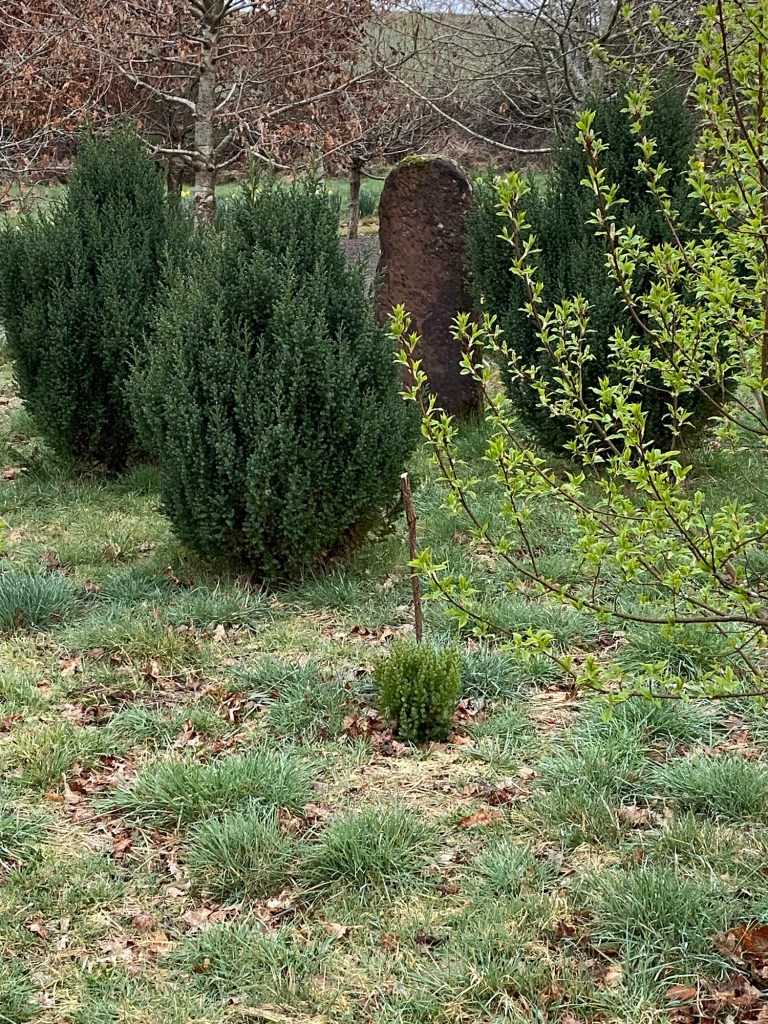
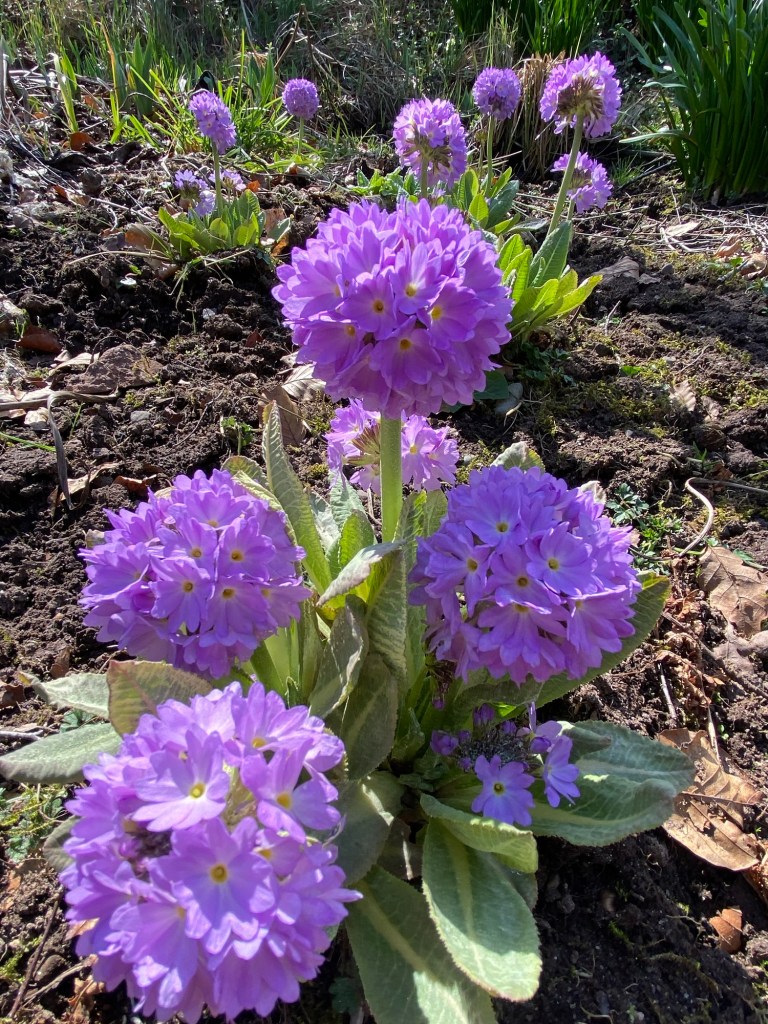
Outside I plant some trees and shrubs. Acers, oak, sorbus, viburnum, and holly. I’m also giving something of a makeover to the west facing border we see from the dining room. I move in some hellebores, a supporting frame for a climbing rose and generally tidy things up. Some tall primulas are starting to come through and I’m pleased to see that a slightly exotic and deep red bergenia has survived the winter and is sprouting new growth.
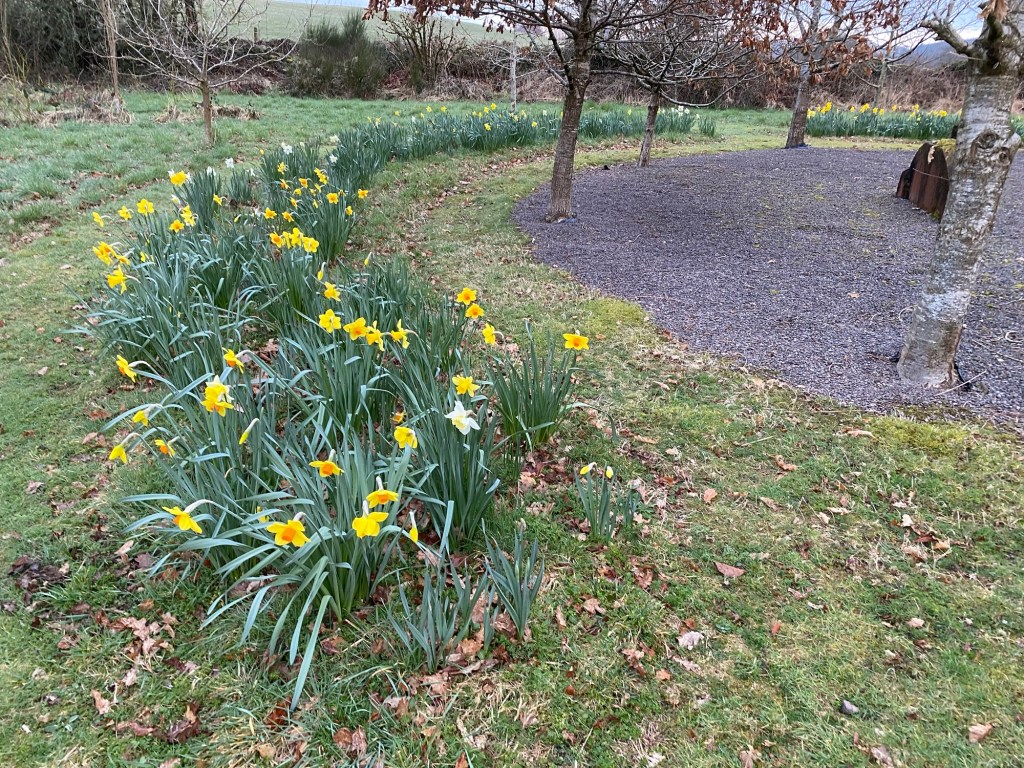
The 14th of March brings the full moon, then a week of frosts, culminating in a very chilly start to the Spring Equinox. The sharp cold has literally flattened the daffodils that have been gradually appearing in hesitant clumps these past weeks. I’m not sure what’s happening, but the stiff, drying wind, the lack of rain and the nightly sub-zero temperatures don’t seem to their liking. Whether cultivated varieties or the wild form that has spread so well in the arboretum these last few years, they are heavy on green stems but light on flowers or even the promise of emerging buds. Last year was not so good either. Perhaps the ones I’ve planted need some kind of a boost. I’m reluctant to try bonemeal, but it’s strongly recommended on Radio 4 Gardeners’ Question Time. Thankfully, the ever reliable dogwoods are having a great peroration before they succumb to the secateurs. Often maligned by plantsmen, the wonderful cornus never fail to please in the Dumfriesshire garden.

By the penultimate weekend of the month, frosts have gone and both day and night time temperatures have risen. The garden feels read to take off. This includes the avian world. Wrens, tits, blackbirds, thrushes, finches, sparrows and dunnocks are much in evidence, and already building nests in some cases. The mallards have set up residence on the pond, where the heron is a daily visitor. The night air shrieks with the sound of tawny owls. Then one early morning on the margins of the arboretum I hear the first song of the chiffchaff from high in the canopy.



***
Spring has arrived, but beyond the domestic sphere there are cold blasts and powerful head winds. A blogger in the North West Pacific writes of her rising anger at the state of things and looks to her garden for solace and reassurance. ‘We must cultivate our own garden’ Voltaire observed in his novel Candide. Is this a protocol for peace and contentment or rather a pathway to pessimism and denial? Voltaire was railing against the 18th century faith in science, rationality and progress. In his novel he describes the worth of a self-contained life that is not preoccupied with the ills or promises of the wider world. His message is to invest in the local, in small projects, and in life-enhancing actions. It’s the same ground in many ways as that which I seek to tread in the writings you’ll find on this site. But of course, the world is much altered since the three days in 1759, when Voltaire wrote his short novel. Likewise, gardens change and evolve, and are to some extent products of their time. Indeed, for some of us, it is the changing garden and the ways in which we tend it that serve as metaphors for our being in the world.
These are just some of the thoughts and experiences that have emerged, in what seems to have been a long month.


* Dave Goulder, The January Man
Picture of Baxter by Hugh Southall
 Quotidian
Beautifully written and thoughtful post. And I’m so sorry to hear about Baxter. The loss of a beloved friend is so hard – our beagle has been gone almost 10 years and I still hear his footsteps behind me sometimes.
And that you for the referral to my blog! I appreciate it.
LikeLiked by 1 person
Thanks so much for your kind thoughts. Gardens, people and dogs: linked across continents.
LikeLiked by 1 person
First of all: Vive Voltaire!
Secondly, my own thoughts on the loss of a beloved dog.
Just a dog
Lies quiet now beneath a low cairn
Half hidden under shading branches
His successor already sleeping in his place
Barking at his postman
Greeting his friends
Dispelling the cares of other worlds
And keeping close
The mystery of his own sadness.
Just a dog.
LikeLike