
At Lammastide 2015, I was lucky enough to secure a modest rent and a long lease on the field adjoining our house in south west Scotland. I set about planting trees, initially in circles and later, linking them together with mown paths.
One circle consisted of fairly closely planted hornbeams. My idea was to create a kind of screen, enclosing the space within. Soon after the trees went in (early 2017, I think it was) I filled up the space with daffodils, planting the bulbs into the meadow grass. The trees were patchy in their growth, and still are to an extent. The daffodils thrived immediately, an early variety that makes a great splash of colour, just when we need it most.
Then in summer 2020, and on a whim, my friend Artur, just before he returned to live in Poland, cut a pattern in the grass within the space. In August of that year, after the terrible fire in Beirut, I planted a small Cedar of Lebanon in the middle, as an homage to those affected.
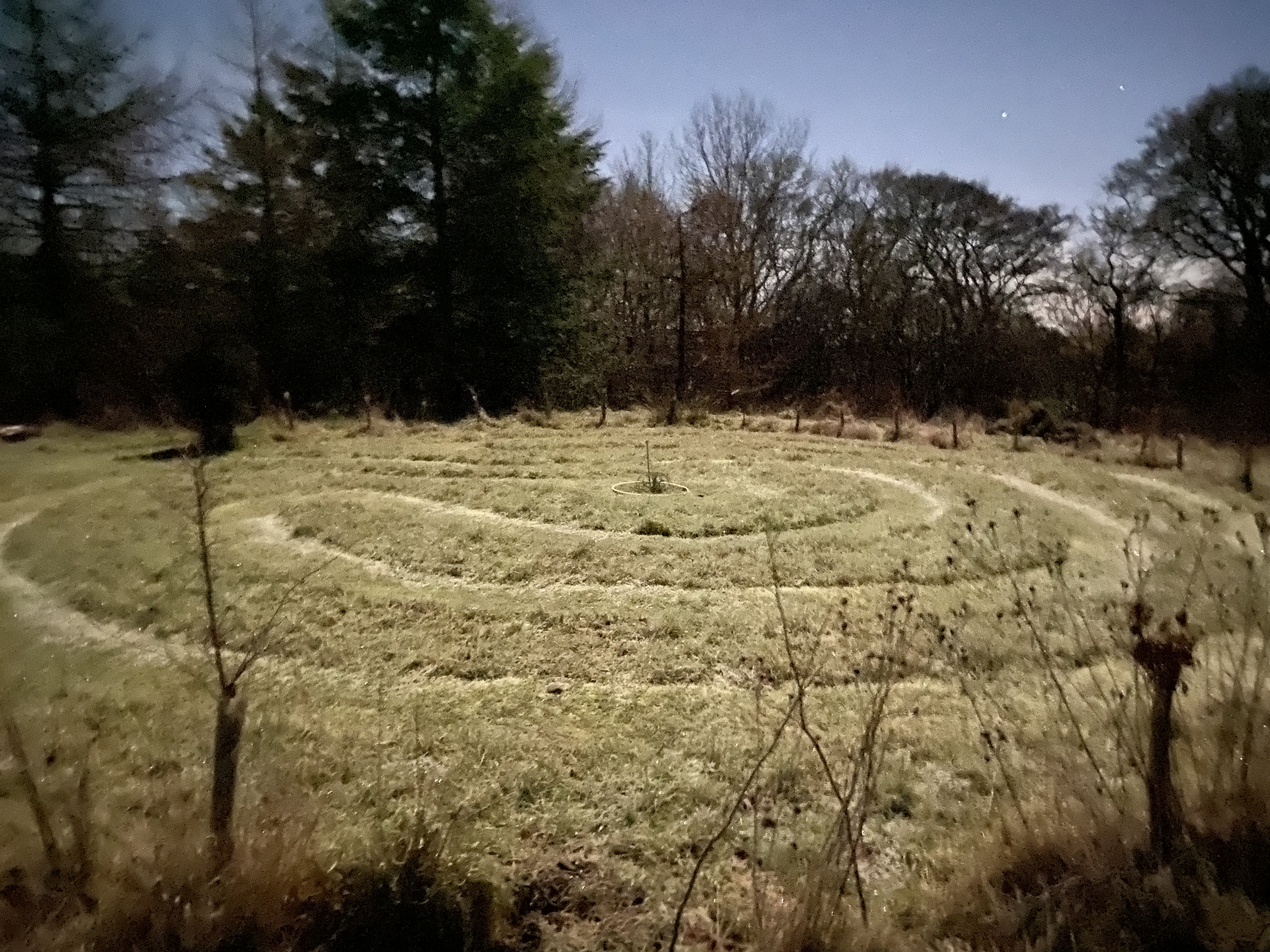
Unschooled in the detail as we were, the creation was neither labyrinth nor maze. One path led to the centre, with concentric circles leading out from it.
Conversations with my brother Peter Clark however, led to further ideas and ambitions. I decided to replace the spontaneously created ‘turf art’, with a recognised pattern.
At the time I took the terms ‘maze’ and ‘labyrinth’ to be interchangeable, but soon discovered they are not. Highly knowledgeable in these matters, Peter explained.
A labyrinth is unicursal. From the Latin cursus, meaning a single enclosed line or path. By contrast a maze is multicursal, following no single course, with enclosed spaces and blocked routes. So, I mused, the labyrinth that contained the Minotaur was really a maze! There are many useful commentaries on all this.
Informed by my brother, I opted for a true unicursal labyrinth and talked it over with Jules, my neighbour and gardener. She was enthusiastic to have a go and immediately strimmed over the whole circle, by way of preparation. The design had to be something our hefty mower could cope with, whilst allowing for the limitations of the space. Labyrinths are better at seven or nine circles, but ours would have to be fewer.
I found a drawing of a simple classical form with just three paths and a central circle. In technical labyrinth discourse, it would probably be classified as a ‘Bobby Basic’. I sent the design to Jules and suggested we try to mark it out on her next visit.
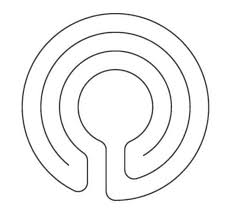
I’m not great at spatial reasoning. Thankfully, Jules proved to be much better. Between us, aided by some rope, a piece of bamboo and some marker spray, we set to work.
At first there was quite a bit of head scratching and a couple of false starts. The main conceptual challenge was turning the line on the diagram into a raised band in the grass (known in the labyrinth world as ‘the wall’), interwoven with a low-cut mown path.
Whilst I was making the coffee, Jules made a start with the mower. On my return she was beaming. Following a eureka moment, it had all fallen into place.
We had our first labyrinth, slightly ragged to be sure, but nothing that future attention couldn’t sharpen up.
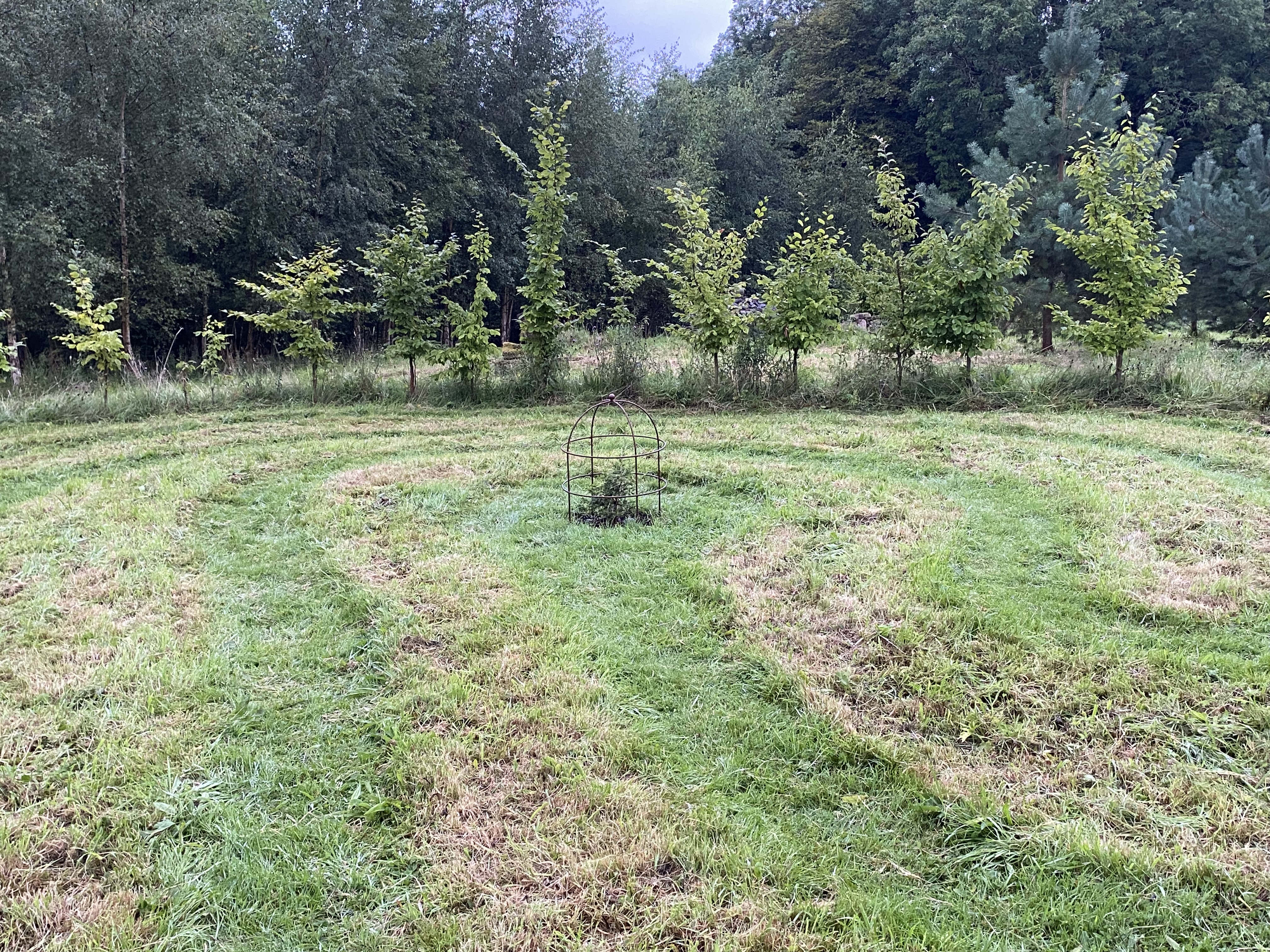
Here’s how it looked after that first cut.
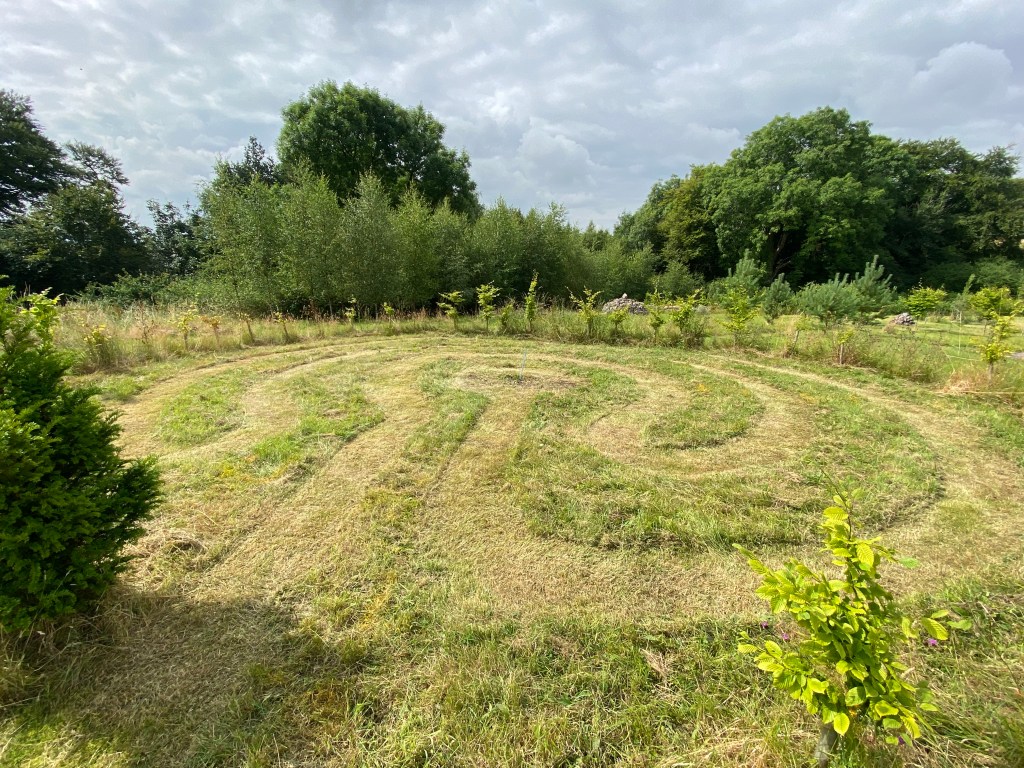
In the weeks, months and years since that August day in 2021, I have ‘walked the labyrinth’ on an almost daily basis. From the inaugural circumnavigation, my sociological scepticism about such encounters fell away.
First, although quite a small area, walking into and then out of the labyrinth does take a few minutes to complete. Precious time to set aside for uncluttering the mind and focussing on the moment. Second, there is something uplifting about unwittingly retracing one’s steps, without making a sharp about turn in order to do so. You simply turn around the Cedar of Lebanon. Walking in and walking out of the labyrinth therefore becomes a single process. Third, I have found that as I concentrate more on my steps and my thoughts, arrival at the exit to the labyrinth brings a surprising sense of release and freedom.
Walking the labyrinth also offers a feeling of intensification. Sometimes, when I have troubles on my mind, I silently repeat a word or phrase to myself as I take the unicursal path. A few months ago when something was bothering me quite a bit, I found this form of silent repetition helped me get through and beyond my concerns.
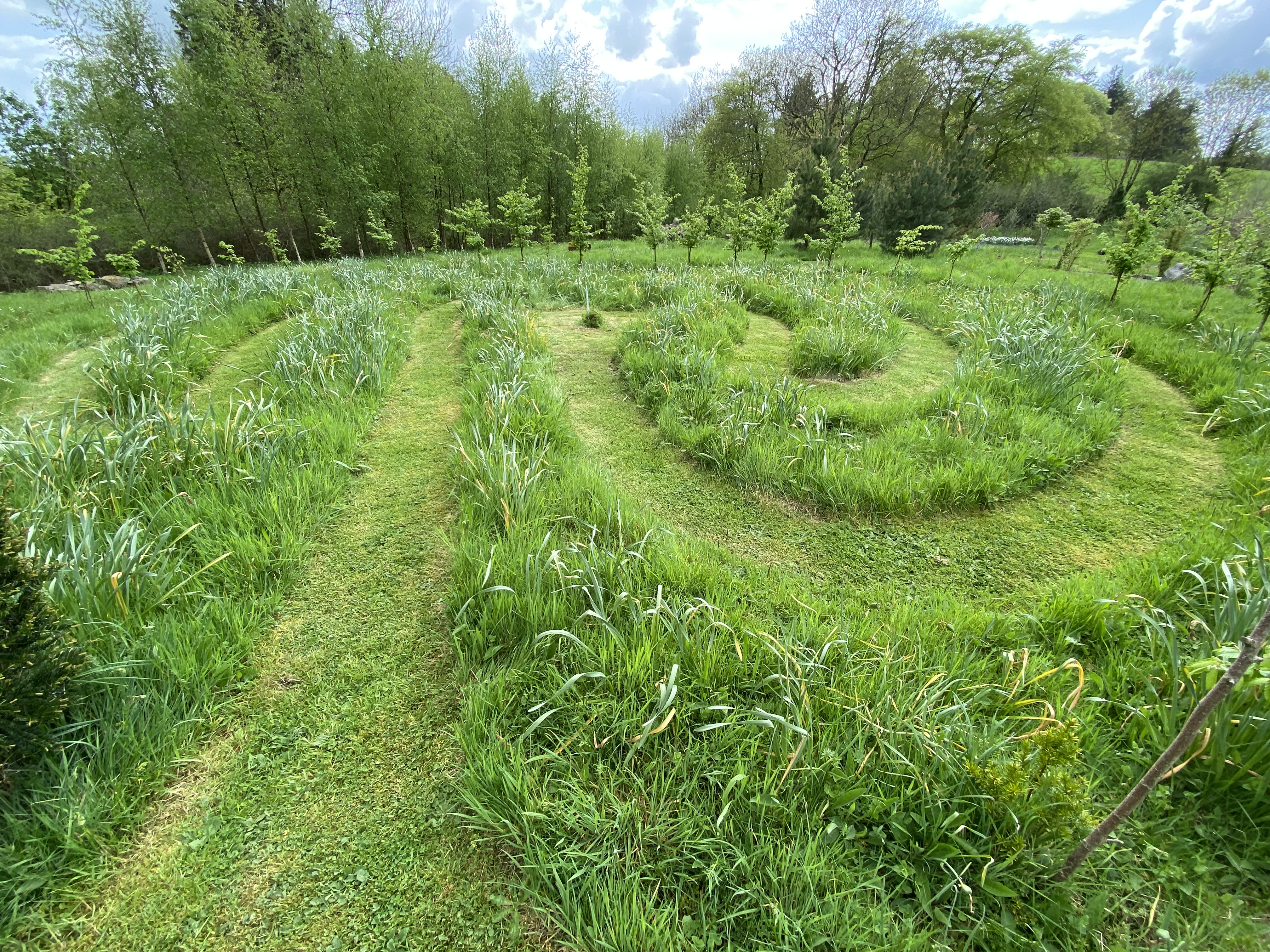
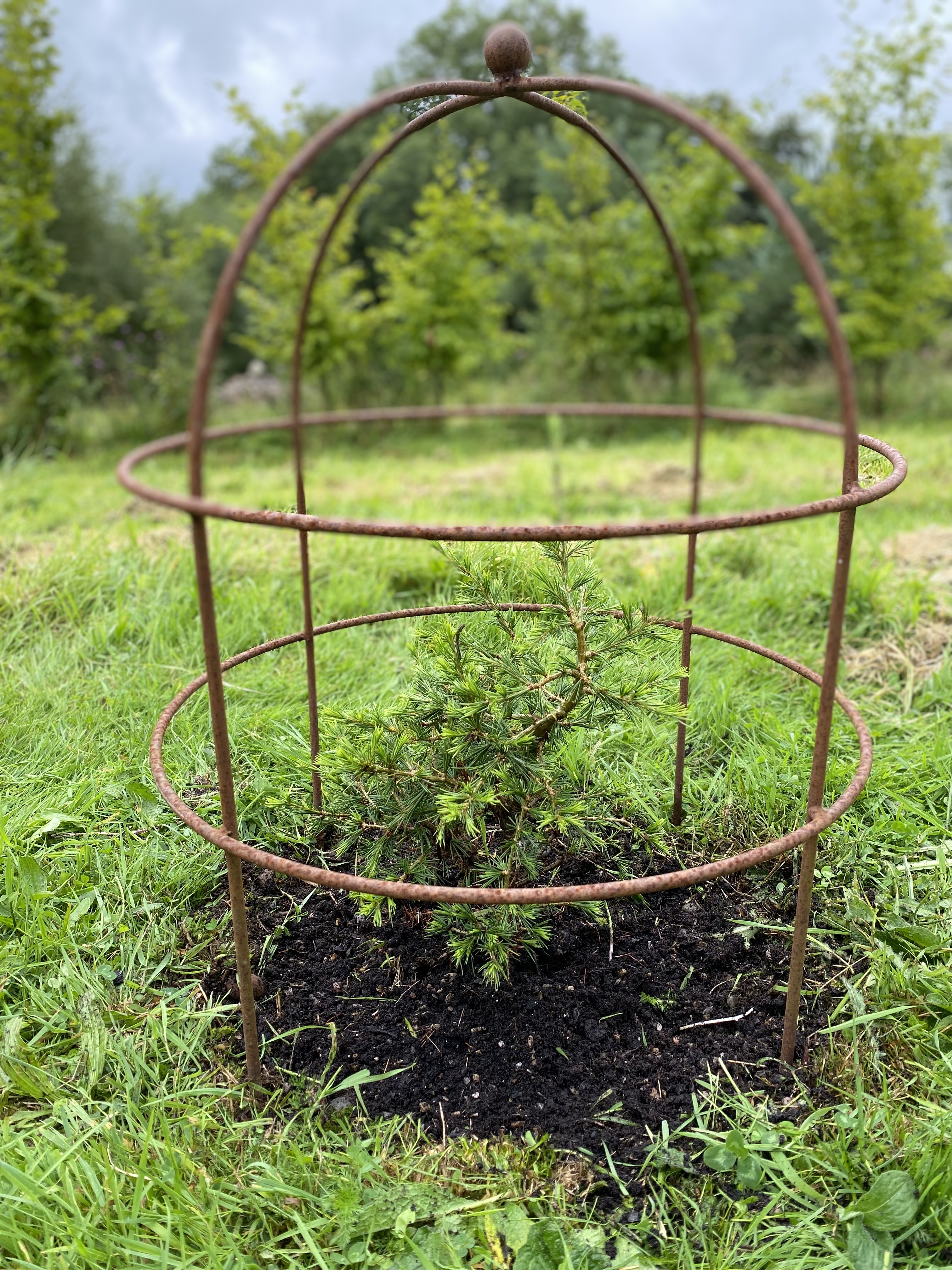
Tending the labyrinth is also rewarding. Jules does the mowing, for which I am grateful. I have gradually dug all the daffodils out of the path and re-planted in the ‘wall’. This year (as can be seen in the photograph below, bottom right) the hornbeams have taken off, and are now benefitting from a little pruning. The Cedar of Lebanon, bought as a tiny specimen, got nibbled by a deer last year but now has a handsome metal protector over it. I try to keep it clear of invasive grass and it too has put on growth this year. More and more I find myself pausing by that small tree, before circling round and beginning my departure from the labyrinth.




Literally and metaphorically, I seem to have been drawn further into the labyrinth experience. Peter has introduced me to an excellent Facebook page of like-minded labyrinth folk. He also connected me with Jim Bailey, a maker of beautifully painted labyrinth spheres, about the size of a tennis ball. I bought one of these as a gift for a partially-sighted friend and was amazed to observe how his index finger instantly sought out and followed the path. This year, as a birthday gift from friends, I received a fridge magnet and a cloth to clean my spectacles – both in the pattern of the ancient and famous cathedral labyrinth in Chartres!
I am fortunate to have my own labyrinth, hidden away on the edge of the Dumfriesshire Garden. My brother, by contrast, creates both temporary and permanent labyrinths in public spaces, making inventive use of recycled and everyday materials. As a prison chaplain he has also made a labyrinth in an exercise yard, as well as finger labyrinths that fit on old CDs. His inventiveness is an inspiration.
Walking a labyrinth has many virtues, but it is not the only way to encounter the labyrinth experience. A labyrinth can be fixed and enduring, mobile or temporary, indoors or outdoors. Whether at your feet or your fingertips it offers a rewarding space for reflection and re-creation. I hope there is one somewhere near you.
Acknowledgements: My thanks go to Artur, Jules, and Peter – for getting me to this point. This piece is partly based on one of my Garden Musings – 8th August 2021.
 Quotidian