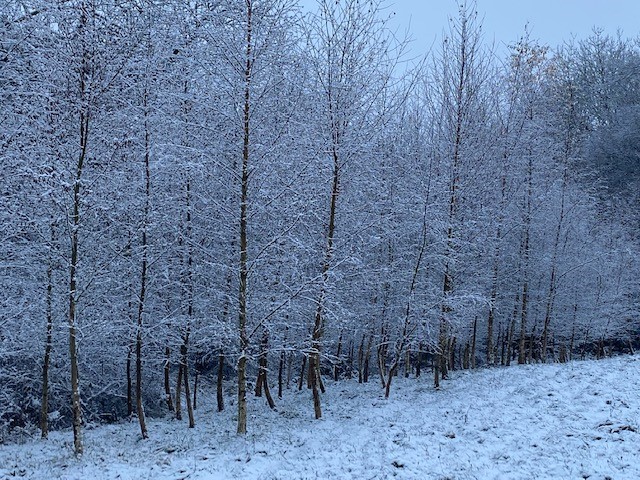
With the Christmas decorations packed away and the New Year holiday behind us, I found myself pondering on those moments in the depths of Winter when the darkness persists and the weather forecast hangs over our plans and commitments. Too early yet to think of Spring, despite the slender daffodils in the shops, but maybe a time to think differently about the affordances of mid-Winter.
Wintering. It’s a word I’d mainly considered in relation to animals and birds. Those that hibernate or migrate. It’s a grammatical curiosity. Winter is a noun (‘in winter’), or tenuously, an adjective (‘a winter soup’) and yes, just possibly a verb (‘they winter here’). But wintering? In fact it’s the present participle of the verb, but now used as an adjective. It seems to be coming more prominent in the lexicon. Not only applied to animals and birds, but more and more to us humans too.
In this sense, wintering seems to take on an active meaning, albeit not in the conventional sense of ‘active’. It’s about slowing down, reflecting more, thinking deeper. It manifests itself in such things as the preparation of certain foods, especially the kind that take a long time to cook on a low heat. It’s associated with reading, with walks, encountering the natural world, or simply doing nothing very much, but in a purposeful way. So having read a little about the practice of wintering, I decided to apply myself to it in the first weeks of 2024. I’ve tried to capture some of the experience here (in the present tense!).
***
The month begins with a flurry of writing. Mainly editing. My first novel, composed in the year past is now complete and I spend some time finessing and fine tuning the manuscript, chapter by chapter. I tend and weed my words, like an assiduous gardener.
Clearing my head after each session, I walk from the house up through the conifer plantation, to the open moor with its wide vistas across the Solway Firth, looking over to the South and to the distant Lakeland fells.
January is a good month for red sunrises around here, and these early-year mornings don’t disappoint. The feathered silhouettes of beech trees stand out against flaming skies, over-seeing my start to the business of the day. Once or twice there is the sketch of a dawn chorus, as optimistic birds encourage us to think towards Spring. Too soon, I murmur to myself, and the birdsong indeed proves short-lived.
In these early, stumbling, days of 2024 the weather alternates from damp and mild to cooler and sunny. It’s pleasant enough but unsettled, perhaps exactly as we feel about our prospects for the new year.
***
By Epiphany, things have changed.
Even in the late afternoon the temperature struggles to get above freezing, only to drop again as the light fades. We move into a settled spell of weather. Flurries of snow accumulate on the frozen ground. Ice patterns itself in swirling arabesques, forming on the greenhouse windows and refusing to budge from dawn to dusk.
As the frost settles in, the clear night sky is charted with constellations. Walking the dog before bedtime, I hear the hoot and screech of tawny owls calling into the Dumfriesshire darkness.
Immersing myself in this extended piece of Winter, I take to lighting the wood burning stove in the pre-dawn, as soon as I get up. I bring in fuel from the cold woodshed at least a day before it will be needed. I chop kindling from logs of sycamore and birch. To these I add thin twigs I collected last Winter from underneath larch trees, each twig bearing a string of tiny cones. The sticks and twigs together make perfect firelighters.
I notice the grey heron has moved from waterside to field. Thick ice on the garden pond has put a pause on food supplies. Now, hunched and out of kilter with itself, the heron stands for long periods in a frost-laced meadow adjacent to the house. Motionless by some frozen molehills and attentive to the slightest movement, it waits for the promise of sustenance.
Outside my kitchen window the most frequent visitors are blackbirds, chaffinches, blue tits, sparrows and robins. I feed them each day and as the cold spell continues they grow in numbers, sometimes pushed out of the way by jackdaws, wood pigeons and a solitary pheasant. The scattered feed is soon eaten up, though the robin is always first and last on the scene and never fails to spot an overlooked morsel, however small.
***
Then, as January commences its second half, the weather shifts. The air is suddenly warmer, and with that, the rain arrives. I have five bare-rooted Scots Pine trees that came in the post just as the frost sank into the soil and had the ground ringing underfoot. But now there’s an opportunity to put them where they belong. It’s wet and windy outside, but a total pleasure to be in the elements and doing one of the most elemental things I can imagine: planting trees.
The five trees are an extension to a clump of six that I first planted a few years ago. In this field, or arboretum, to use its Sunday name, I have planted about 250 trees in the last decade. Down one side are 100 silver birch, now approaching 30 feet in height. Several species are planted in circles: oak, beech, hornbeam, hazel and dogwood. There are a few specimen trees, dotted here and there – redwood, holly oak, and cedar. Mown paths link them together, leaving patches of meadow in between. I’ve added a few cairns and large rocks here and there. Now in mid-Winter, the full structure of the place is on view. When the sun shines the cornus ring with colour: sanguineous, sharp green and purple-black.
The conjunction of Jupiter and the waxing moon seems to be a portent. Soon afterwards, Storm Isha arrives. The hatches are battened down and a restless night ensues, so wild it’s hard to figure from which direction the wind is coming. Next morning comes the cautious inspection. Big branches litter the ground. But no trees are down. A flag has appeared in the hawthorns: a gaudy plastic bag, wrapped round a stem and flapping noisily in the stiff breeze, too high to reach.
More is to come. On the evening before Storm Jocelyn, a remarkable sunset clothes the horizon, its shifting orange light reflecting and shimmering across the flood plains and the ghost lochans (1). But Jocelyn’s aftermath is modest and we wonder if the worst of the winds have now gone by.
***
Meanwhile, safe indoors, other aspects of wintering creep into my routines.
In the kitchen, long a culinary improviser, I now turn my attention to recipes and their diligent application. I slice, chop, sweat and brown. Prepare onions, mushrooms, carrots, leeks and garlic. Become closely acquainted with beans and pulses of all types and colours. The ensuing vegetable soups are conjured up and served for lunch, the cheese sandwich now a distant memory.
Likewise, my daily diary entries, valiantly kept up over the years, now become more reflective. I shift from lists of activities to thoughts about the day, the times, the things that seem to matter most. I take even more pleasure in writing my weekly letters, emails even, to distant friends and relations.
In such wintering times, it’s not surprising that my orientation to reading also shifts somewhat. Normally pushing on with a pile of new books that must be read, I now turn back to the bookshelf and re-read two short volumes by Claire Keegan. A writer of exquisite economy and observer of quotidian detail, she seems to exemplify the best principles of wintering. Measured, restrained, each sentence weighted for its beauty and utility, nothing extraneous, her works delivering even more pleasure and insight when encountered for a second wintering time.
***
In recent years this practice of ‘wintering’ has become the subject of scrutiny, a steadfast activity in its own right. Whole books have been written about it.
Horatio Clare has journalled his struggles with Winter. Seasonal depression, hopelessness, feelings of failure. This type of problem with Winter has clinical dimensions that he seeks to manage by turning outwards, to nature, to weather, to landscape, to finding beauty among bleakness and the absence of colour.
For Katherine May , wintering seems to be more a concept than an activity or period of time, indeed it need not necessarily apply to the cold months of the year at all. In her memoir, she uses the dark months of Winter as a metaphor for making sense of an extended time of challenge and misfortune in her life. Winter is far more than a season of the year, it can also be a fallow period when a person must retreat in search of repair. So wintering is a response to these situations, in Katherine May’s case through a range of activities, rituals and daily practices.
My own ‘wintering through January’ has been thankfully free of these deeper challenges, but the broader idea still holds good. When I started this blog three years ago my purpose was to deepen our encounters with daily practices and actions. ‘Wintering’ has added a new dimension to this in the dark and stormy early weeks of 2024.
Indeed, I’m already looking with new perspective to what February may bring.
(1) I have borrowed the term ‘ghost lochan’ from Dr David Borthwick, in appreciation.
 Quotidian