
I think I first spoke to Denise Zygadlo at a death cafe. An occasion where strangers meet together over coffee and cake, to talk about mortality in all its aspects. I was impressed by her clarity of thought and speech and her open-ness about her encounters with dying and death in her family.
I already knew something about her work as an artist. I also observed over time how she would be present at the opening of exhibitions, at film screenings and talks: just some of the many places where creative people gather together to celebrate, to look, listen, and to share ideas.
I confess to being slightly puzzled by her work. Simply put, it isn’t easy to pigeon hole. It draws on many materials, on human bodies, on physical movement, fabrics and photocopies, print and pencil. Created in a Nithsdale glen, it seems to be anything but pastoral. It provokes, up-skittles and questions. Taken as a whole it’s a vast bricolage of inspiration, made and remade, and literally re-fashioned over time. Assiduously and with discipline.
So it was terrific for me to get such a positive response from Denise when I invited her to take part in my series of interviews with people who do interesting things as they live and work in Dumfries and Galloway. One who self confessedly likes structure and focus, she completed the email interview process far quicker than anyone else has done so far.
From her answers to my questions I learned so much about her practice, which has been developing, shifting and changing over more than five decades. I hope you’ll enjoy reading her story and taking advantage of the links which lead to various aspects of her art over time. My thanks go to Denise for sharing all this – and for creating a remarkable body of work, which just seems to keep on giving.
Can you tell me where you were born and something about your early life, education, and influences?
I was born in Chatham, Kent and brought up in Strood on the other side of the River Medway. An only child, I was surrounded by family. We lived next door to two of my mother’s siblings and their kids, so I had four cousins close at hand. Our parents built three identical bungalows in a row after the war. It was all hands on deck for two years. We moved in when I was three months old and my gran moved into the middle bungalow with my uncle’s family. She later moved in with us for the last 19 years of her life, so I benefited from her sewing skills, especially learning how to embroider and use a sewing machine.
I went to the same school that my mother attended for one year, until the new Catholic school building was completed. School was a very happy time and where I made a life-long friend. We were inseparable and both went on to the Girls Grammar School in Rochester. I was never very academic, but always did well in art. I didn’t study History of Art, so was pretty ignorant, but we had a very enthusiastic art teacher who introduced me to various artists and took us to exhibitions in London.
I always loved drawing, from the moment I could hold a pencil. Being shy growing up, I spent many hours drawing at home, before finding the confidence to socialise. We were close friends with our family doctor and his family of six. I spent a lot of time in their house and was in awe of the fashion drawings the eldest daughter showed me. I remember clearly a drawing of an elegant figure in an evening gown she gave me to paint. I was enamoured with the Pre-Raphaelites later on and had posters in my bedroom.
So you did encounter the arts in your early life?
In my early life I was always drawing, painting and making. My dad was very gifted, despite having no formal education, and could turn his hand to anything. Post-war parents were very resourceful and creative and this rubbed off on me. My paternal grandmother had been a milliner. My parents took me to my first art exhibition around the age of 15 – it was a Rembrandt show. I was very impressed and still have the postcards. In fact I have a vast collection of art postcards, that I’ve kept from all the exhibitions I’ve seen since.
I remember putting an illustration on my bedroom wall from a copy of the Women’s Weekly. By coincidence we were visiting friends in Birchington and my dad went to meet their neighbour, an illustrator, only to see the original painting on his wall – he was pretty chuffed when my dad told him. This made the whole art thing more real to me. I think being an only child gave me the opportunity to focus on drawing without distraction and having an enthusiastic audience without any competition.
Can you remember the first time a piece of art had an impact on you?
Gosh that is so long ago – I guess it was the Rembrandt. Also, I was always interested in fashion and would model aprons in the kitchen at the age of four and my dressing up box was used most days. Kitchen performance was a regular activity – I was a keen dancer and went to ballet and have tried various types of dancing ever since.
What happened after you left school?
I went to Canterbury Art School for a foundation course. That’s where I was introduced to the work of Egon Shiele, an Austrian artist whose innovative, continuous line drawings are raw and sensitive. He is still a favourite. I enjoyed every aspect of the course but found it difficult to specialise, so I was encouraged to follow the path of textile design. Then I went to Winchester to study a degree course in textiles, and specialised in print. I never enjoyed the tricky process of silk screen printing, but had a wonderful time there. Then I took a post with Courtaulds in Manchester after my degree show. The job moved to London and I worked in three different design studios after I left Courtaulds, before moving north in 1980.
That was quite a long time ago. What led you to Dumfries and Galloway and can you sketch out the range of work you have done over those years? Does it fall into particular phases or preoccupations?
We followed some college pals to Dumfries and Galloway.
My husband Mark wanted to start making Windsor chairs (he had studied painting at Winchester, where we met, but I don’t remember where this chair idea came from). Finding workshop space in London was financially out of the question, but our friends had moved to Bentpath, near Langholm as there were so many empty schools, churches and cottages available at tiny rents. Mark was keen to have a look.
Being four months pregnant and an only child, I was somewhat resistant to move so far from my family with their first-to-be grandchild. But we found a lodge house near an old school and took the plunge. This was on the road between Dumfries and Moffat and we lived there for three years, fairly self sufficiently with not one, but two children, 25 months between them. Mark gradually built up a business and joined a wood turning friend Andy Kirby to become Kirby Zygadlo, and we moved in with these partners in Penpont, where Andy already had a mill building as a workshop.
I tried to keep up my artwork, but there was no way I could continue textile designing out there in the sticks – we didn’t even have a telephone. Two more children came along and I was pretty busy bringing them up, while Mark and Andy’s business grew and grew, employing up to 16 lads and moving to a bigger mill at Cample.
Then I ran an exercise class which was really popular, as there was nothing else available at the time. My first class attracted 50 people! It ran for five years. Later on I taught for years at a Friday art class in Thornhill. I also began community arts projects, – Steps and Stitches – with a dancer, Vida Hedley. This was commissioned by the Dumfries and Galloway Arts Association, which is no longer with us. From this experience, I made a Community Quilt with Thornhill folk, which you may have seen in Thomas Tosh sometime.
Once I had studio space in the steading where we live now (this is our 31st year in Auldgirth) I began designing furnishing prints and worked with an agency in Manchester. But it wasn’t financially viable (I was never a natural textile designer) so I then worked for Help the Aged, fundraising with schools for two years.
It was after this that I began focussing on my own artwork and had my first exhibition at Designs in Castle Douglas in 1999, with Judith Goldsworthy. But our eldest child was about to go to university, more funds were needed, so I then joined the NHS psychology department in Dumfries part-time, as a Self Help Guide. This was a pilot project, I was the first S.H. guide, using Cognitive Behaviour Therapy principles. It was so successful that it became permanent and became a team of ten, giving access to Self Help to every general practice in the region. The post grew to four days a week and I was no longer an artist working part-time with the department, but a Self-Help Guide that worked part-time in a studio!!
During these years I joined the Society of Scottish Artists and exhibited work most years in their Annual show at the RSA. I have also taken part in about 11 of Dumfries and Galloway’s Spring Fling Open Studio weekends since they started in 2003.
So now to the work itself. I have always drawn, as I mentioned before, and I was keen to get back into drawing around 2009. I began a series that would become 13 drawings of a dancer – Tara – using photographs that I took myself. I wanted to draw unusual poses, using a lace top to describe the body beneath and leaving hands and body areas in outline only, but drawing the hair and lace in great detail. These upper body works were almost life-size and later included her legs. I exhibited several pieces from this series in Spring Fling, Scottish Society of Arts, VAS and the Society of Women Artists in The Mall, London. [You can find a list of Denise’s shows and activities from 2011 here].
I love the quality of a photocopied image and made a lot of work using my own body and cloth to transfer onto silk and canvas. I made collages of the body, photocopied a piece at a time, and printed them onto lengths of silk using a Dylon product initially. It took forever but the result was slightly stiff and un-washable, so eventually I used the Centre for Advanced Textiles in Glasgow to digitally print the images from photos. The result was beautifully soft and floaty and can be washed! Some images of details of cloth and body I made on canvas. I am interested in the relationship we have with cloth as a second skin.
In 2012 I had a solo show at The Mill on the Fleet, Involutus Memet, with the silk hangings and wall pieces, and collaborated on a performance with Florencia Garcia Chafuen for the opening. In 2014 I expanded on this show and created Wrap, a solo show at the Gracefield Arts Centre in Dumfries, with hangings, canvas works and video projections. It opened with a performance created by myself and two dancers accompanied by a live string quartet playing a classical piece composed especially for the performance by my son Rudi.
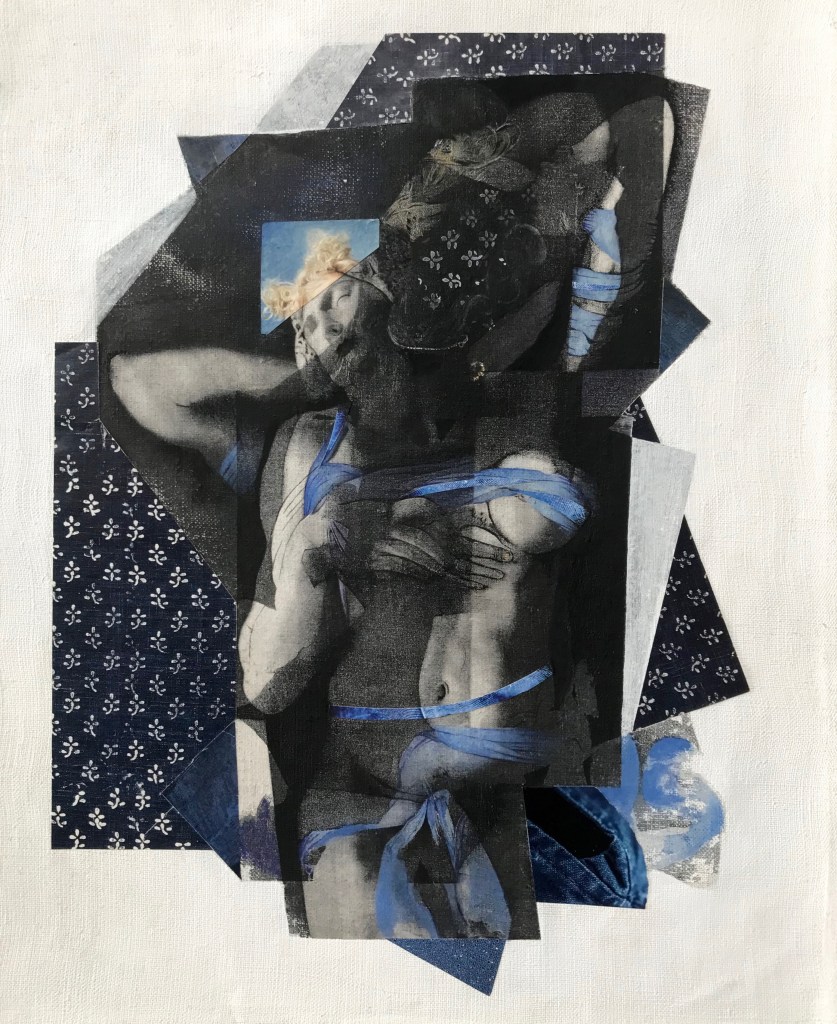
I joined the Arusha Gallery, Edinburgh in 2016 and have shown work with them in their gallery and online. In 2018 I had a small solo show there with large works on canvas, using transfer printed collages of my body mixed with classical sculpture.
In 2020 I had an online exhibition with Arusha exploring treasured garments that I have kept; looking at ways to express my connection with them. I used painting, drawing, printing and collage in that exhibition. Collage runs through most of my work.
Another strand is performance. I have been involved in performances with the group Oceanallover and a group that my husband Mark created – The Secret Ministry, and a few solo works.


It’s a remarkable personal and artistic journey that you describe. Can you say some more about the underlying themes of your work? For example, you mention the relationships between skin and cloth, and seem to have an enduring interest in embodiment, as well as clothing and sustainable fashion …?
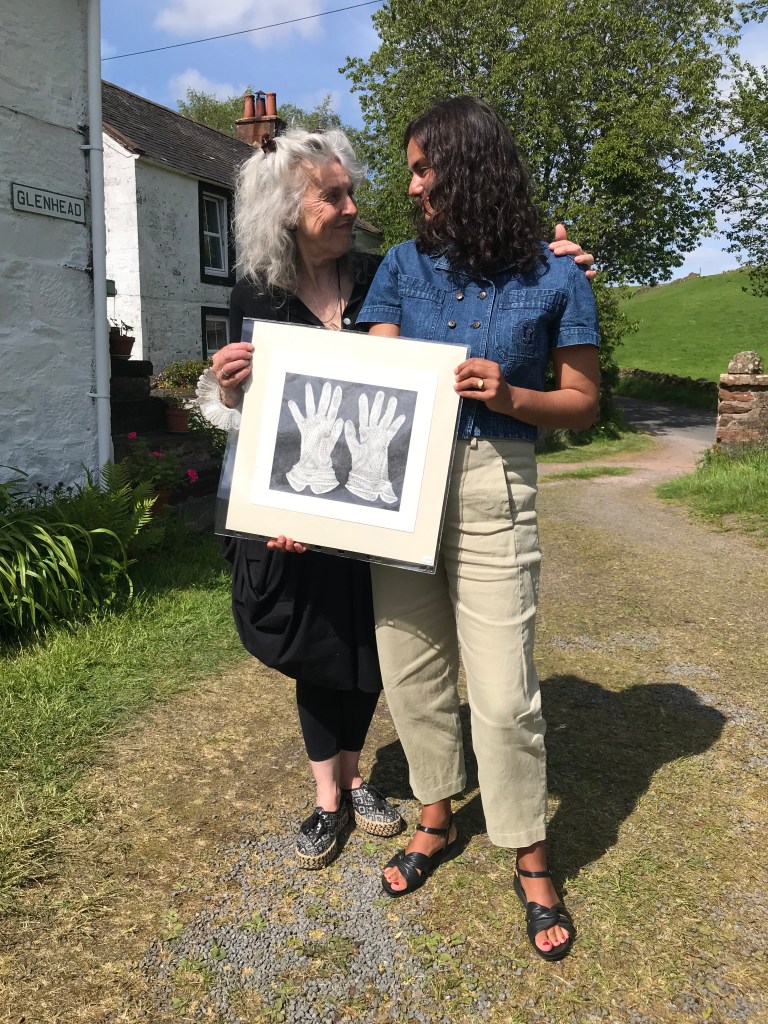
My series of Tara drawings focus on lace, in detail. I never show the face of the wearer and like to find an unusual pose or angle that may take a while to identify. This draws in the viewer and gives them ownership of what they discover. The use of a dark, black pencil 6B-8B gives a depth and solidity to the work.
I am interested in the relationship we have with cloth. I have always loved dressing up, since I was tiny, and had a dressing-up box, overflowing, in the cupboard that led to the attic. I delved into it most days and took on different characters. I am fascinated by fabric and will always want to feel its textures. Looking back at my first picture books in my fifties, I remembered the smooth feeling of Old King Cole’s hose and the soft puffiness of the kitten’s silky quilt.
Cloth surrounds us from the moment we are wrapped as a new-born, to our final windings. Clothing, furnishings, bedding, towels, face-cloths. Cloth holds memories and significant moments that evoke previous times in our lives. Our choice of clothing gives us an identity, our second skin.
I use collage, in some form, in most things. The photocopied image has a special quality with a heightened contrast, again the deep blackness, that I like to use. For my classical sculpture series, I enlarged photos and combined them with photocopied images of my own body parts and cloth. They have a surreal feel to them and include objects that relate to the subject. The texture of the canvas sometimes comes through the image, making it part of the surface.
Can you say something about how these works are shaped and influenced by underlying beliefs, values, questions? For example, is Catholicism an enduring influence?
My most recent works are concerned with treasured clothing. Cloth and clothing, textures and collage, memories and connections. I am also a keen ‘make-do-and-mend’ advocate.
I mend everything – our socks are more darning than original sock. When I decide I will no longer need or wear a particular garment, I think of someone who might like or suit it and pack it up in an appropriate wrapping and send it or leave it as a surprise at their door. This is my Pass-It-On project. I gave up buying new clothes several years ago and only buy if absolutely necessary and then only from Charity/Second-hand shops. The damage the fashion industry creates is horrifying and it is so important for us all to support sustainable fashion.
Once a Catholic … I haven’t practiced for 50 years, but it’s definitely in the blood and I have replaced it with other rules for myself: diet and exercise rituals to name but two. If it comes out in my work, it is not intentional.
And what about a sense of place. Am I right in thinking that the rural setting of Dumfries and Galloway seems in some ways to be at odds with the provocations in your work? Or are you inspired by the idea of making such arresting art in what some might consider a counter-intuitive context, which you have called here, ‘the sticks’?
My work comes to me organically, triggered by images that occur to me or just what crops up. I don’t research for my work. I tend to work towards a goal, an exhibition for example. At the moment I am making a daily collage as part of Februllage organised by the Edinburgh Collage Collective, who give out a one word prompt each day through the month of February. [NB – some stunning images here, check them out on Denise’s Facebook page]. I thrive on structure, another influence from Catholicism.
I’m not a landscape person, but I do love living in it and experiencing all aspects of nature. During COVID my youngest son Rudi and I had a daily art swap to keep us motivated. His way of looking at the world made me see things anew. His way of looking at the world made me see things anew. His creativity is a constant source of inspiration to me. It was exciting to try different things and I spent time in the woods and fields in an attempt to interact. I found a large antler-like branch and made a short video with it on my head. My grandson also got into the spirit of this and spent an afternoon helping me, taking a series of ‘antler-moment’ photographs, from which I made four drawings – The Wild Woman series.
Your work seems to evolve without dramatically obvious changes of direction or approach, the ideas and methods looping in and out and back, without visible ‘breaks’ or ‘shifts’. Is it possible to speculate on where it will go next?
Thank you for noticing this. My works does jump about, but the underlying themes weave in and out consistently.
I am interested in all aspects of art and like to have a go at most things if there is not much process involved – I’m very much a ‘hands on’ artist and jump from one material to the next, often coming back to a project months or years later to pick it up again.
I am currently making daily collages for Februllage, it gives me structure during this dreary uninspiring month, and I thrive on structure. I have stretched some paper ready for my next drawing, although I’m not sure what the subject will be yet and I have made a list of relevant points, from previous work, to follow up on – there are a lot. This is an attempt to find a way back into work, having been very unwell after my last Spring Fling exhibition. I am taking stock and reviewing my life as a whole, it has been an enlightening experience. I’ve realised how much I rush and I now make time to try to be more mindful and appreciate each moment. It has a calming effect, increases awareness and productivity.
While we are still able, my husband and I intend to stay living in the countryside, with our spacious studio/workshops, so I would like to make full use of such a luxury. I have a beautiful etching press which I hope to continue exploring and would like to experience more collaborative projects. Recently I have been involved with Re:Dress Scotland and their slow fashion projects. This has been the best fun and fulfils my desire to dress up and fool about with extremely big hair! All for a good and important cause, I hope to do more.
And finally, as my energy returns, I look forward to discovering new and exciting ways to develop my own work, perhaps combining drawing with large-scale collage and bringing in video and writing with a dash of performance.
I wrote some haiku-type poems for Involutus Memet, to accompany the exhibition. This one might help trigger my next work and send me off in a new direction. The first line is based on a dream I had.
find the fire in your belly
dip the cloth in tallow
and run the torch
****************************************************************
Featured image: Victoria Murray
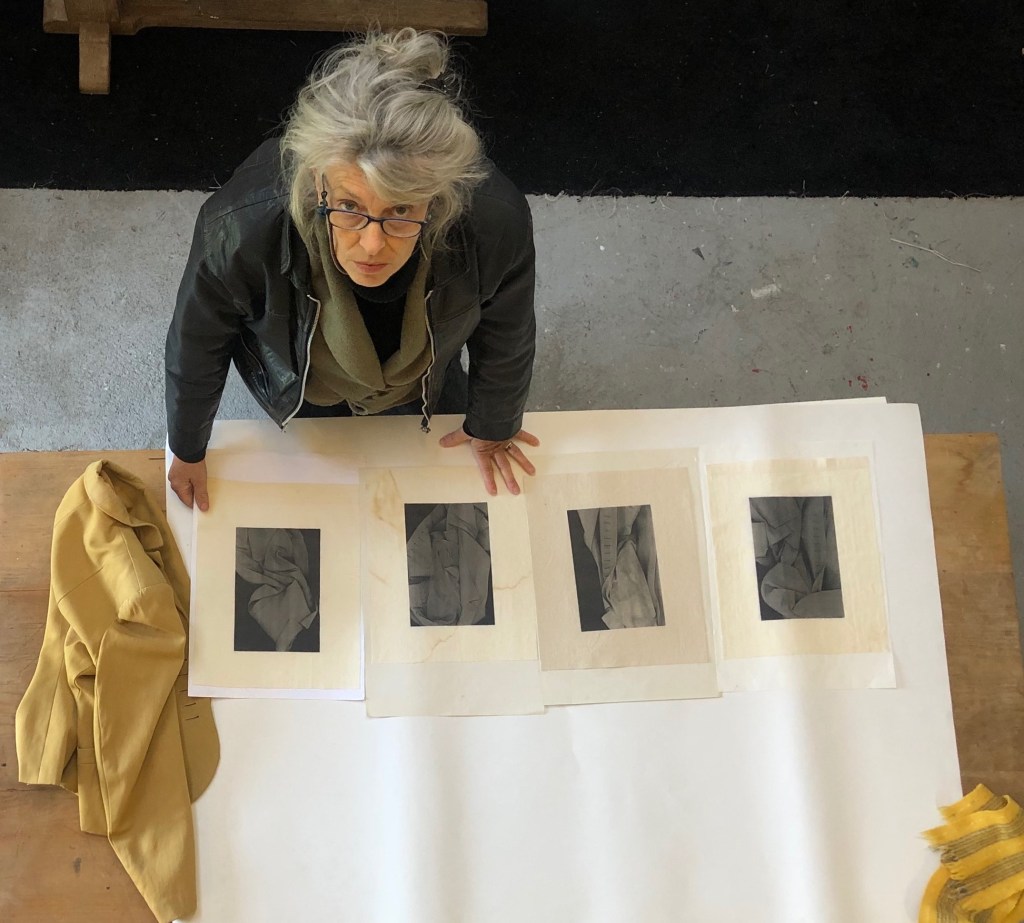
Overhead image: Rudi Zygadlo (Rudi is a composer, musician, performer, artist and writer. He is the sound designer for the Guardian daily podcast and has had three written features with them and one for the Observer. He also makes very funny videos for You Tube).
You can learn more about Denise’s work at: http://www.denisezygadlo.co.uk/ and https://www.facebook.com/denise.zygadlo and you can make contact with her at: denisezygadlo@btinternet.com
For more interviews of this type, see: https://davidgrahamclark.net/interviews/
 Quotidian