
The February man still shakes the snow
From off his hair and blows his hands (1)
For the Romans it was a month of purification. British weather lore declares it brings rain or snow, or both. The Venerable Bede called it the month of cakes. From Brigid to Valentine, many saints are associated with it. The shortest month of the year seems packed with connections and affordances, inspiration even. But there’s also a devious side to February, it can flatter to deceive, offer up false promises, and unsettle us with its fickleness.
This February has been particularly turbulent. Like so many others, I am reading the daily newsfeeds with increasing concern, whilst at the same time trying to hold onto the simple assurances of daily life. How do we reconcile these conflicting tendencies? In uncertain times, there is some merit and a degree of comfort in keeping a focus on the quotidian world. But not at the expense of realism and an effort to understand what is happening to the wider world. These twin poles have been much to the fore in February 2025.
***
The month begins with mild, damp weather. I take a look at the seven day forecast and decide to take the plunge. I have three bare rooted Korean pines, newly arrived from the grower, with stations prepared. Two go into the arboretum, one into the main garden. They are no more than 6 inches high. Their roots three times that. I mark them with straight rods of hazel and wonder whether to give them some protection. In the days following I pause and admire these little trees, already telling myself they seem to have grown a little.
A morning of heavy, soft rain is followed by an early afternoon of sunshine and blue skies. I rush out after lunch, resolved to complete some turf cutting in preparation for a new border in the garden. It is to be devoted to topiary. With a sharp new stainless steel spade, given to me as a Christmas gift, I cut lines across and down through the marked area. From a previous day, about one third of the patch is already done, but this time I resolve to finish the job.
My turf stack builds up and I press on. Just as the sky darkens and the rain starts to lash down, the last square of turf is removed. I dash into the house for a cup of tea, quietly pleased to have finished the first stage of the task. Over the next few days I begin to dig out the planting stations, seven in all. It’s slow work. There is good, rich soil there, but its laced through with post/glacial tilth and stones. The bigger items require a crowbar for their removal. The biggest stones turn out to be bedrock.
Though I can’t position them as precisely as planned, I take some care with the planting holes. The Buxus that are to be moved here have done well in rich soil with plenty of mulch. I want to keep them richly fed. A couple of miles from where I live, a small-holder has bagged up a quantity of well rotted horse manure, and placed it at a gate by the road: free to good homes. I get a few bags and dig it into and around the stations. The transplanting now has to wait until a few nights of frost are passed. I don’t want to risk a sudden chill to newly relocated shrubs. When the forecast is for mild, wet weather for a week or more, I get going in earnest.
Seven good sized box bushes must now be taken out of the biggest border in the garden. Originally placed there to give winter interest in a bed of roses, they have rather quickly grown too large, hampering the adjacent plants in the process. One by one I lift and move them. It’s hard work and I break a much valued fork in the process, its ash handle snapping in half under the strain. The seven plants are gradually moved one barrowload at a time, and their roots carefully checked. There is bindweed in the rose patch and I don’t want to spread it elsewhere.
But when the work is done, the end result is pleasing indeed. Once settled and smartened up, these new transplants will enhance the adjacent clipped holly, yew and box and give a huge amount of structural interest, especially in the winter months.
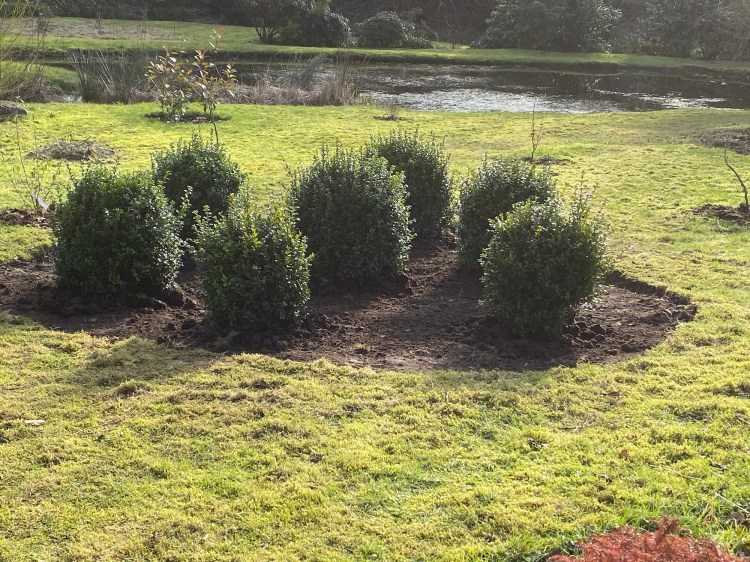
I’m ready then to turn my attention to some other smaller gardening tasks, but just as I do, the snow blows through, albeit not for long. For now, I’m content to have finished my new border, and what must be the gardening highlight of the month.
***
The first Sunday of February brings Candlemas, a festival with multiple origins and associations, that I have written about elsewhere. On the radio there is some exquisite choral music from the Metropolitan Cathedral in Liverpool. I particularly enjoy the Sanctus and Angus Dei from the Missa Brevis by Haydn. I belong to no faith and describe myself as an atheist, but such atmospheric singing and organ accompaniment lift my heart – as I stand ironing my daughter’s school shirts for the week ahead.
Among other indoor tasks, I have two pieces of writing on the go at the moment. One a short story set in a university. The other a miscellany of essay-like reflections on novels set in and around bookshops. Both have been in my head for a few months, as partial notes and experimental openings. But now they are getting into gear, pulling together their own logics and gaining momentum. That’s always an exciting stage in the writing process.
The short story is most advanced and over a weekend, I keep returning to it. Drawn back to the text to adjust and tweak. It’s reaching the level of development when it’s good to question the structure, the progression, and of particular importance, the final paragraph. A few days later, there’s a full draft. It’s a satire based around the serious problems British universities are facing. I send it to an academic friend who has worked at high levels in the university world. She finds it ‘horribly accurate and plausible’. Thus encouraged, I resolve to let it sit for a day or two and then post it here.
A couple of frost-glittered mornings burst into blue sky days of bright sunshine, the temperature almost reaching double figures. The mallards are back on the pond. The blackbird is on the gable. The robin by the gardener’s spade. Bullfinches feed on the blackthorn. The heron crouches pondside. The snowdrops are finally fattening up and looking good in sunshine or rain.
Away from the natural world, I need time to get ready for a lengthy podcast focussed on the life and work of Cicely Saunders. By way of preparation I find myself reading the early chapters of her biography, which I wrote some 10 years ago. I’d forgotten some of the detail covered there. I ponder on how we can approach the works of a person, in whatever field, without a deeply contextualised understanding of their life-world at the time those works were set in train. Treating a text without its context or attention to the social practices which generated it, seems to be too partial and lacking in conviction. But there is a lot of it about.
Not so in the commentaries on Wordsworth’s Prelude, that wonderful decades-in-the-making and posthumously-published 700 lines of iambic pentameter that is his poetic autobiography. This is a work that has fired my imagination since visiting Dove cottage, his home in Grasmere, last November, and then again this month. I have now purchased a copy of the Prelude and am slowly working through it. Poetry as memoir is an appealing idea and by the end of the month, I have apologetically sketched a few ideas of my own – in free verse. I send one piece to my brother Peter and gratifyingly, he replies in kind.
The month comes to a squally ending of gusty rain and mild conditions, then a sudden frost. As the weather quietens it begins to feel a little like Spring. The daffodils show their faces, green buds swell on shrubs, and each day there is some new and welcome appearance, poking through: early primula, monk’s hood, flowers of dead nettle, allium ursinum.
***
But beyond these simple pleasures, the month of February 2025 has much to trouble us. The news brings growing dismay and alarm. Our settled views on how the world order operates are scattered to the winds. Wars are to be ended by ‘deals’ of various kinds or with card game analogies. Long established principles of integrity are shattered by fiat. International structures of compassion and solidarity are vitiated by national interest. This is a February that won’t be forgotten in a long while and may prove deeply consequential far into the future.
On the penultimate night of the month, I walk my ageing dog and stand, marvelling at the clear sky, the planets arrayed in majestic alignment. I can see five of them quite clearly with the naked eye: Mercury, Mars, Venus, Jupiter, and Saturn. The brightest of them all is Venus, with its associations of love, beauty and harmony. As I gaze upwards in the still night air, I reflect on how those virtues are so much needed here on planet Earth, right now.
Postscript
And the next and final day of February 2025, this happened:
https://www.bbc.co.uk/news/videos/cdel2npwe50o
(1) The January Man by David Goulder
 Quotidian
Well done for viewing the five planets. I didn’t make the effort, having been disappointed by cloud cover on so many previous occasions of astronomical interest. Also well done for having marked the outrageous and shocking endpoint of February 2025.
LikeLiked by 1 person
You might be interested in the opening paragraph of this Bog Myrtle and Peat post, if you haven’t already seen it. https://gallowayfarm.blog/2025/03/03/curlews-on-passage/
LikeLike
Thanks Stephen. This is an interesting short post altogether. I read his book with great interest a few years back. I think I’ll sign up for alerts on his blog.
LikeLiked by 1 person
Beautifully written. February is, indeed, a month of cakes and deceptive weather. But it is a beautiful month in all its varied ways and days. Lovely post.
LikeLike
Many thanks for your kind comments. Unfortunately, this February had a very terrible ending – in the Oval Office. I am behind on your posts and look forward to catching up soon!
LikeLiked by 1 person
What he is doing to our country is tragic, immoral, and genuinely evil. His actions are hurting not just us, but the entire planet. If that isn’t a definition of evil, nothing is.
LikeLike