
My debut novel Epiphanies and Robberies came out this summer. It tells the story of three people who find new friendships and ways of looking at things, as they simultaneously get drawn into sleuthing a series of art thefts that breaks out across their home region in south west Scotland. I have tried to write a story that is uplifting, funny at times, but which also explores some of the serious and enduring issues of the modern world: like climate change, community resilience, changing patterns of personal and family relationships, and the opportunities and challenges of working life. I’ve put my heart and soul into writing it and am watching with interest as it journeys out into the world. It’s a good moment therefore to reflect on what I have learned in the process.
At the top of the list is the value of sticking with something you believe to be worthwhile. From the beginning of the project, I decided to set my novel in Dumfries and Galloway, where I live, and to place it in the calendar year 2023, with 12 chapters, one for each month. I then took the decision to write the book in ‘real time’ and to serialise it on this blog in 12 instalments, from January to December 2023. Looking back, I had set myself a significant challenge, but the commitment to writing and posting each month undoubtedly gave me a motivational structure which kept me going. Another way of looking at this, to mix metaphors, was that I got caught in a biblio-lobster pot, with no room for writer’s block. Anyway, it worked for me.
Resilience was a requirement not only for the year of intense writing however. The next 12 months were indeed more challenging. They began with checking and polishing the manuscript, and trying to improve it as much as I could. They also involved gathering information on publishers and agents and beginning systematically to make approaches to both. The process was fraught with disappointment. I found that the agents and publishers I contacted rarely sought any kind of dialogue. Most didn’t reply, or if they did, simply sent a formulaic rejection, caveated with the observation that evaluating a book proposal and its author are matters of individual taste and judgement and that rejection should not be taken as a definitive judgement on the work or the writer.
Another early realisation was that very few publishers will accept direct submissions from authors. Yet trying to secure an agent as your representative is also deeply challenging. Many agents are not taking on new clients, or have highly specific criteria for doing so. Despite the gushy prose of their websites, many also come across as aloof, unapproachable, and rather full of themselves. Making submissions to agents and publishers is also time-consuming. For each application one wants to come across as sincere and focussed on the recipient. Generic and standardised covering letters are out (though there is plenty of generic and standardised advice available on how to write them). Likewise, within a range of elements, each publisher or agent wants to know very specific things in order to judge your submission. Approaching them in this context was a discouraging experience.
Fortunately, there was one glorious exception to this. At the 2024 Boswell Book Festival I attended an interesting and entertaining session in which a literary agent and a publisher spent an hour ‘in conversation’. In the Q&A that followed, I described the process I was following and the challenges I’d met. The publisher, onstage, asked me to send him my manuscript. ‘He won’t get back to you’ said an embittered sounding fellow author as we left the room. His prediction proved false. Within a week, the publisher, himself the editor of several literary giants, emailed me back. He’d read a ‘chunk’ of my book and gave some specific and highly encouraging feedback: on my approach, about my overall style, the believable characters, and the sense of place in my writing. Sadly, he couldn’t make the book work for his long established imprint. But the support he gave through his comments was more than enough.
I therefore redoubled my efforts, and now started looking at Indie publishers rather than subsidiaries of the ‘the big five’. This took me to publishers with less concern about marketability and profit, and more emphasis on getting good writing out for people to read. The breakthrough came when I found Beaten Track and its remarkable founder Debbie McGowan. The welcome was warm and positive, the process simple and skilfully deployed, the values of the publisher, admirable. Beyond that I found a community of Beaten Track authors, inspired by Debbie, where people help each other with proof reading, tips and hints, social media shout-outs, and shared experience. It’s a good place to be, and I thank them all.
This takes me on to the wider value of a support network. Writing is stereotypically a solitary business. Having folks around you to keep up your motivation is very important – though it pays not to over-share your literary contortions with family and close friends! Author fatigue can apply to your interlocutors as well as yourself.
As I wrote the first draft of Epiphanies and Robberies in 2023, I was lucky to have four friends who read each chapter before it was posted on my blog. They kept me motivated, queried elements in the plot, suggested alternatives and picked up my typos. It was invaluable and much appreciated. Likewise, over time, the serialisation created its own community of interest. Readers entered into the spirit, emailing and posting comments, stopping me in the street and wondering where the story was going to take them. This is gold dust to a novice fiction writer and a great boost to confidence.
In addition to these forms of support, I was blessed with some less common examples. One friend compiled a playlist of all the musical items in the script. Three others composed and recorded some original music, aiming to capture the spirit of the novel. Another distilled the scope of the book into a single haiku. You can find all of these here.
I’ve never been drawn to writing courses, tutorials and ‘how to’ sources of help, though it may be that others find these very supportive and useful. An unexpected aspect of the process I am describing was therefore my decision last year to reach out to others in my local community and form a writing group . We now meet monthly and our gatherings are invariably a source of new information, feedback on work in progress, tips and advice. There is no doubt they add to my writing habitus and have quickly become a fixture in the writing month.
Underlying much of this, I have begun to realise, is the question of ‘where creativity comes from?’ As an academic I have been used to writing in ways that rely on evidence from primary or secondary sources. Careful analysis of the data is a cornerstone of academic rigour, leading one hopes, to reliable conclusions. Fiction writing may require some elements of research – relating to setting or character formation, for example. But for most of the time the writer is alone with a blank screen or page that they must fill by drawing on the imagination. This can be daunting, but also exhilarating.
I found as the writing of my novel progressed that there were moments when I was grabbing my notebook and scribbling ideas before they were lost to memory, or desperate to get to my laptop to produce a first draft of some imagined scene or plot twist. Where such urges and the ideas that drive them come from, is hard to say. Reading widely oneself is certainly an important source, though many will say they can’t read the work of others when they are engaged in a period of intense writing.
In terms of organisation, I don’t subscribe to the view that I must write a given quota of words each day, as a discipline. Yes, for the first draft I had the monthly deadline to attend to, but for the most part I wrote as the inspiration took me, or indeed where I could fit in the time in relation to other commitments and constraints. For the most part I was ‘writing in place’, at home in the region where the book is set. There was one exception to this. On holiday in France during summer 2023, I did enjoy the pleasure of an hour or so each morning, as others gathered round the pool, when I found a quiet spot indoors with a small table where I could go into my own ‘writer’s retreat’. There are no doubt many ways to approach the challenge of creating a book length work of fiction and it is always interesting talking to others about what fires their writing practices.
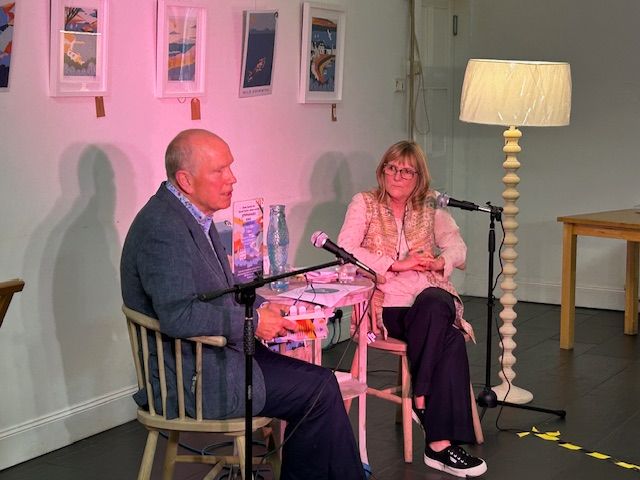
When the time came to celebrate the publication of my novel, three events were held in my local area. In Thomas Tosh, a well known cafe, book shop and much more, it was a privilege to be in conversation in front of some 70 people, with Clara Weatherall, as she probed me on many aspects of the book, its plot lines and themes. In Waterstones, Dumfries, comments and questions flowed from the audience, which included several fellow-writers and enthusiasts. In my village florist and cafe, Blumen, we organised a pop up event across a whole morning, in which with a friend, I read several extracts from the book and we chatted back and forth with people over coffee and – such a lovely surprise – a splendid cake, iced with the image of the book cover. I am truly grateful to my hosts at these events for their help and consideration, and to all the people who attended them.
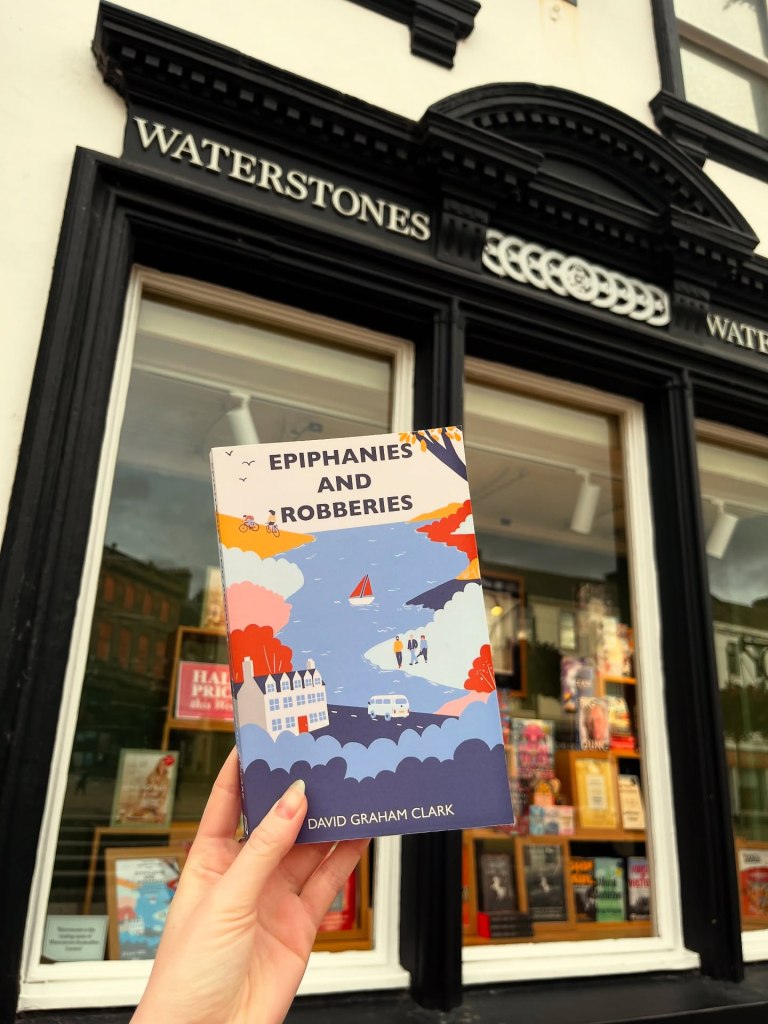
It’s often said that a book should not be judged by its cover but the design for Epiphanies and Robberies seems to be universally admired. Created by Louisa Birdsall, it captures exactly as I hoped, the feel of my story line, characters and setting. Once again, I found someone to work with who read the manuscript and responded supportively and creatively, to enhance the whole look and feel of the book. An A4 poster of the cover now hangs on my study wall and looks really splendid.



So where next? It’s a question I was asked at all the launch events. Two ideas are oscillating in my notebook. The first has already been requested by some readers: to write a sequel. Readers and author alike seem to have been drawn into the lives of my main characters and the places they inhabit. I therefore have two strong elements of a novel to work with. Currently however I am unclear about the plotlines. By contrast, I have some more fully developed ideas for a prequel. I’d like to develop further the back stories of some of my characters, to again set the work in a specific year, but on this occasion some decades ago. Perhaps crucially, I also have quite a detailed plot in mind and have already begun some ‘historical’ research to strengthen my approach.
So in the aftermath of publication, there is much to occupy my thoughts. I’m also keeping a weather eye out for reviews, enjoying enthusiastic emails from satisfied readers, and yes – seeing some modestly good sales as well. I’m also looking forward to 1st October, when I shall be appearing at the Wigtown Book Festival and talking again about the whole exhilarating process of writing my first novel. Perhaps I’ll see you there?
Photographs by Paul O’Keefe, Louisa Birdsall and David Clark
Epiphanies and Robberies by David Graham Clark was published 17 June 2025 by Beaten Track and is available in bookshops and online
 Quotidian
Congratulations on getting published! That’s a tough thing to accomplish, but you succeeded. If it becomes available here in the States, I’ll definitely read it. If not, I’ll pick up a copy when we return to the UK next year.
LikeLike
Thanks for this! It’s so pleasant to see folks responding to the book as it goes on its journey. I think you should be able to buy the book online in the US. If you don’t object to Amazon, it’s available there in print form and on Kindle. Exciting that you are coming across here next year!
LikeLike