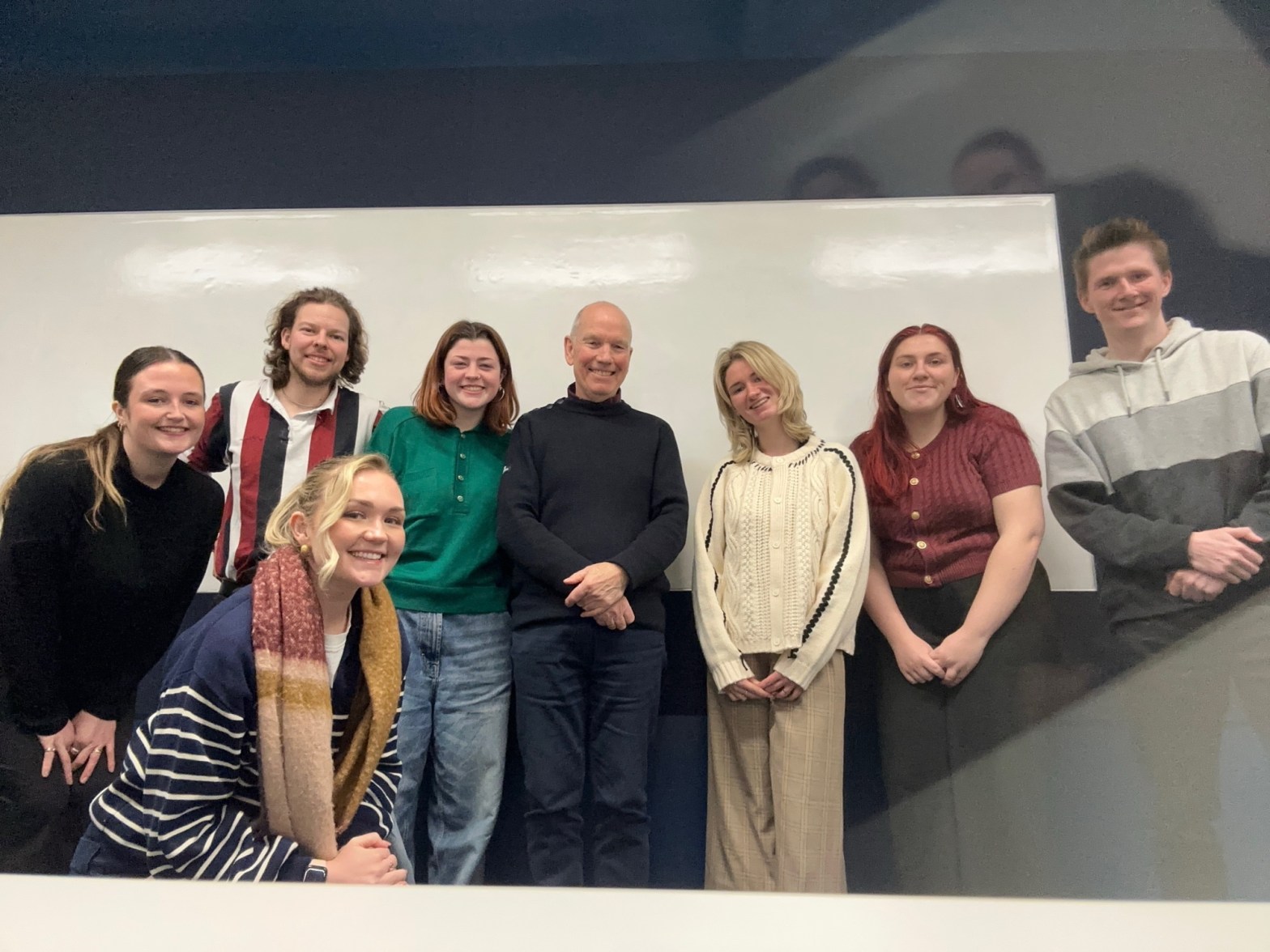
In the last few years, I’ve learned that playwriting is most productive when others join you in the process. On those occasions, huge benefits can result. New voices and perspectives come into effect. Cherished approaches get subtly challenged. Potential lines of new development come into view. Alternative perspectives surface. Perhaps most of all, there is the sense of community that arises when people with shared enthusiasms join together in a diligent and respectful way to take a playscript to a new level. It can be a pivotal moment.
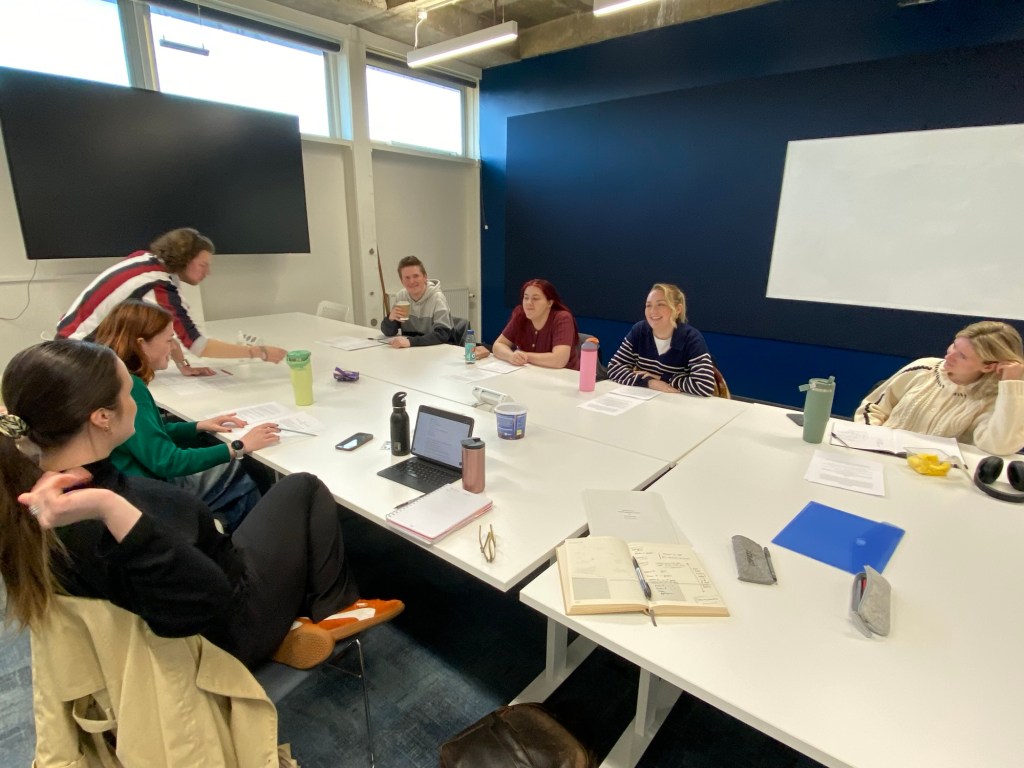
That’s what happened to me on 19th January this year in Edinburgh, in a room at Napier University. There I was in the company of seven young graduates, each seeking to make their way in various aspects of theatre-making: in acting, directing, producing, writing, stage management, sound and lighting, dramaturgy, even policy creation. Most of them doing more than one of these, along with various forms of part-time employment. Now here they were on a chilly winter afternoon, giving up their time for a Table Reading of my new play, Being Cicely, and bringing a lot of expertise into the room.
The entire process was brilliantly orchestrated by Meghan Wallace, who worked as a co-director on my first play, Cicely and David, performed at the Edinburgh Fringe in 2022. Meghan has now agreed to direct the new play, which we hope to take to the Fringe in 2027. Using her vast range of contacts, she was able to engage six friends and co-workers for the Table Reading. I knew of course, that this would involve rather little preparation for the participants, but I hadn’t realised until the day in question that none of them would even have seen the script before arriving at the session. It was going to be an interesting ride.
Once fully assembled, there were brief introductions all round and I was asked to give some context, concerning my academic work relating to Cicely Saunders and how the first play had arisen from that. I explained that the new play is its sequel, beginning in the early 1960s and covering the entire remaining period of Cicely’s life, right up to her death, in 2005.
With that, Meghan distributed copies of the script and allocated the participants to one or more roles in the cast. She noted how much of the dialogue is likely to be in ‘Received Pronunciation’ and offered the opportunity for that in the reading. She also indicated she would read out the stage directions for each of the scenes as we went along, as a guide to the readers.
Then we were off.
***
My first reaction was astonishment at how each person dived in and immediately read the script with accuracy and insight, often in ‘RP’. Words on a page, never before seen by the readers, were coming to life in their voices, in a way that astonished me. I quickly shifted from following the script myself, to watching the readers as they spoke, and then to closing my eyes and listening intently.
The reading proceeded at pace, but never seemed rushed. At times I felt a frisson of emotion at some favourite sequence I particularly like. Was I alone in experiencing that? I don’t think so. Also gratifying was when people reacted favourably to light-hearted moments, and touches of humour or irony.
In one scene where Cicely and her friend Woozle are writing to each other, I saw how when the letters were short, then the interaction was heightened, but in other parts long passages came over as didactic exposition, without a sense of dialogue. It was a useful confirmation of a doubt I already had in mind. Around the mid-point, I began to wonder whether the story was unfolding in a credible way or whether there was a risk of the scenes becoming semi-independent vignettes, with too much being asked of the audience to join up the dots between them. The script is designed to be performed at the Fringe in one act, taking about one hour. Was it moving too quickly across too long a time period?
In the event the brisk reading came in at a duration of 46 minutes. As it concluded I felt empty of oxygen, drained indeed, yet simultaneously full of admiration for the participants and relieved that, subject to revisions, this might just be a play that could be taken to the stage. A short refreshment break ensued, then it was time for the feedback.
I had not previously heard of Liz Lerman’s Critical Response Process® It is a method for giving and receiving feedback on creative work-in-progress, and is designed to leave the maker eager and motivated to get back to work. It seems ideally suited to something like the Table Reading of a play. The writer presents a work in development, in this case to the readers. A facilitator, in this case Meghan, then takes the group through four key levels of discussion: 1) statements of meaning about what has just been experienced 2) questions from the writer to the group 3) neutral questions from the participants to the writer 4) ‘permissioned opinions’ expressed by group members about the work (and where the creator can decide if they wish to hear them or not).
***
Here’s a summary of the main themes that emerged in the Table Reading of Being Cicely, under the four categories.
What had been particularly evocative or meaningful to the readers?
Much of the story involves religious faith, but not in such a way that becomes unrelatable to anyone who does not believe; the quotations from scripture made an impact. The ‘forensic level’ of detail in the script was admired. The strong depiction of female friendship struck a chord. The ordering of scenes worked well and especially where they traced Cicely’s developing relationship and eventual marriage to the artist Marian Bohusz-Szyszko. The ‘heavy topic’ of end of life care had moments of lightness. The depiction of Cicely working clinically with one patient, had a positive impact.
My questions to the readers
It was helpful to be reassured about the sequencing of scenes and the ability to follow the story over its long time period. It was suggested though that the script might contain more attention to the obstacles Cicely faced in developing her work. Each reader seemed able to pick out a favourite character, without Cicely herself dominating. But could the other characters be brought to the same level of depth? Marian’s backstory creates a helpful sense of mystery around him, without requiring more detail. I asked if the treatment of assisted dying and euthanasia in the script needed more attention. There were quite a few ideas, from developing this more in the production rather than necessarily in the script, to bringing in more of a conversation around these issues, in which the audience might feel involved.
Neutral questions to me
Could there be more attention to Cicely and Marian, together? Should there be less of the men in the conversations between the women? Why did one character appear so late in the play?
Opinions
There was widespread endorsement for the view that ‘scene 4’ should really be ‘Scene 1’ – surprising the audience with its setting, and very quickly getting to the heart of Cicely’s ‘project’. Aware of the current parliamentary debates on assisted dying, could the issue be given more prominence in the storyline, perhaps emphasising aspects of agency and autonomy, rather than a ‘last resort’ when access to palliative care is unavailable?
***
We had worked for three hours. Still reeling from the experience, I expressed my heartfelt thanks to everyone for their contributions. As we broke up to leave, the participants were still talking about theatre matters: arranging to meet up again, sharing news about current and future projects, and exuding a palpable sense of mutual support. Optimistic people with a calling to the theatre and a will to succeed. For me, their enthusiasms and insights had more than fulfilled the goal of the Critical Response Process. I left the building with a sheaf of useful notes, a headful of ideas, and in deep gratitude for the support I’d been given. Just as Liz Lerman’s process intends, I couldn’t wait to get back to my script and fire up some new possibilities, building on the strengths of playwriting as a shared endeavour.
Acknowledgements My huge thanks and appreciation go to Meghan Wallace, who facilitated the Table Reading with such skill and sensitivity, and to each one of the insightful and inspiring readers: Maria Woodside, Jack Elvey, Ben Ramsay, Betsy King, Rachael Moyle and Arlene McKay. I wish them all well in their theatre-making.
Here’s a current summary of the what Being Cicely is about
It’s the 1960s and Cicely Saunders is on a personal mission: to improve the care of dying people. She has been a nurse, a social worker, and is now qualified in medicine. Her ambition is to build on the older traditions of hospice care and develop something new: a modern approach that can revolutionise pain relief and foster dignity in the face of death. But as she sets out these plans, her own life experiences complicate the path of ‘the woman who changed the face of dying’. Being Cicely is set over six decades and takes us on a complex journey of successes, dilemmas, faith, friendship, loss, and ultimately, love.
Read more here about my first play, Cicely and David
 Quotidian
What a great collaboration.
LikeLiked by 1 person
Thanks Denise. Yes and time to refine the script this year before auditioning and going into production in Spring 2027. Will we see you at the Fringe again?
LikeLike
It makes sense that writing a play is a cooperative, collaborative process. Many voices/ideas/insights reflect the connections with/to each other that we feel.
LikeLiked by 1 person
That captures it exactly, many thanks!
LikeLike