The January man he goes around in woollen coat and boots of leather (1)
The year begins with weather warnings. Frost settles into the garden ground and doesn’t move. Motivation is low. Piles of hazel thinnings lay unsorted or trimmed. Tall herbaceous plants, long past the ‘interesting in winter’ stage need cutting back. Leaves are still to be raked up. But by the first weekend of the year, such tasks go unheeded. Piles of books and winter fires seem more inviting.
The morning and evening dog walks continue however. A steady routine that keeps me in close touch with the garden and arboretum, no matter what the season. On the sixth of January – the night of Epiphany – an unusual experience awaits.
With my teenage daughter, on the second day of January 2025.
We arrive at Southerness lighthouse, on the Solway shore.
The tide is just on the ebb. To our right we can paddle through lapping waters and reach the track beyond. Here we pass huge boulders of white granite, barricaded to protect the properties above. Cockle shells crack and crunch under our feet. Another walker comes towards us, carrying a plastic haul of netting, bottles and single-use detritus.
Wading birds – knot and dunlin – collect on the littoral. We watch them lift in small groups. Then comes a long column in an extended fly past. Difficult to capture on a smart phone. ‘Stay in the moment’ my daughter says, as the squadron passes to our left and lands in the bay beyond.
We come across an archipelago of pools on the salt marsh. Around them, wind bent grasses swirl and sworl. In each pool the brackish water is plated with ice and frosted on the margins. Behind us, tall reeds sway in the light breeze, washed out and drying against the China blue sky.
Here is a single black trainer. We smile, thinking of a friend who takes pictures of such objets perdus. I recall a Scandi-noir novel, where one such trainer also contained a foot.
We stop to examine an improvised lobster pot, fashioned from a plastic fuel can. Lengths of rope lie half buried in the hard sand. On the top of a dune to our right, golfers come into view, preparing to tee off, and bantering in the sharpness of the day. A driftwood branch, like a long lizard, surveys the scene.
Now the sun is dipping lower over the retreating Solway tide, losing its warmth. We stand and look across to the Lakeland fells. The chill is settling in. At the water’s edge we spot a thick tide mark of ice crystals.
Walking on, our steps find an arbitrary turning point, and we decide to head back the way we came. Reaching the Southerness lighthouse, where the walk began, we make New Year resolutions: to do this more often.
On a spring break this year at a well known family resort, I noticed that adjacent to the ‘spa’ and overlooked from the heated recliners was something called a ‘Zen garden’. I have to say I was quite taken by it and for some months pondered how something similar might be created in Dumfriesshire. Yes, it did look a bit kitschy, perhaps over-populated with items, but there was something attractive about the concept and how it faded into the surrounding woodland.
Dry or Zen gardens of course have a distinguished place in Japanese culture and are taken very seriously. Often located near temples and shrines they symbolise elements like mystery, simplicity and assymetry. Mainly comprising rocks, moss, gravel and sand, they are intended to be looked at in a meditative way from a single viewpoint. In Japan they have evolved over centuries and taken on many aspects, thereby stimulating numerous interpretations. More recently they have found multiple expressions in the west.
Since that spring encounter at the resort, I’ve pondered on a Zen garden project at home. There is a terrace where the planked decking is coming to the end of its life and could be replaced with something quite different. I even made a rough sketch of a ‘Zen garden’ that might be made there. But gradually my enthusiasm for the project has faded. Partly on practical grounds – would it work and how would it be maintained? Increasingly on aesthetic grounds – would it just look like some ill-conceived confection, born of syncretistic whimsy? I’ve slowly dropped the idea.
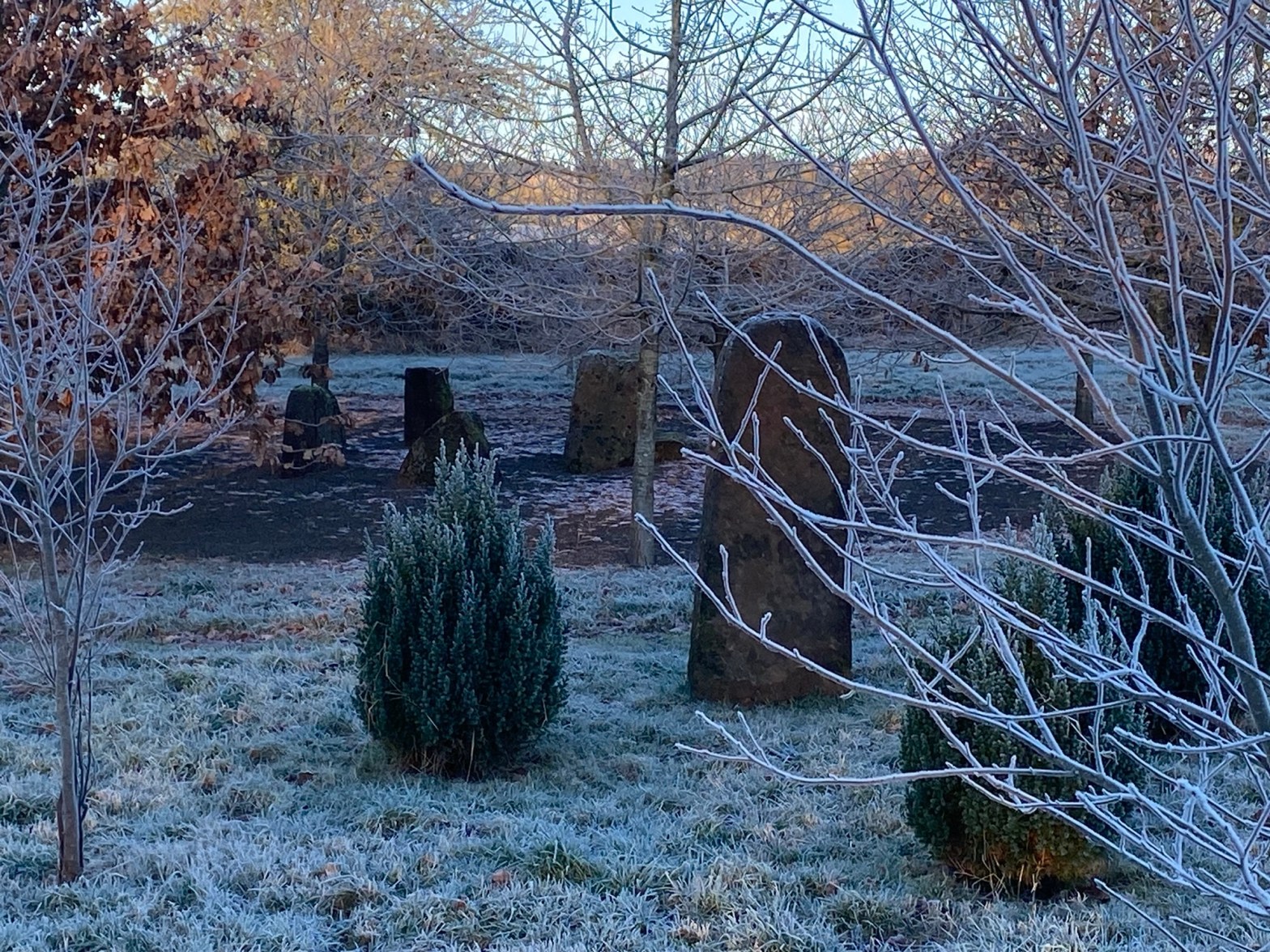
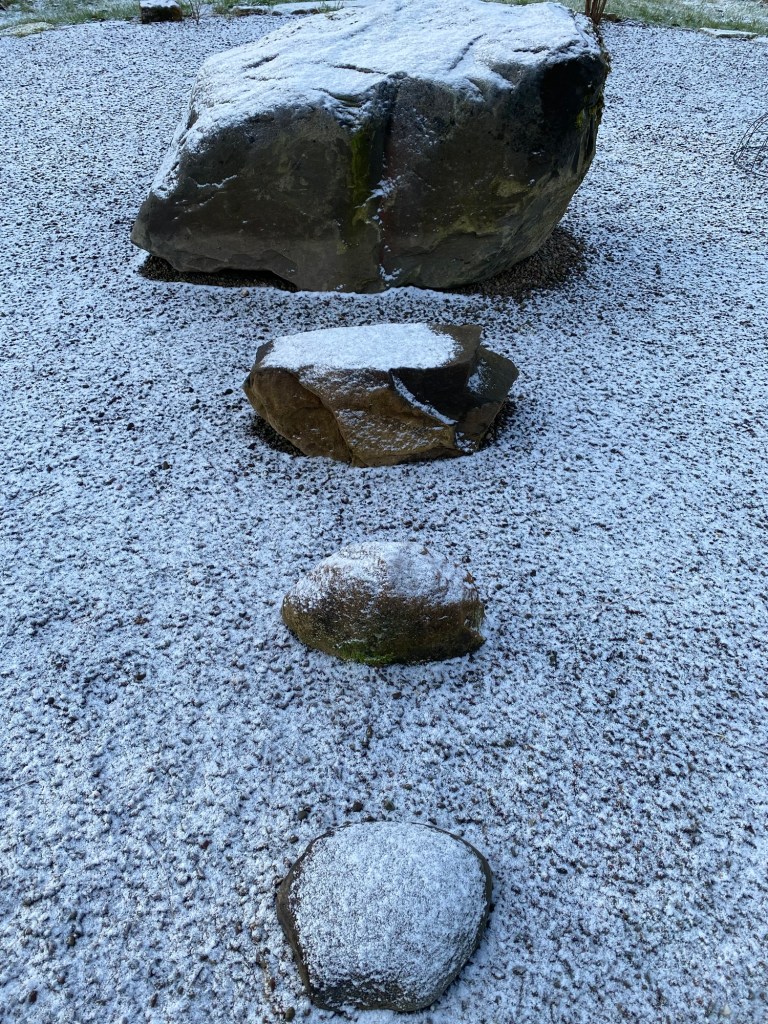
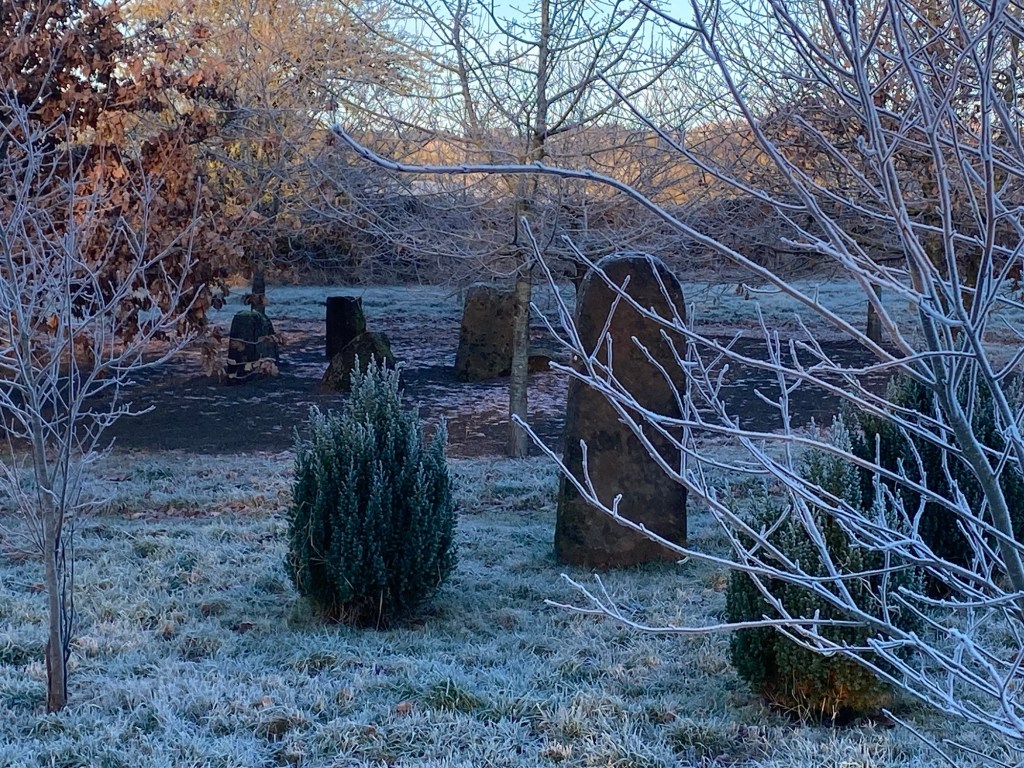
In fact rock and gravel are already present in my garden. I look upon them quietly most days. I’ve arranged some of the stones in a way that has a planetary dimension to it. The combination looks wonderful by moonlight, in rain, and whenever there is snow or frost. The lesson is clear. Sometimes, even in a garden, the things we seek are there already. We just need to let them find us.
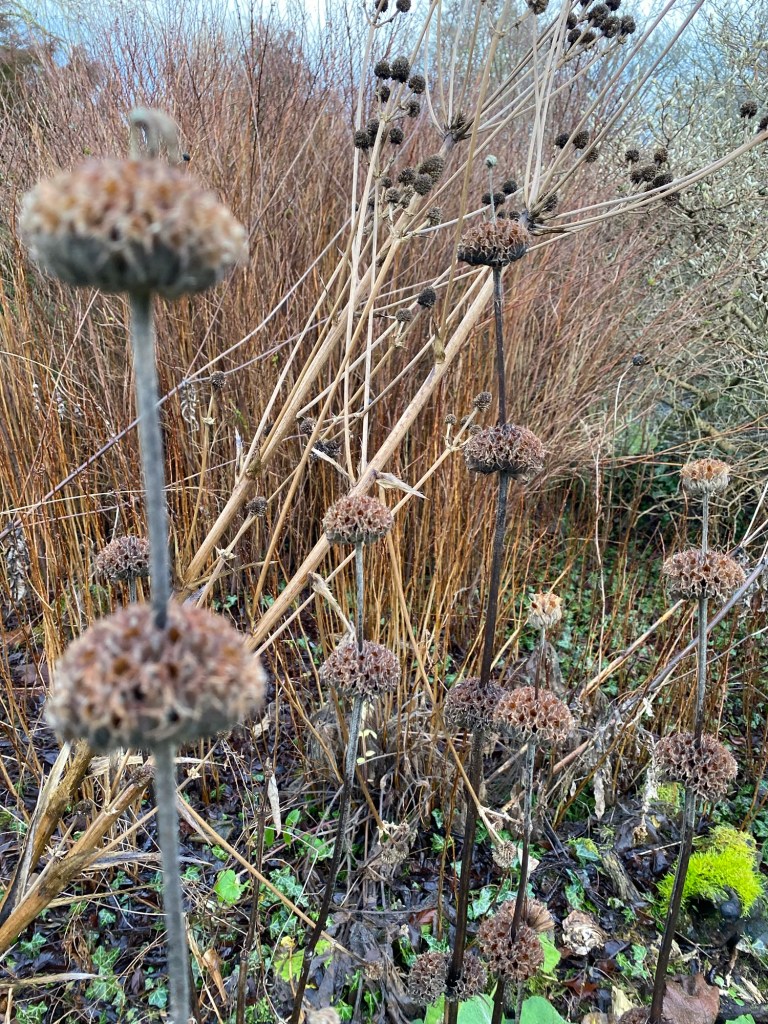
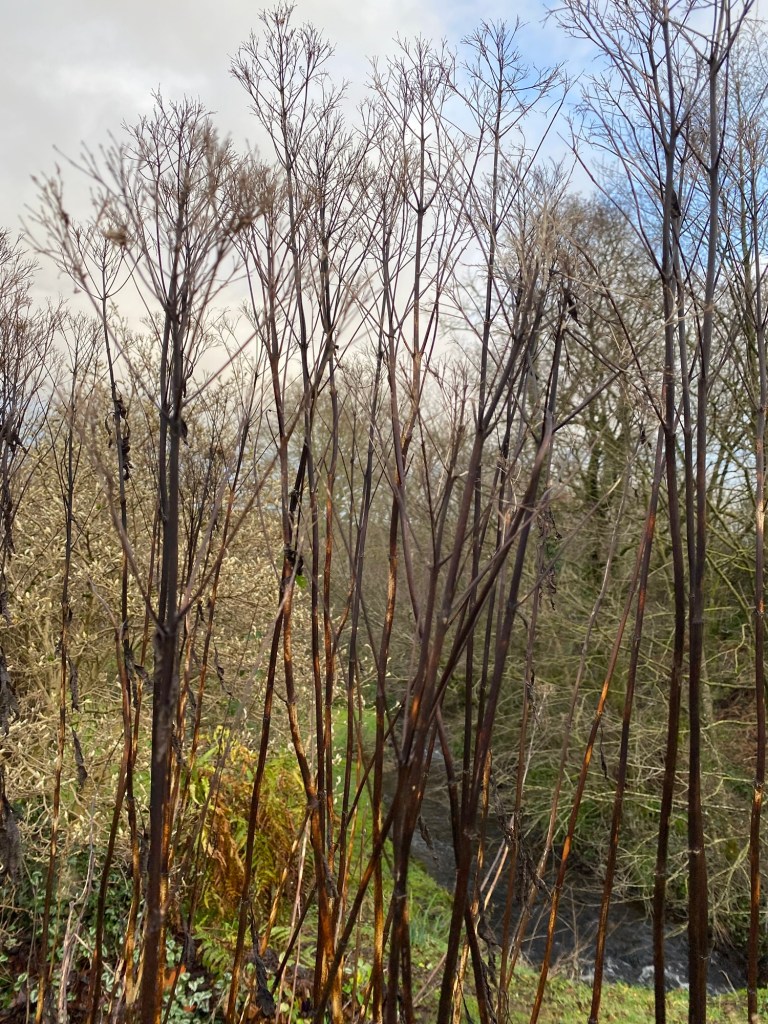
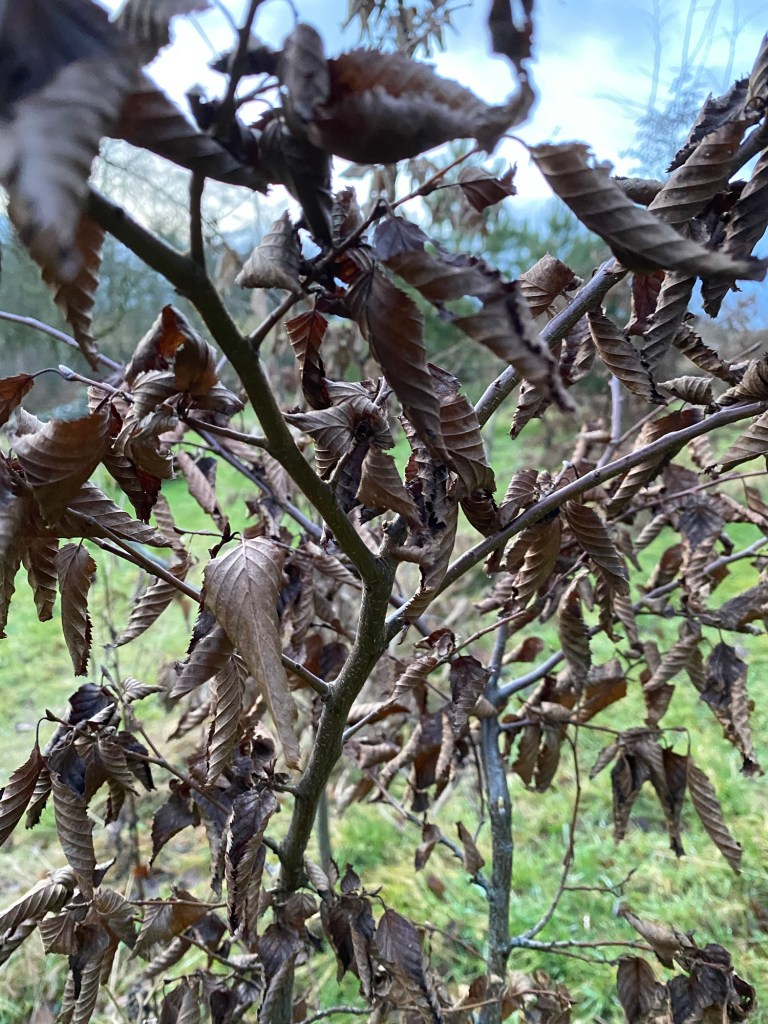
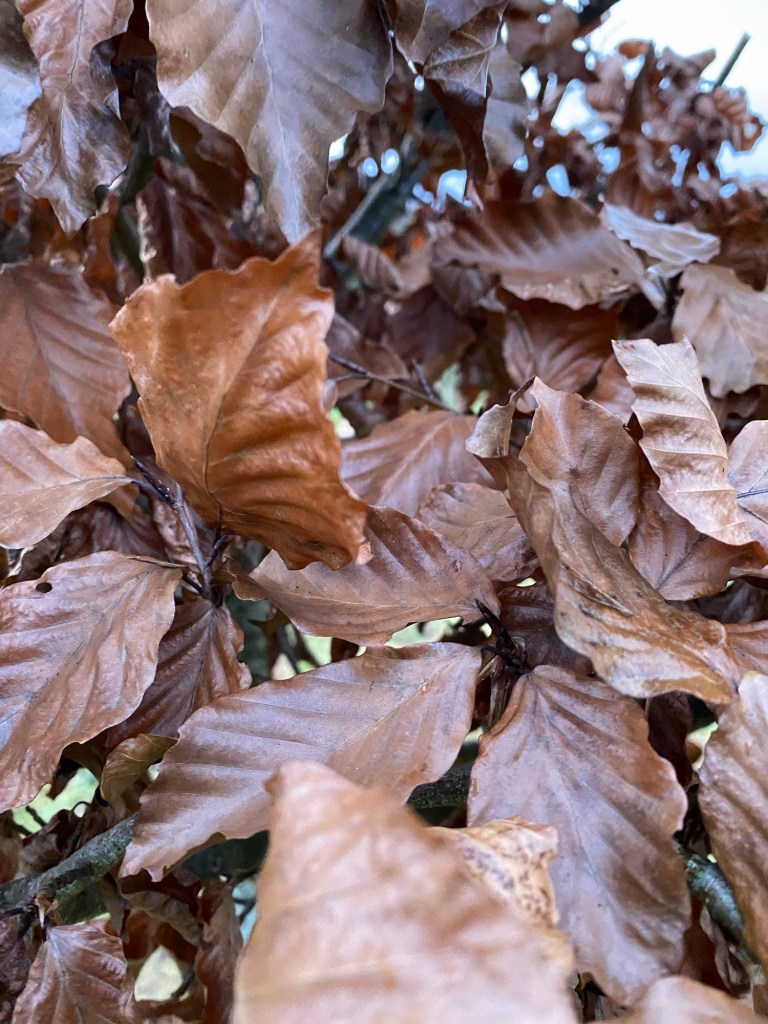
It’s always a delight to see these catkins as the year is ending. Bright, shining, moving in the breeze, they are an inspiration for the year ahead. But elsewhere in the Dumfriesshire Garden there are still plenty of reminders of the year that’s coming to a close. The pictures below also have their own beauty, revealing the structures and variations in common plants that fill our borders and the annual cycle of the trees.
The year ending, as I have shown in this A-Z of the garden in 2024, has been rather mixed. A curate’s egg, good in parts, but also with losses and disappointing results. Yes, the roses, the potatoes, the bog plants and the younger trees all did well. But the bursts of colour in the big border didn’t materialise as in previous years and the weeds got unruly. The garlic crop was meagre compared to last year. The spring bulbs were patchy. A number of transplanted viburnums didn’t make the transition. At best, we could describe it as a contradictory year in the garden.
Yet if we set these minor vicissitudes against the greater problems in the world, any horticultural misgivings seem a crass indulgence. Whatever the merits and demerits of the gardening year, we are always left in credit. The garden is something I live with constantly and day by day. When I’m away, I garner new ideas for it. The garden has a unique place in my life: the perfect backdrop to my quotidian world and the people I love most dearly.
So as this year nears its end, I feel thankful, and look forward to 2025 along with everything it may bring – and not only in the garden.
This letter of the alphabet was causing me a problem with my A-Z of the Dumfriesshire Garden in 2024. Then I realised the solution was right in front of me.
One day this summer, my neighbour rang to say that the owner of a large specialist plant nursery in Galloway had called to say hello and in his van was large number of interesting plants. This is a call which does come from time to time, and to which I happily respond. The horticultural equivalent of the ‘fish van’, albeit intermittent, is a wonderful opportunity to buy interesting material at the garden gate, and not to be missed. On this particular day I bought a variety of shrubs as well as an unusual hornbeam (Carpinus Fangiana) and a rather special horse chestnut, Ohio Buckeye (Aesculus Glabra).
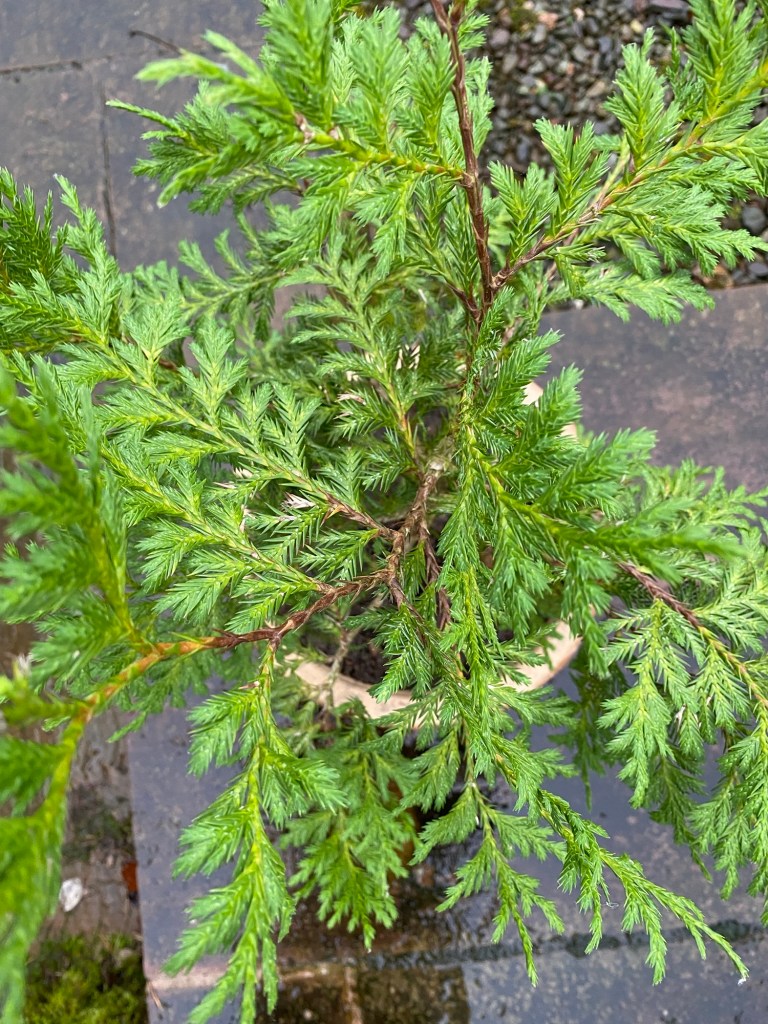
Content with my haul, and somewhat poorer, I turned with my wheelbarrow, only to receive one more compelling pitch from the plantsman. The shining green specimen in question was the Vietnamese Golden Cypress – or Xanthocyparis Vietnamensis. Despite the ‘golden’ of the common name, it seemed to have a touch of silver sparkle about it. The plant was obviously healthy and had been grown locally. But I was told it had only been discovered in the wild in 2001 and is considered an endangered species. At £18 I added it to my purchases and vowed to take care of it.
Over the summer I kept it on the terrace among other groups of potted plants. When early frosts arrived in September I decided to bring it into the house, where it sits happily among more standard indoor plants. Thus cared for, it has almost doubled in size. I think I’ll continue with this interior-exterior mode of cultivation and if the plant gets stronger it will eventually go out into the garden proper. I’m hoping for great things from this recent and rare arrival – bought off the back of a van.
Sadly, it will no longer help with ‘X’ in any future A-Z that I may write. Following various taxonomic disputations, its name has now been changed to cupressus-vietnamensis
The tasks of winter in the garden, it seems to me, are twofold.
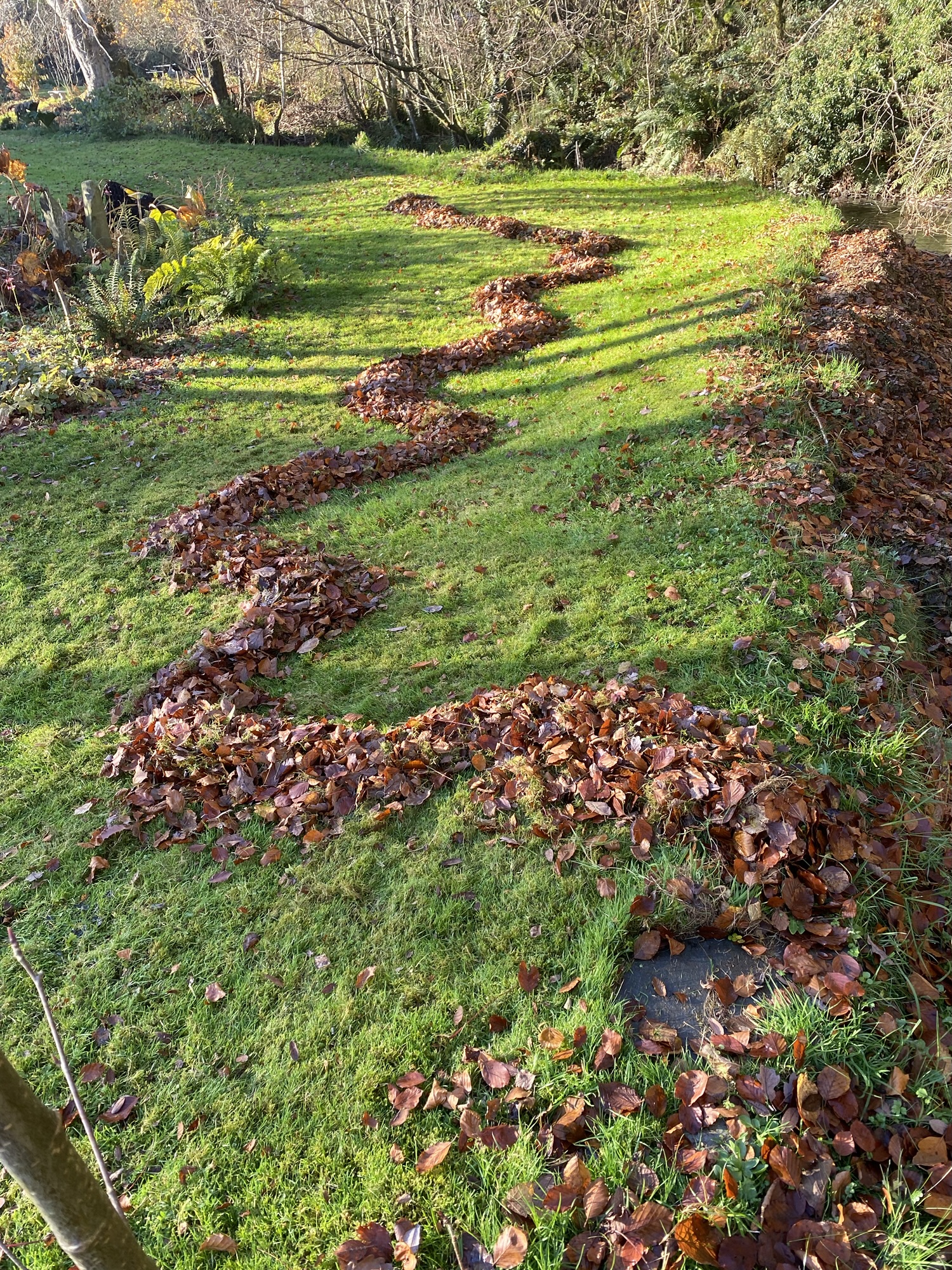
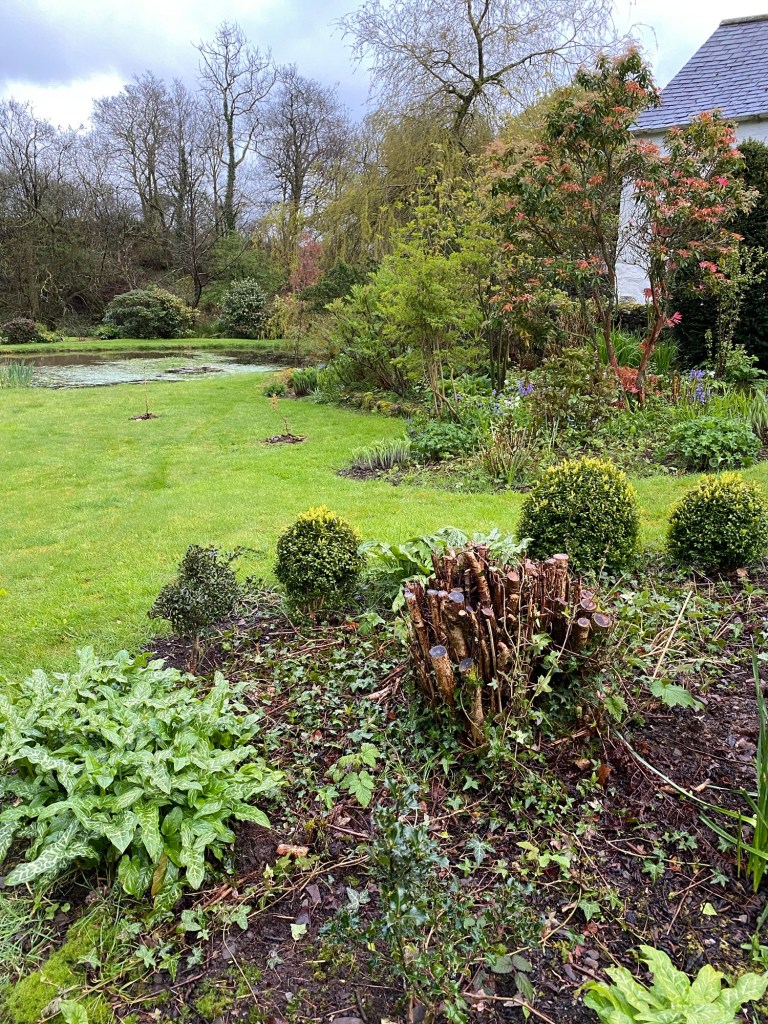
On the one hand there are practical things that need our attention. Pruning out the hazels, tidying up the rose arch and the bentwood hornbeam tunnels. There is some strimming to be done in the longer grass where daffodils and narcissi will be pushing through even before the year’s end. There are leaves to rake, first into serpentine forms if the fancy takes, and then piled up to make leaf mould or dragged onto weeded borders as a mulch. There’s also planting, mainly of trees and shrubs. This December in an unusual mild spell, I’ve been busy putting in rowans, acers, juniper and viburnum. Then don’t forget the vegetable patch – cleaning out some of the raised beds, tidying up the leeks, keeping watch for the garlic to appear in bright shining rows. Such are the tasks we take on when feeling energised or called outside by a spell of sunshine and a patch or two of blue sky on a winter’s day.
But there is another exquisite garden task in winter that should not be ignored or under-estimated. I am thinking about contemplation. For when the leaves are gone, the garden reveals to us its structure, drawing our eye in different ways and suggesting new ideas. When snow and frosts come (not much this year) the appearance of the garden is further enhanced. Winter is a time for deeper thoughts and plans. It’s also a time for reading and for entering the storied world where the unique array of relationships between gardeners and gardens are revealed in all their fascination.
Both sets of garden tasks are important in winter time, though the second is of course the more tempting!
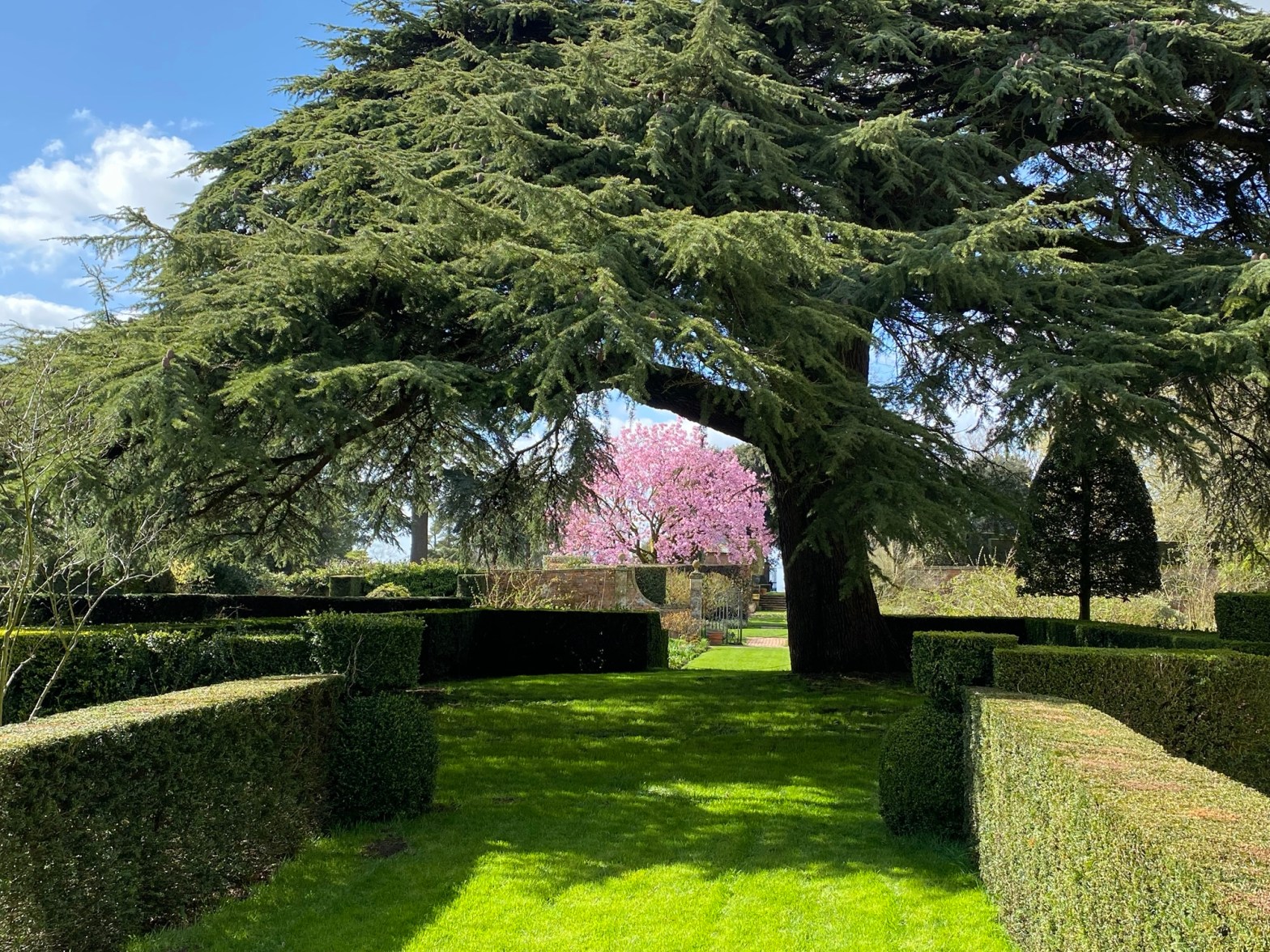
I’m not an assiduous visitor of gardens, though I do have my favourites, such as Hidcote Manor in the Cotswolds (seen here in the featured image), which we head to at every opportunity. Visiting any garden is always a chance to garner new ideas and inspirations and maybe to bring them home for local adaptation.
Sometimes the stimulus comes from unlikely places. The tree planting at the University of Navarra, for example, was instrumental in shaping my ideas for the arboretum in the Dumfriesshire Garden. The sunken garden at the Crichton Campus in Dumfries also found a refracted application in a sunken area of my own garden ‘design’. In 2024, three contrasting gardens stand out as sources of pleasure and influence that might in some small way be transferred and translated at home.
We spent a very wet five days in the Lake District in mid-April. I enjoyed wandering around the informal country garden as well as the more structured elements adjacent to the property and had two take away ideas.
First the photinias. I noticed how they were doing well planted in grass and in wet conditions. So when I got home, I replicated the approach near the pond in my own garden. In the more woodland area of the Lakeland garden, with its mown paths, I encountered a beautiful wooden circle that was pleasant to walk through, but which also created a wonderful focal point and could be seen from various angles. This surely will merit a conversation with our joiner in 2025.
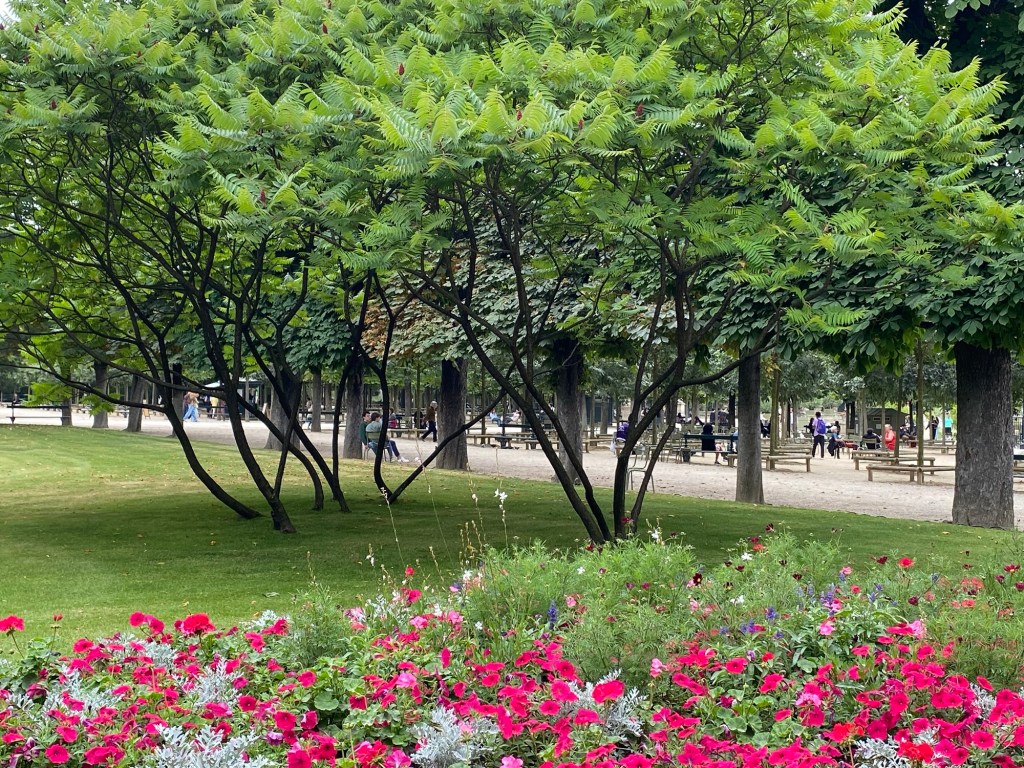
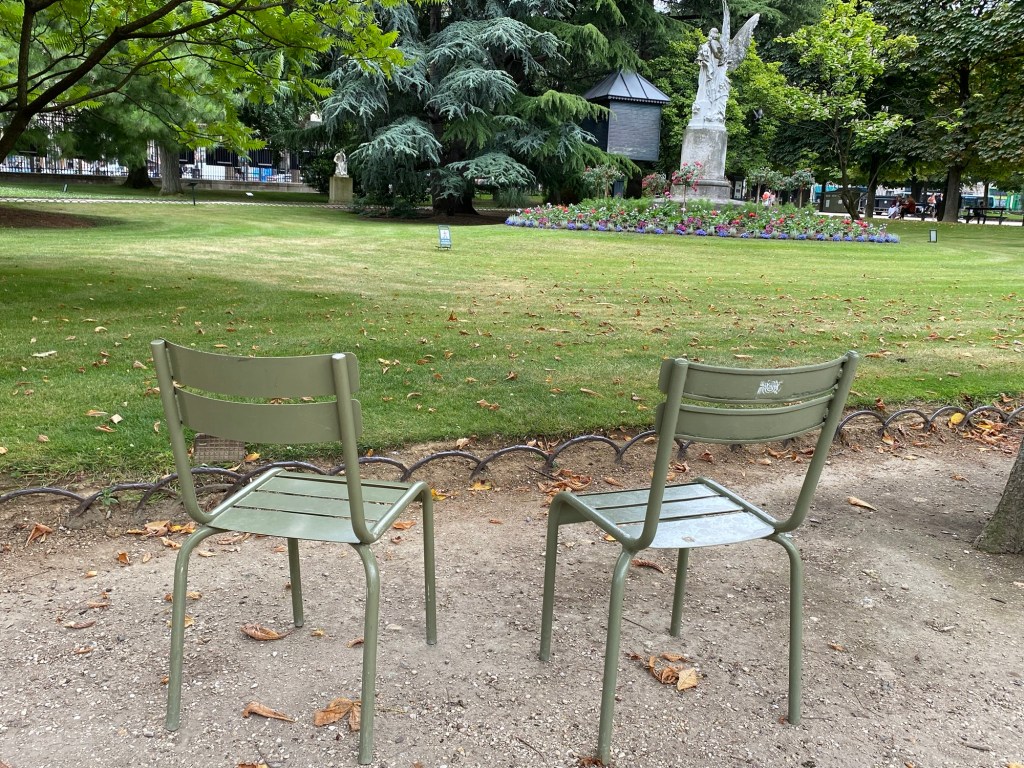
In July, a few days in Paris provided the chance to visit the Luxembourg Gardens, well known through films and novels but never experienced first hand. It covers 25 hectares, divided between the ‘French’ and ‘English’ styles. With its centrepiece of elegant fountains falling into a 50 metre long bassin, an orangerie, and chestnut groves it has much to admire. ‘Le Luco’ as the Parisians call it, has everything a city could want in a public space. Including its wonderful garden furniture, stylish and robust and perfectly suited for a quiet spot in the Dumfriesshire Garden!
August brought a weekend at Matfen Hall in Northumberland , where a recent uplift had included enhancements of the original Victorian garden. Like all the best gardens, this one demonstrated the important quality of foresight, manifested especially in wonderful trees to delight generation after generation. Thus inspired, and on returning home I planted a giant redwood (at the moment about 15 inches high) to add to other specimen trees like coast redwood, Californian pine, holm oak and cedar of Lebanon that are already doing well in the Dumfriesshire Garden.
If travel ‘broadens the mind’, it also has the capacity, even in small ways, to enhance our gardens at home.
For a place that is largely unfenced and merges seamlessly with the surrounding landscape, the Dumfriesshire Garden has been mercifully free of serious damage by rabbits and deer. Certainly the former have been scarce in numbers in recent years, but the latter are seen regularly in the nearby woods and fields and do occasionally visit the garden. In the past they have browsed on young holly and on dogwood stems in winter. One year they munched off all the seedheads of my meconopsis before I could collect and store them. But in general they have not caused serious damage.
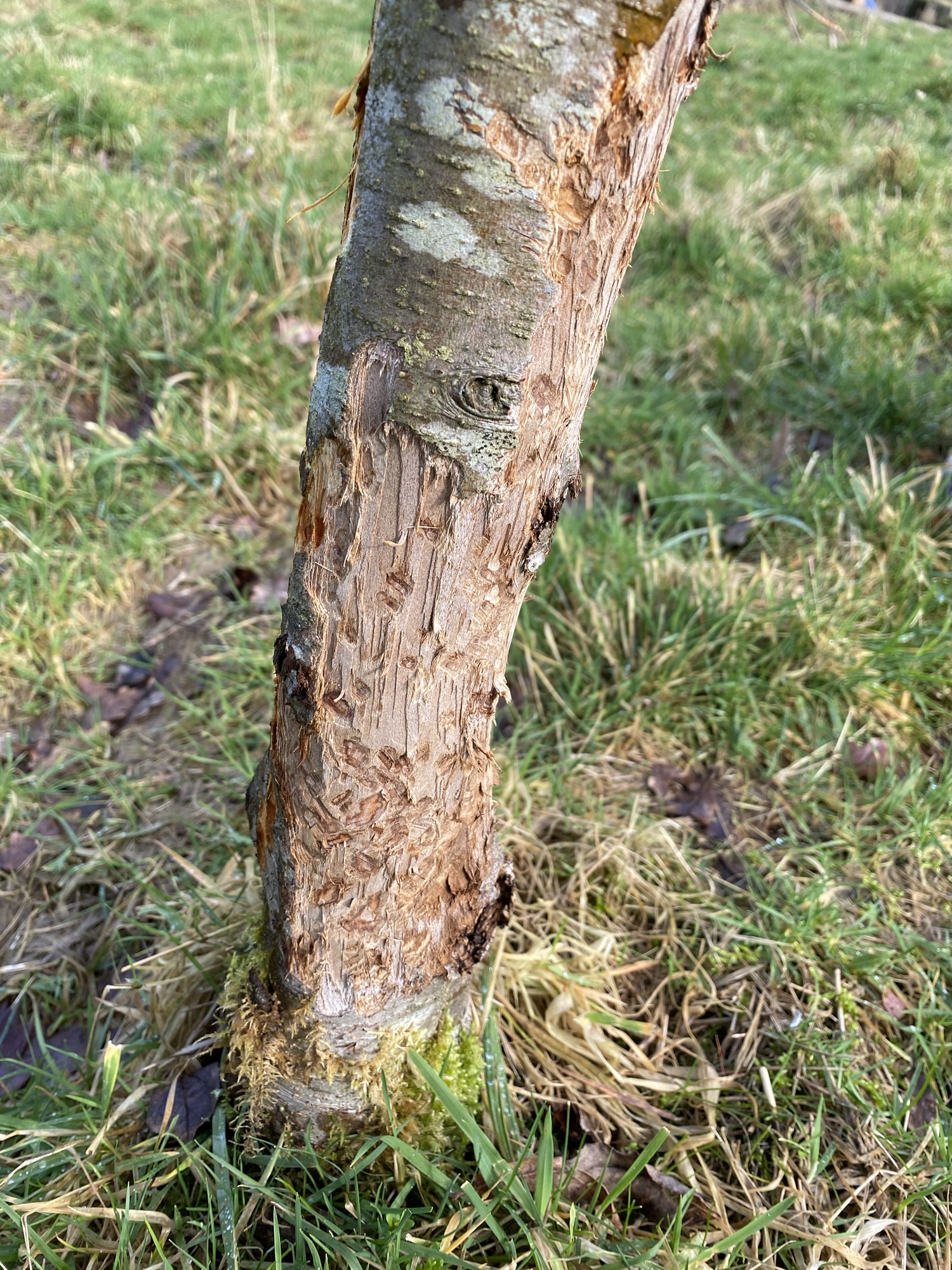
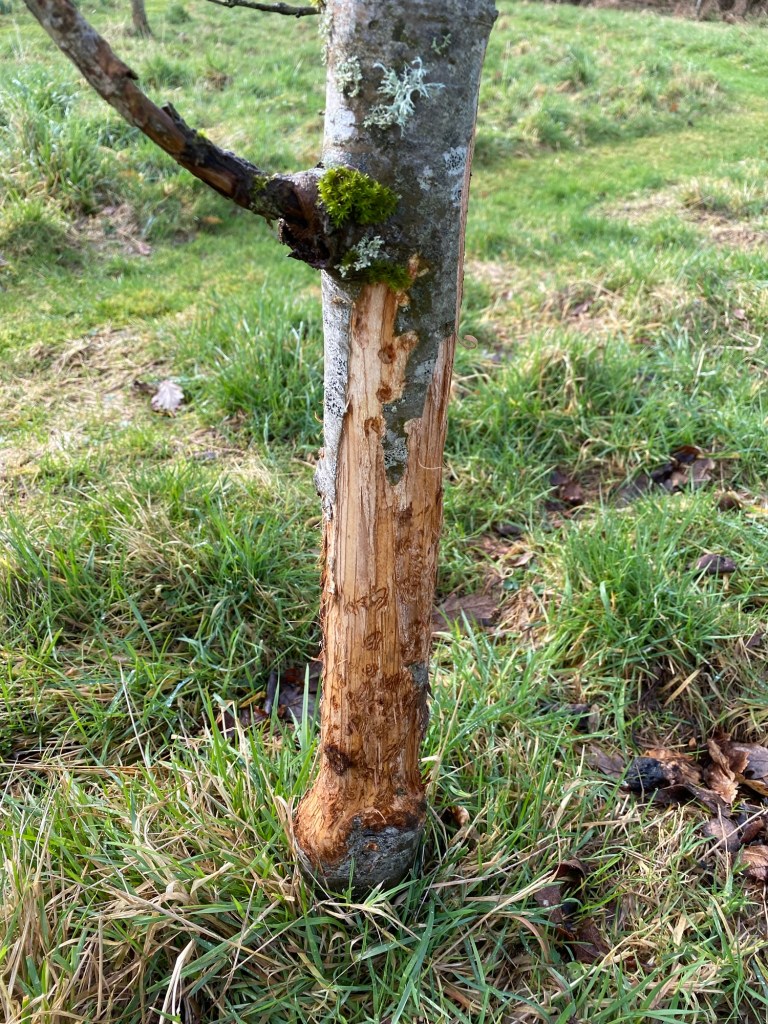
The night of 9th/10th February 2024 was a different story however. On this occasion what may have been a small group of deer, species unknown, came into the orchard and with antlers and teeth, made play with the trunks of some still fairly young apple and plum trees.
I rapidly closed the stable door after the horse had bolted. Wire netting was found in the garden shed and quickly wrapped around a half dozen trees. In a few cases I wondered whether the damage had been enough to kill the tree. Fortunately that was not the case. But the uninvited guests of a February night undoubtedly contributed to the sub-optimal apple crop of 2024.
Come the spring, one plum tree failed to come into leaf and was later pronounced dead. Paradoxically it was one the deer had left alone.
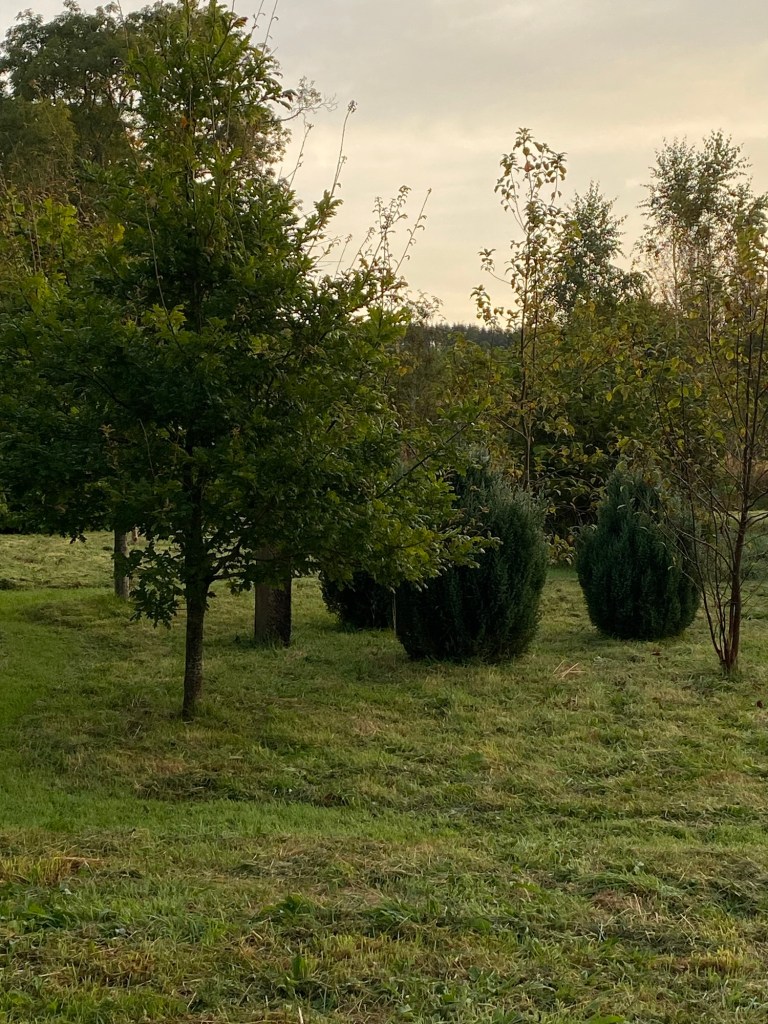
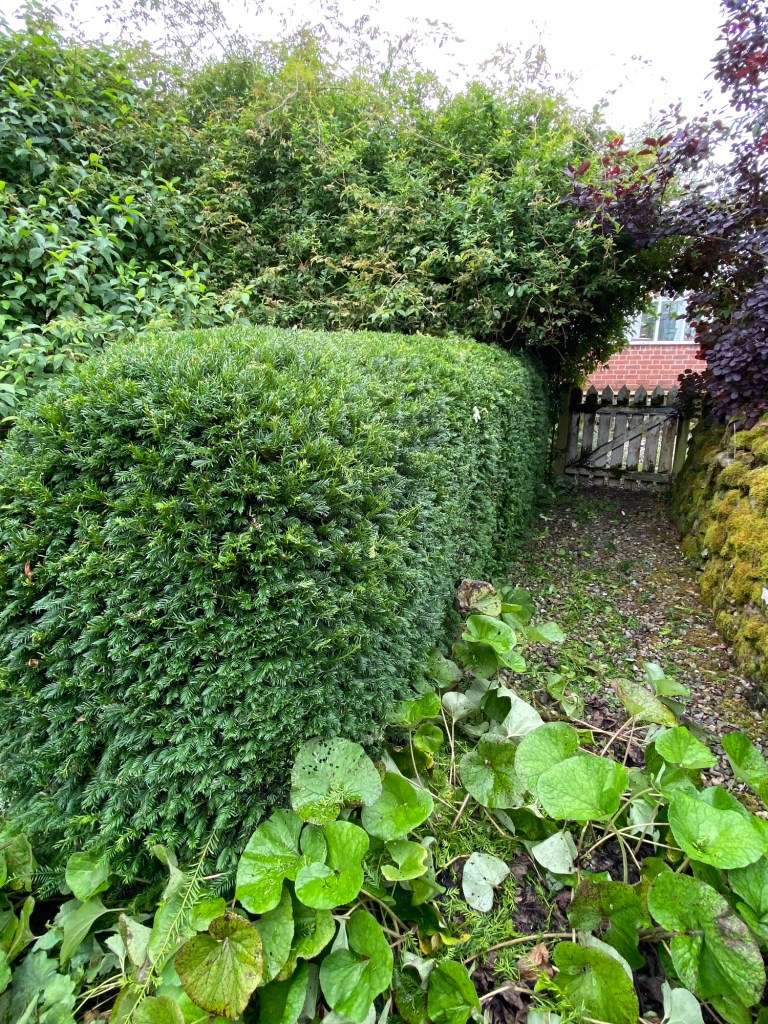
Topiary is putting it rather strongly. There are no elaborate geometric forms, leaping dolphins or stags at bay in the Dumfriesshire Garden. But over the lifetime of the garden I have come to appreciate more and more the evergreens (and the beech hedging) that we have been able to clip into pleasing shapes. In truth I wish I had planted more yew, box, and ilex in years gone by. Especially at this time of year, when their clipped forms seem to emerge from herbaceous borders, come increasingly into view, and give structure and elegance to the garden.
Recently I have discovered a faster growing alternative holly and yew, in the form of lonicera nitida. This tough plant not only establishes itself quickly, but cuttings that fall to the ground from the shears are quick to take root, thereby providing a steady supply of new cuttings which can be brought on in pots before planting out around the garden. This lovely lonicera ring, seen below, surrounding a garden table and chairs was planted in spring 2020 and is already one of the most striking feature in the garden. So topiary may not be the long game that many people think. I am certainly planning more creations, and using home grown material to create them.
It’s one of the great pleasures of gardening to grow some crops for the family to eat. However modest the quantities, something grown at home, freshly harvested or carefully stored over time adds to our diet and the pleasures of eating. To this end, the greenhouse and the raised beds work in conjunction to extend the growing season, providing an early bite and a late garnish.
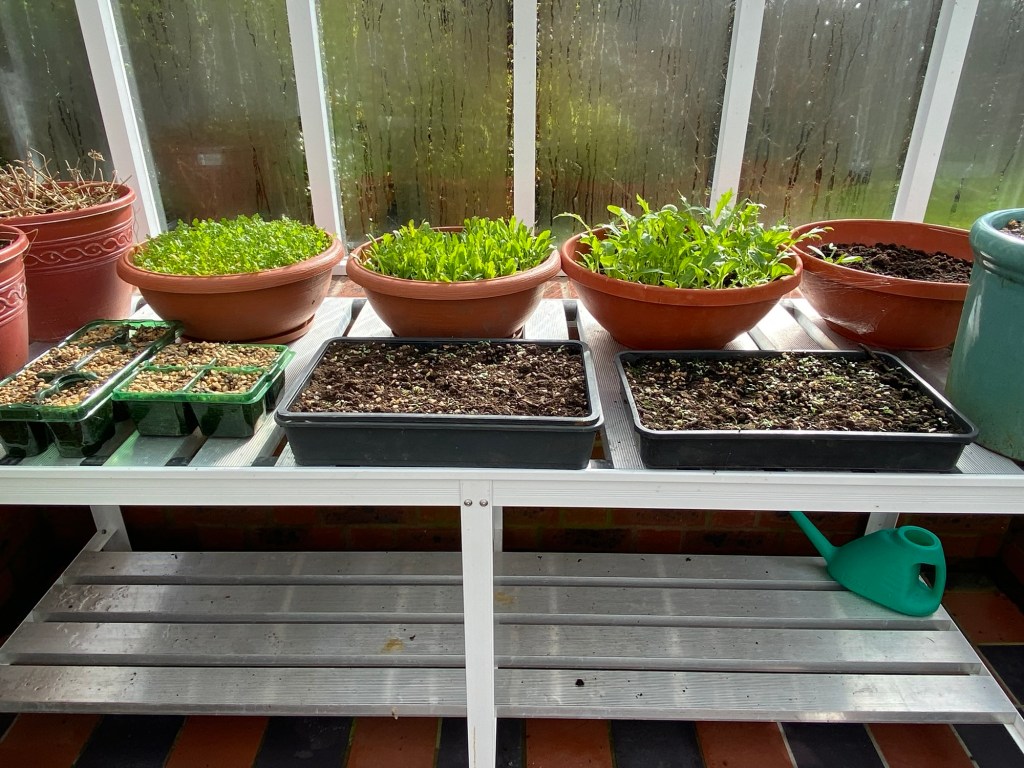
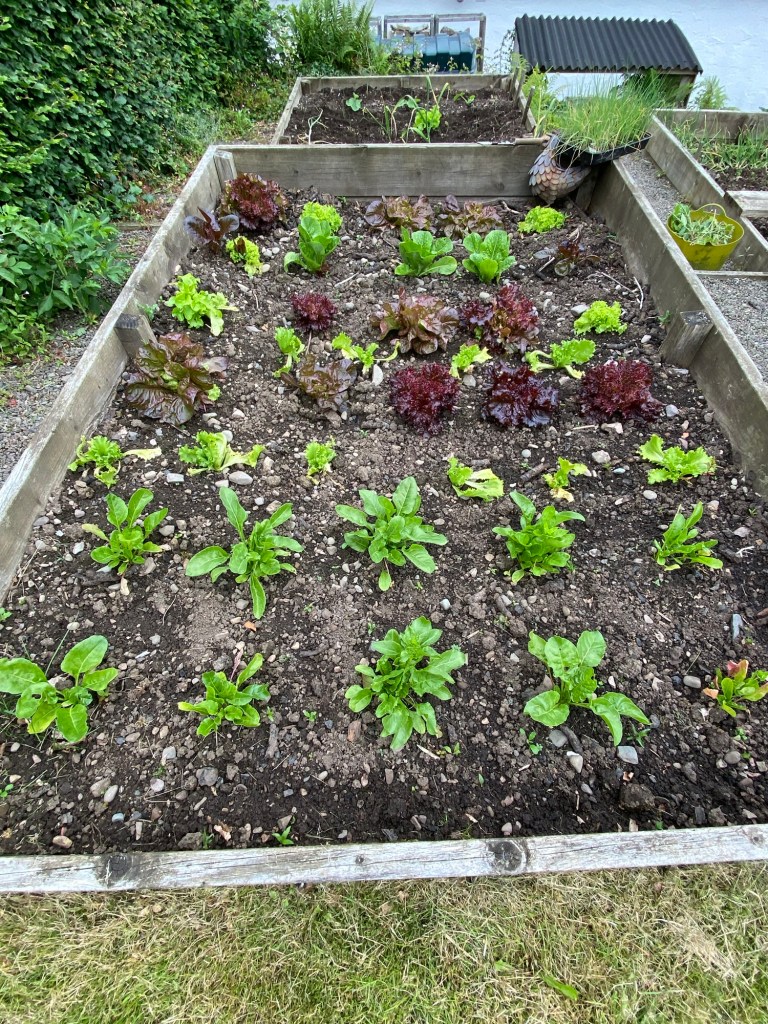
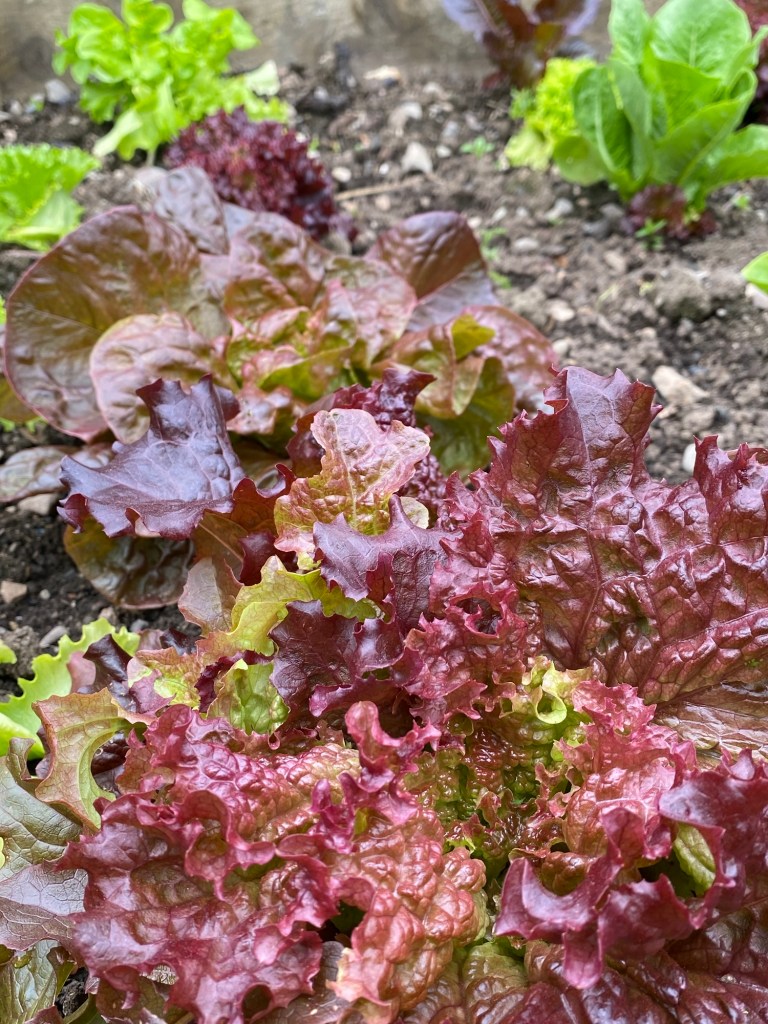
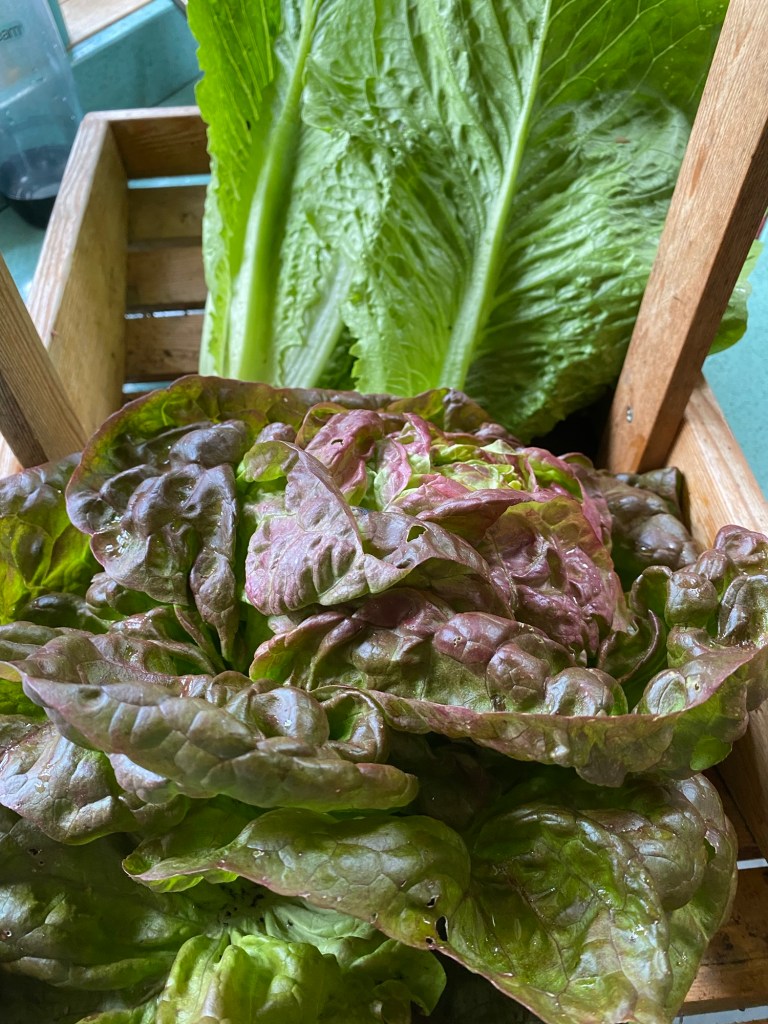
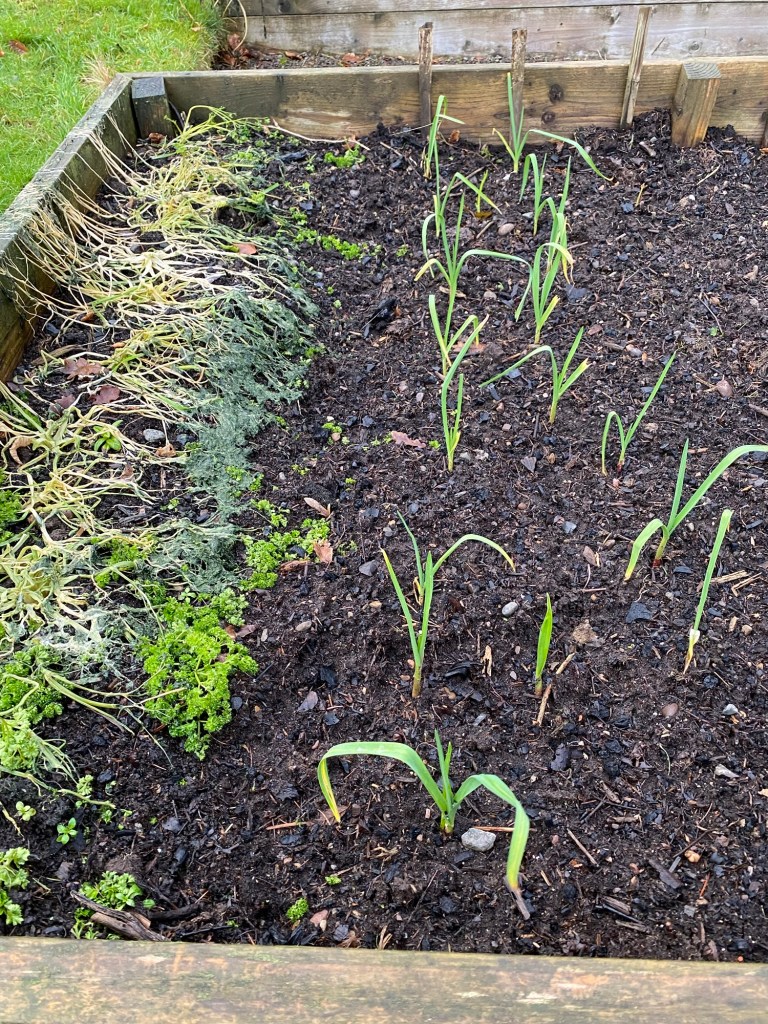
I like to grow early salads in bowls in the greenhouse, moving on to herbs like dill and coriander when the weather gets warmer. Then I plant out red and green pick-and-come-again varieties of lettuce, followed later by the hearting varieties. all of these started off in the greenhouse. For more than six months of the year it’s possible to ignore the salad section in the supermarket. We have parsley all year round, under glass and outdoors, though this year a nasty frost in November put paid to a lovely row of that all-round useful herb. It can be seen in the pictures below, flattened next to the first sproutings of garlic.
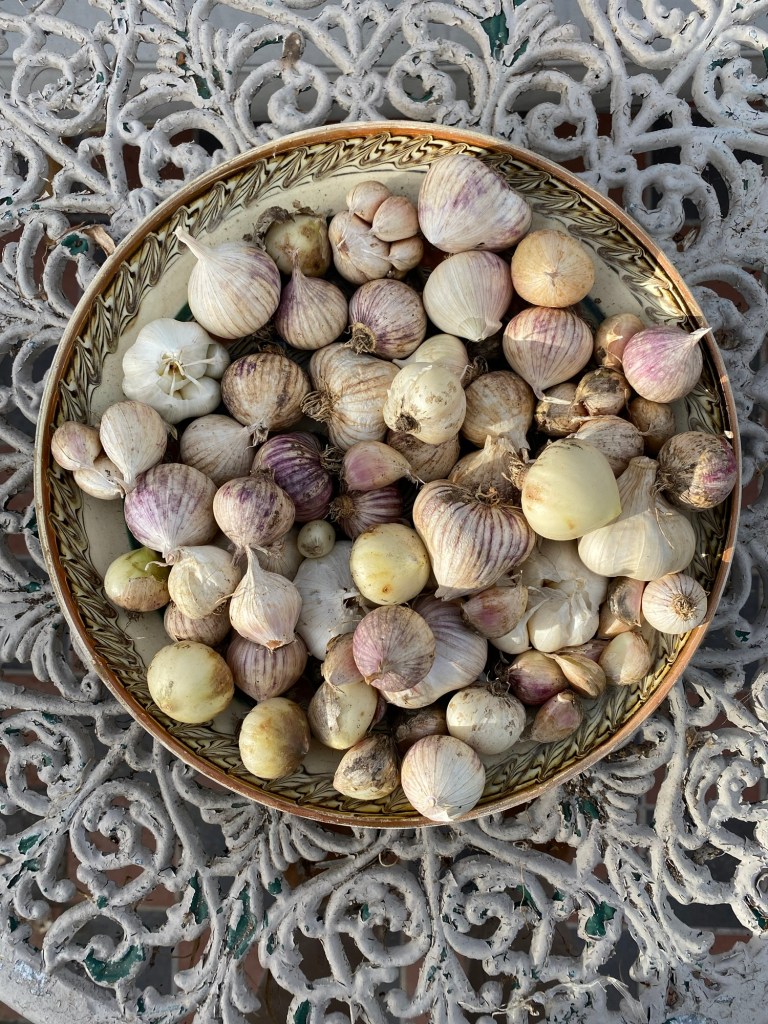
In 2023 the garlic crop was exceptional and saw us through to harvesting in late June this year. But the 2024 crop was meagre by comparison. The bulbs were small in general and in some cases did not subdivide into cloves. Come planting time this year I bought in fresh seed stock and am hoping for better results in 2025.
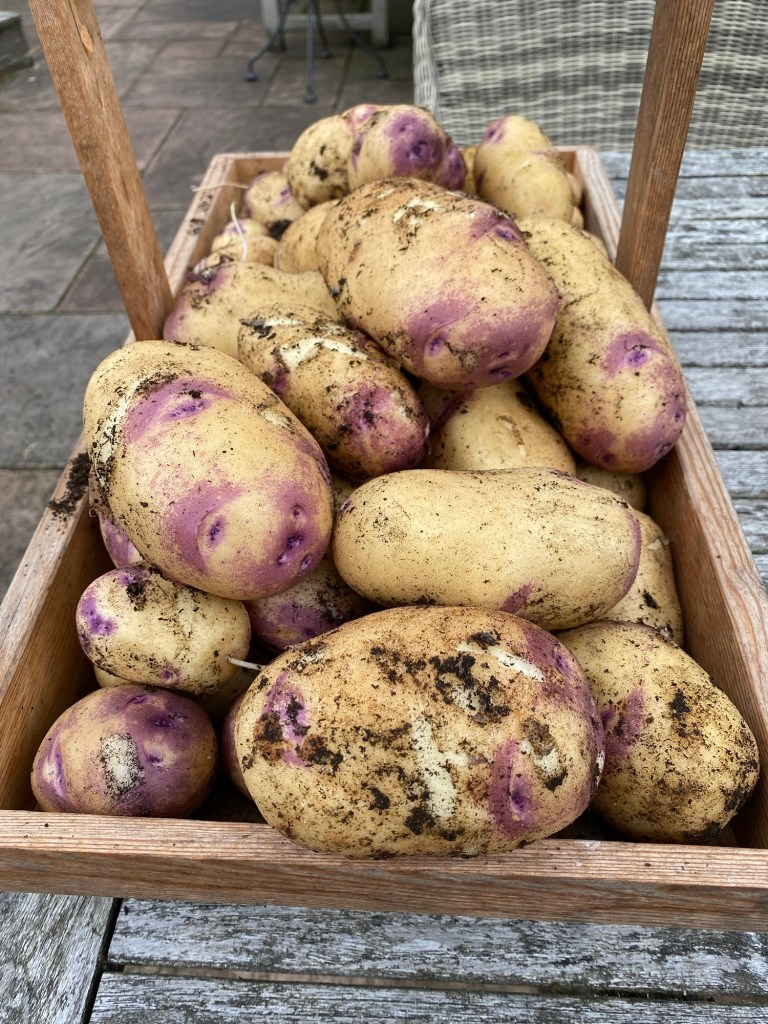
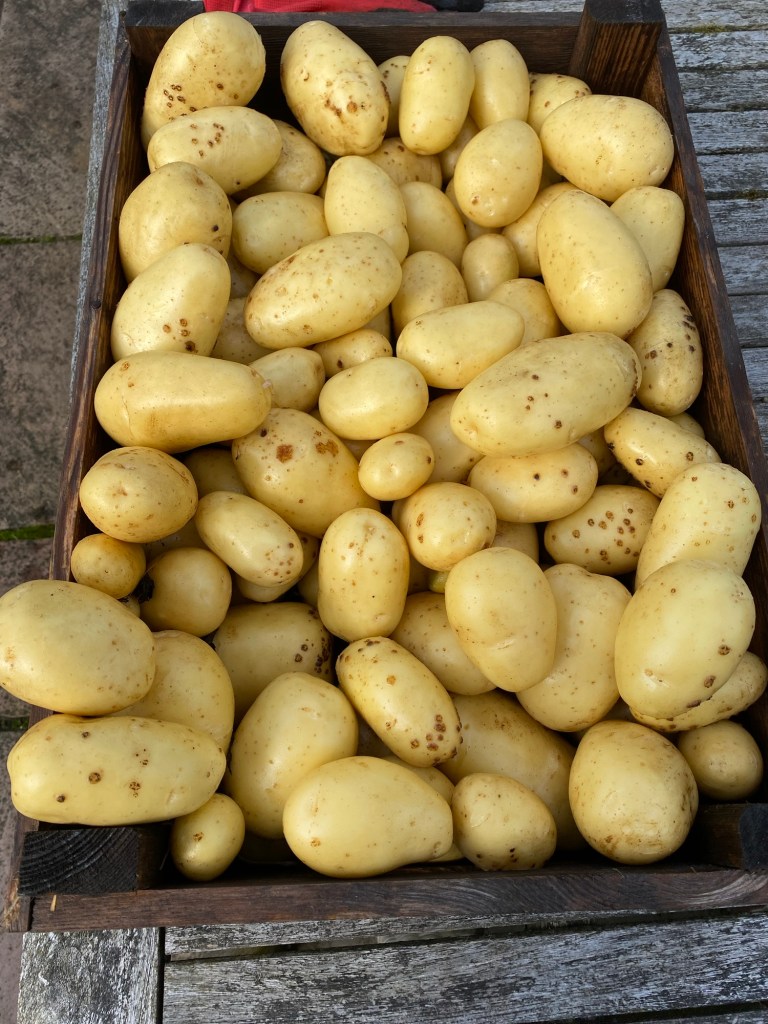
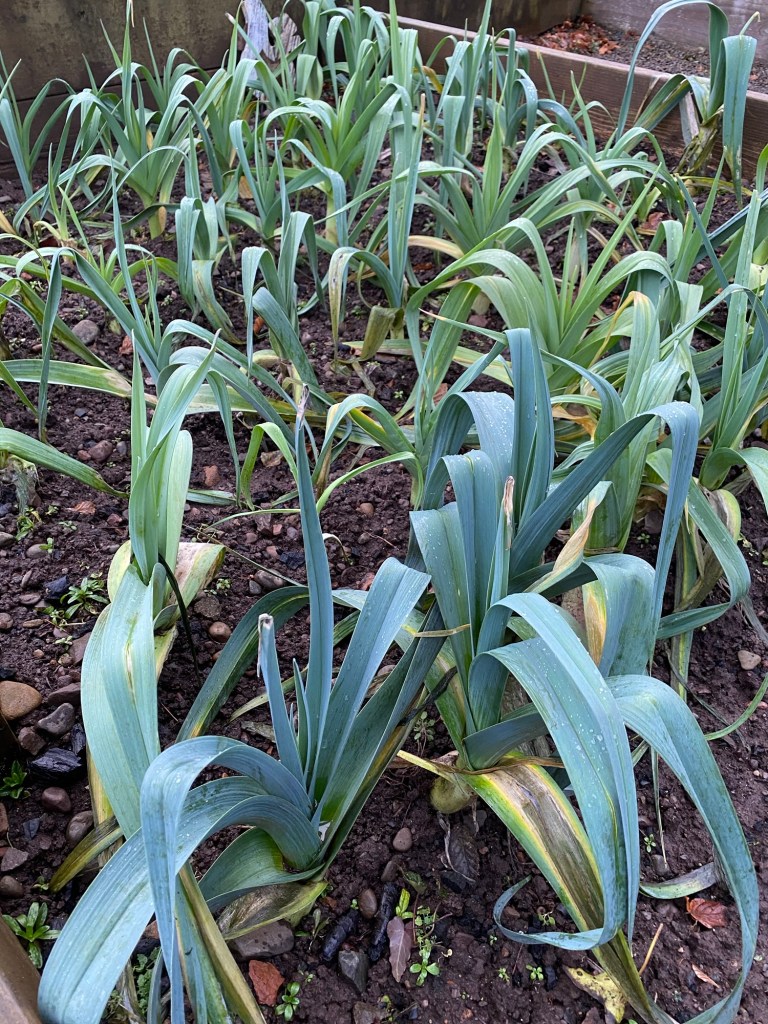
Potatoes, however, did superbly well this year. One half of a raised bed kept us fed for five months. The crop was heavy and generally in good condition. The leeks too have been very excellent, and I continue to stick with the reliable old-fashioned short variety, Musselburgh.
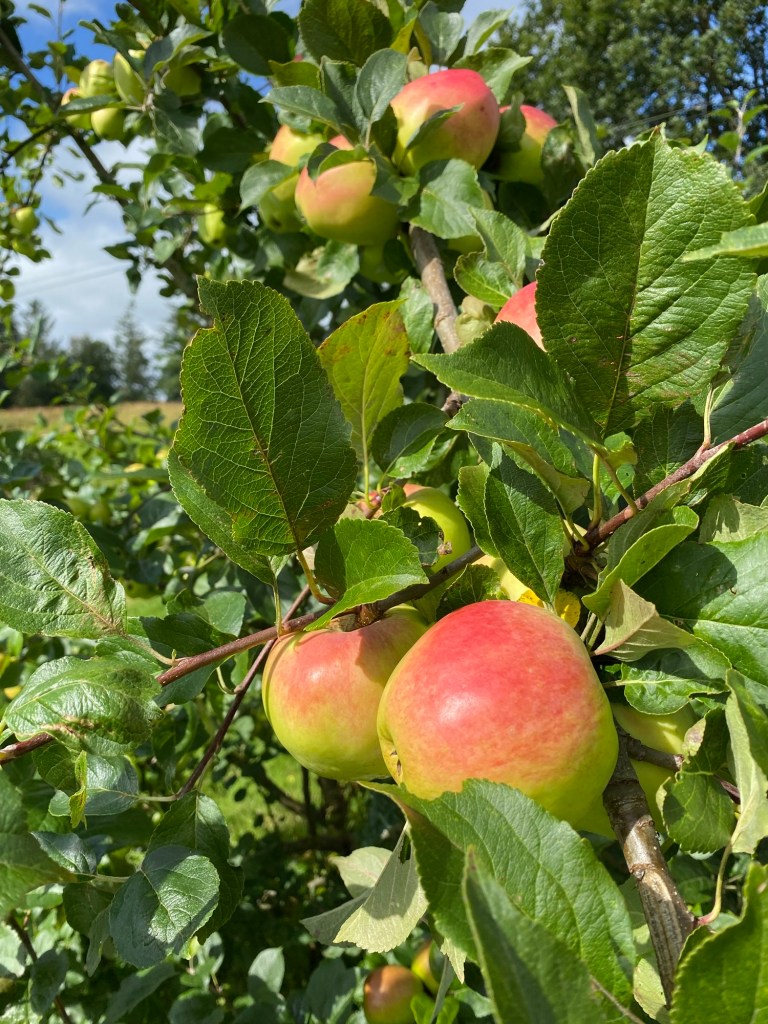
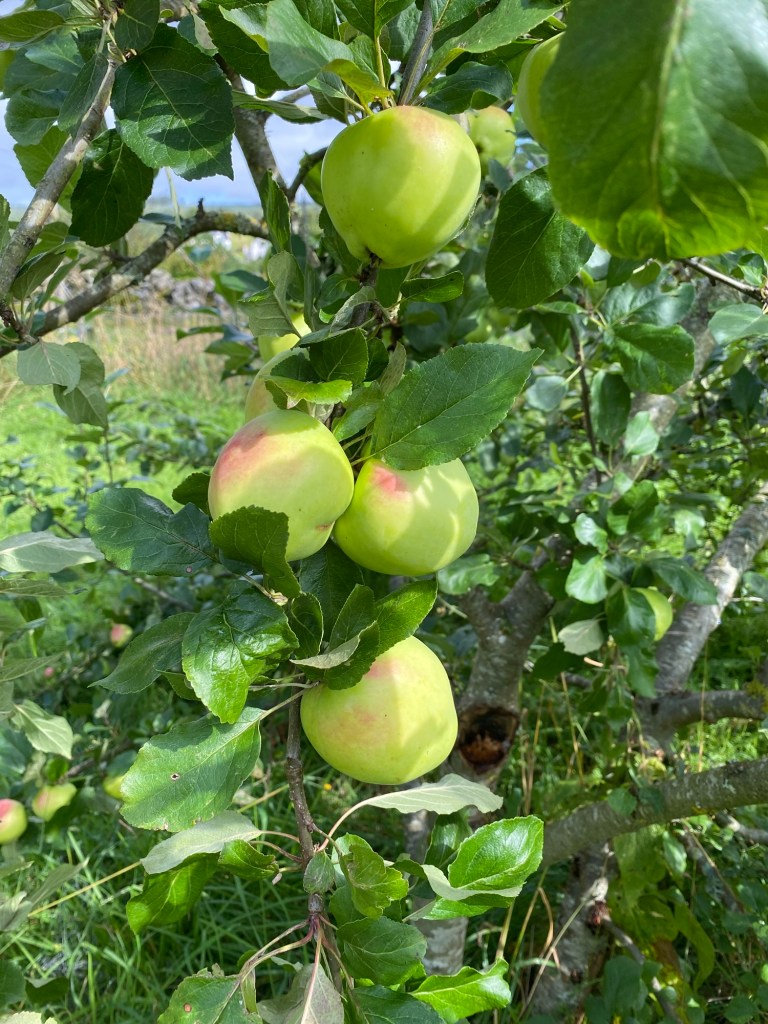
The apple crop I have already described. The last ones in store are the Bramleys and they will see us through until the end of January. The raspberries yielded enough fruit to make a batch of jam, but the patch is in need of two things: some fresh canes to replenish old stock, and a hefty mulching of well rotted manure.
At the moment (21st December – the day of the Winter Solstice) the weather is very mild. I am tempted to sow a bowl with salad seeds in the greenhouse. There’s just a chance they will germinate and provide a few leaves to add to a sandwich before the new year is too far advanced. I’m keeping an eye on the rhubarb patch too, and hoping to force a few early stems.
As elsewhere in the garden this year, the vegetables, salads and fruit have been like the Curate’s Egg – good in parts. Yes some things did well, but there was nothing quite like the spectacular escarole, seen in the picture below, which did so much to excite an Italian visitor in August 2023. But 2025 is another year, and who knows what culinary delights it will bring forth?





























 Quotidian