
At the end of a beautiful spring day in Pamplona, northern Spain, I am in a local theatre, waiting for the curtain to come up on Cicely and David, my play about the early origins of modern hospice and palliative care. A niche topic, certainly, but 250 people have come along to this Spanish premiere of the work, and the actors are full of nervous energy, eager to hit the stage.
The story within the play explores how in 1947 a newly qualified social worker, Cicely Saunders, became involved in the care of a dying Polish émigré, David Tasma. Their encounter in a London hospital over just a few months, was to shape the foundation of a future global movement to transform end of life care.
The story of how I come to be here in Pamplona goes back to when the play was first performed and filmed in a student production at the Edinburgh Fringe Festival in August 2022. For when that five night run of Cicely and David was over, I had no idea of the directions the play would soon be taking.
Within months, screenings were happening in Germany, Argentina, Slovenia, and the Netherlands, as well as at various locations in the UK. The film was being shown in various settings – at palliative care conferences, as part of public engagement activities and also on training events.
The performance in Pamplona represents a milestone for Cicely and David. For now, a new stage production is happening – and in Spanish.
The process began when my dear friend and colleague, Carlos Centeno, Professor of Palliative Medicine at the University of Navarra, read the playscript and commissioned a Spanish translation. Soon afterwards, members of his palliative care team and research group (the Atlantes group based in the Institute for Culture and Society) organized a rehearsed reading of the play, as part of an annual away day ‘retreat’. Enthralled by the experience, the participants made the ambitious decision to take it to the stage.
No one involved in the group had any track record in acting or directing, so help was sought from the theatre training programme in the Museum of the University. Six months of dedicated preparation ensued, and as confidence grew, resources were obtained for three performances in 2024. The first at an international palliative care conference in Cartagena, Colombia; then in front of their home community in Pamplona at an annual University Theatre Festival; and later for the Spanish Conference of Palliative Care, in Malaga.
On the 8th of March the players received a standing ovation from 500 conference goers in Cartagena. Now, five days later they are back home and about to perform for a second time. Many of their colleagues are in the audience, along with people from the local area, and a large contingent of students. For my own part, I can’t quite believe this is all happening!
The stage setting is elaborate and carefully orchestrated, with all five members of the cast on view throughout the drama. The attention to detail is remarkable, as they add numerous small elements to personalize and enhance the visual experience. My Spanish is far too limited for full engagement with the dialogue, but I can tell how faithfully, and line by line, they have represented the original English version. The performances are riveting.

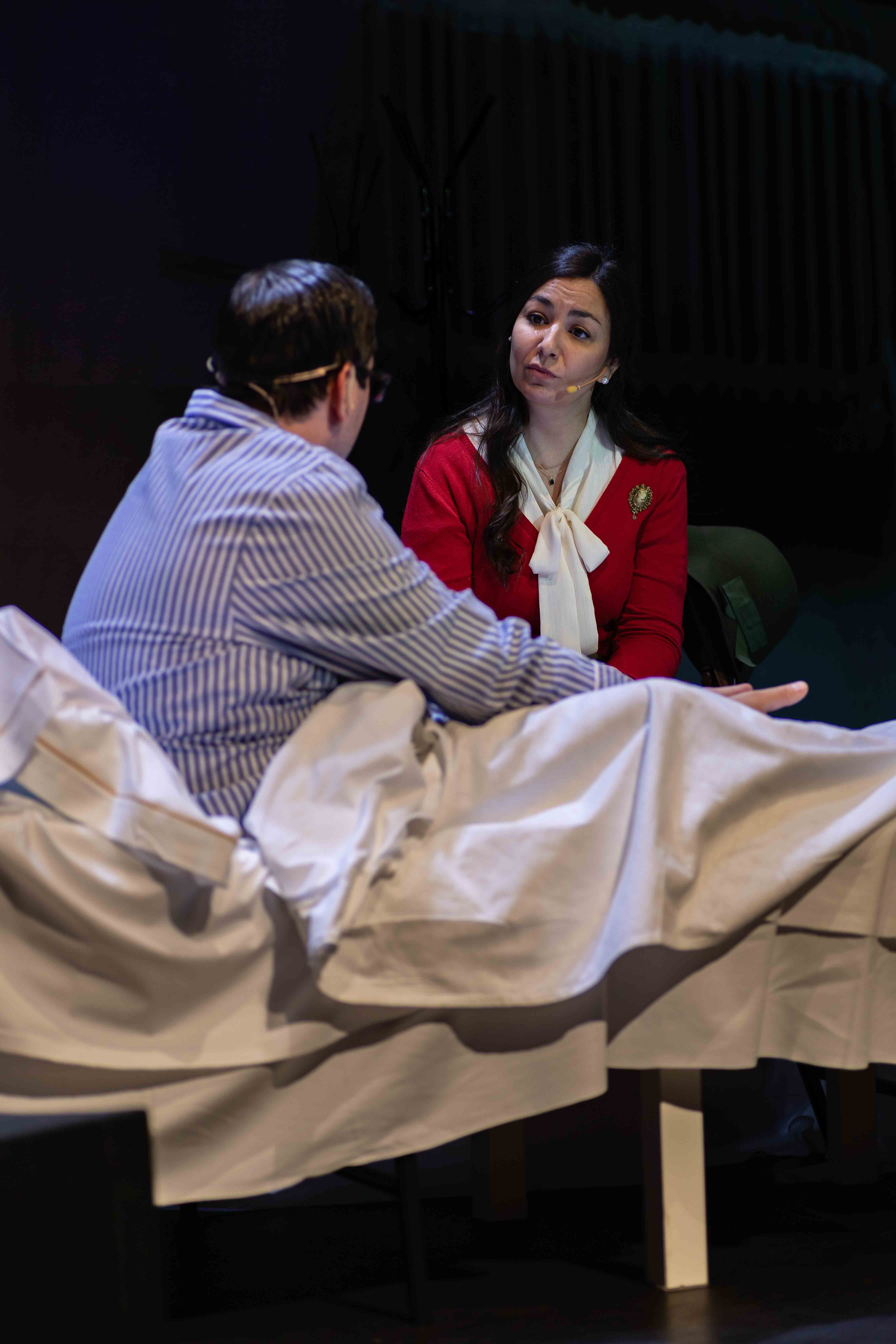
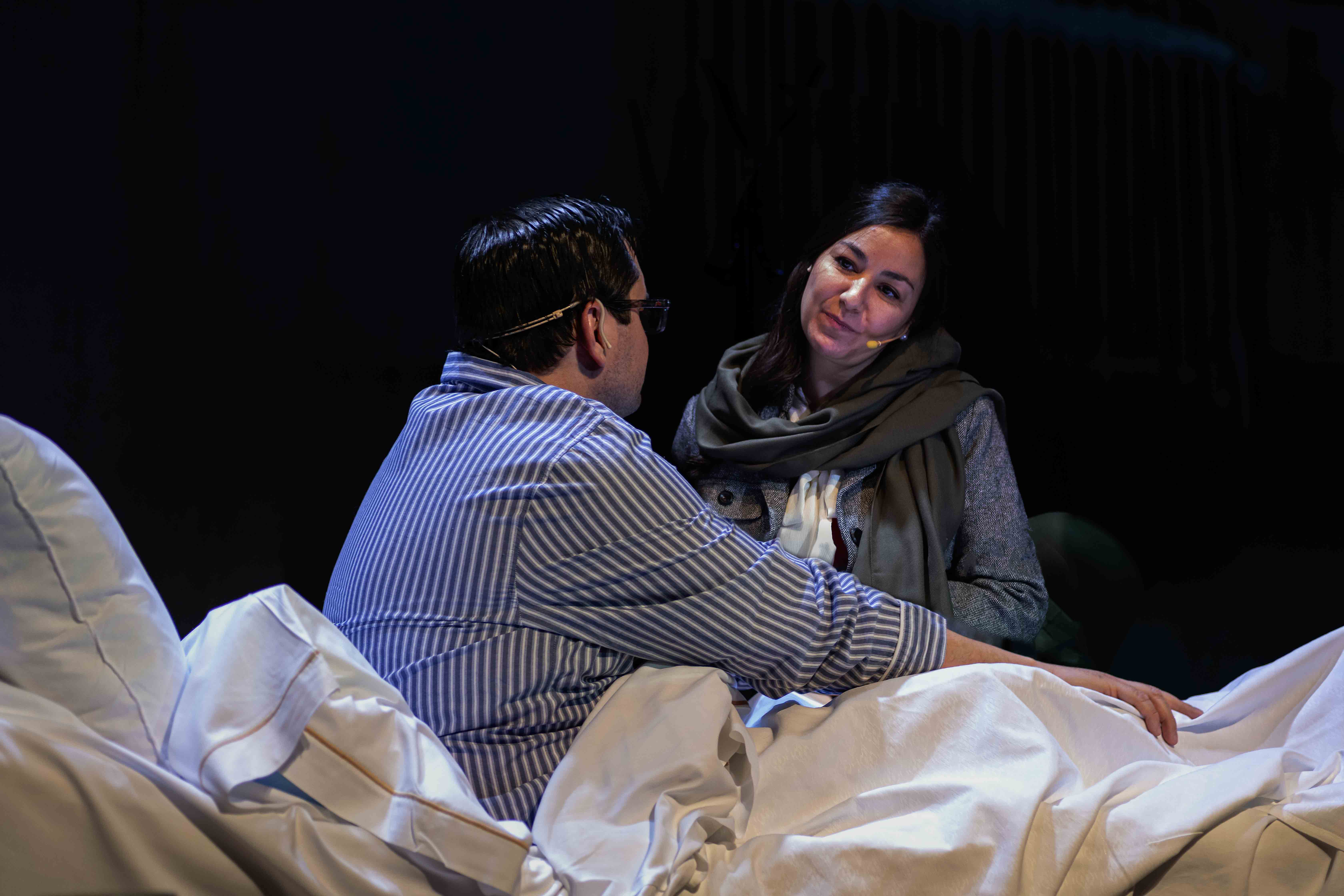


The play lasts an hour. There are moments of great emotion (‘I cried three times’ one student tells me afterwards). Carefully chosen recorded music adds to the experience. There are back projections, imaginative props and well-conceived transitions between scenes.
Above all, the palliative care professionals put in performances of great skill and emotion. In their depictions of dying, death and bereavement on stage, we see the cast’s clinical abilities turned into powerful drama. They create moments of tension and resolution, as well as humour and irony. Their facial expressions, gestures and movements are the product of deep experience in the real life world of pain and suffering, now brought to the theatre. It’s a remarkable achievement.
When the play reaches its rousing yet poignant conclusion, the audience members are on their feet, the cheering commences and the cast come forward to much deserved acclaim. I am even invited on stage to take a bow myself.
But that’s not all.
As the applause dies away, Carlos Centeno reaches for a microphone brings the whole crew out in front of the stage for a rich and varied Q&A session that unfolds over the next half hour.
People ask how the play came about, what it means for palliative care professionals to perform it, and how it brings a message to the wider public, using drama to stimulate discussion of a topic from which many still fight shy.
I’m asked what it feels like to see the play performed in this way and in the Spanish language. I can speak only of gratitude, admiration and the deep satisfaction that comes from further elaboration of a story that happened long ago, and which is still having such widespread consequences.
As we leave the theatre I ponder how, despite major challenges, palliative care continues to expand its reach around the world. I even wonder if perhaps Cicely and David can play some small part in supporting that unfolding process? Perhaps it can.
You can find this post in Spanish here: https://atlantescuidadospaliativos.wordpress.com/2024/03/25/cicely-y-david-mi-obra-en-espanol/
Acknowledgements: With thanks for the support of the Pía Aguirreche Foundation and the Campus Creativo program of the University of Navarra.
Photo credits: Jorge Miras Pouso
PERFORMANCE DETAILS
Venue
Civivox Theatre, Pamplona, Spain: 13th March 2024
Cast
Older Cicely: Ana Larumbe
Paul: Alvaro Montero
Young Cicely: Alicia Hernando-Garreta
David Tasma: Diego Candelmi
Woozle: Ana Paula Salas
Direction and Production
Vilma Tropdoro: Director
Alicia Hernando-Garreta: Co-Director
Production: Carlos Centeno
Technical team: Fernanda Bastos, Cristina Bejar
Music: Albert Recasens
For more information on Cicely and David, see: https://davidgrahamclark.net/cicely-and-david-a-play/


Congratulations David! I was a part of this all, as I learn Spanish with Vilma, in a weekly phonecall in two languages: called tandem-language-learning: half an hour of English, half an hour of Spanish. It works! It was great fun, to hear some of the workings, to feel the lead up to go to Columbia and the nerves that jingle around such, and then this great success! Congratulations!! Ruthmarijke
LikeLike
Many thanks for your kind words Ruthmarijke and fascinating to know about your links with Vilma. She did an amazing job directing the play.
LikeLike
Congratulations David – great to read about this and can only imagine how moving it must have been for you.
Are you OK for us to republish this article in ehospice – it would help to give it wider coverage. (I would have sent an email but only seem to have your university ones which I assume no longer work). Greetings to the family. Best wishes, David
LikeLike
Thanks for your kind words David. It was a wonderful occasion. My old UoG email address still works, so please drop me a line there about e-hospice.
LikeLike