
In the autumn of 2022 I was a couple of years beyond the institutional world of full-time academic employment. I’d been putting my efforts into new forms of writing, such as reflective biographical pieces, garden musings, and short stories. I’d also written a play which had been well received at the Edinburgh Fringe that summer and plotted out a debut novel which I planned to start writing the following year. In general, I was winding down my involvement in academic publications, save for a few legacy works, and at the same time building up my commitment to storytelling, essay writing and larger works of fiction. I was very happy with the trajectory and saw no reason to deviate from it.
Then, out of the blue, I received an email from Edward Elgar Publishing, inviting me to edit a major research handbook on the theme ‘end of life care and society’. I pondered for a day or two, then spoke with the commissioning editor. I learned that the proposed volume would be part of an established series of social science handbooks. It was explained that the work should be wide-ranging: reviewing the state of the field, highlighting research of major significance, and flagging up new areas for development.
I have to admit that this more than piqued my interest. Nevertheless I wondered about the scale of the task and quickly realised it was something that would be much more effectively and creatively carried out by two people. At this point I contacted Dr Annemarie Samuels at Leiden University in the Netherlands. Her interests in psychological anthropology, narrative studies, phenomenology, and medical anthropology seemed a very good complement to my sociological, policy and historical perspectives. Moreover her work on globalizing palliative care funded by the European Research Council had impressed me greatly and seemed to resonate with the approach I had taken in my final Wellcome Trust project, focussed on global interventions at the end of life. Thankfully, Annemarie immediately saw the connections and despite having never met in person, we agreed to work together as co-editors, harnessing our varied interests and networks to produce a volume which, in a field still heavily dominated by bio-medical frameworks, would showcase the contributions of the social sciences and humanities and frame end of life care as a societal and cultural issue.
Three years on from the initial discussions, it’s a pleasure to share details of the resulting Research Handbook on End of Life Care and Society, which has just been published. Our collection brings together the writings of 60 contributors from 20 countries, gathered in a total of 34 chapters and 576 pages. Moreover, the entire volume is available on Open Access, free of charge.
In the Handbook, early career and established contributors range across questions of theory and method in the study of end of life issues. The book is packed with empirical research on multiple topics, conducted in diverse settings. Examples include: social inequalities in access to palliative care, engaging the public in palliative care research, assisted dying in different settings, and new cultural responses to life-limiting illness, human mortality and bereavement. There are detailed case studies, on areas such as poverty, homelessness and displacement at the end of life, as well as culturally specific nursing home care, end of life care pathways, and palliative care in post-colonial contexts. These sit alongside broader reflections relating to places of care, experiences and meanings surrounding pain, as well as end of life care that is informed by the arts and humanities. There are in-depth discussions about current approaches to end of life care in public health strategies and health policies and several contributors focus on the scope for dynamising compassionate care at the end of life using bottom-up, community-led strategies. Drawing on these rich seams of interest, we also offer some thoughts about future directions for research in this context.
The Handbook is testimony to a growing body of scholarship worldwide, which is theoretically and analytically oriented, yet also highly relevant to end of life practice. Such work has the potential to stimulate new and much needed critical conversations on the place of end of life care in society. The Handbook has already received praise from major thought leaders in the field. There is also widespread pleasure and appreciation for the fact that the it is freely available online. We earnestly hope it will prove a vital resource for students and researchers as well as practitioners and policymakers in palliative and end of life care.
Back in the autumn of 2022, the invitation from Edward Elgar Publishing took me by surprise. Did I really want to take on such a demanding task just as I was edging into a new phase of life? In the event, my ‘retirement’ plans and this major academic editing role have complemented one another. The Handbook was completed and appeared just three months after the publication of my first novel. The editorial collaboration with Annemarie Samuels has been enriching and has introduced me to numerous new perspectives and research orientations. The whole project has been demanding of our time, inventiveness and resilience. Unlike me, Annemarie’s work as co-editor has taken place alongside a more than full-time roster of academic duties. Fortunately, modern technologies, along with excellent support from the entire team at Edward Elgar, have eased the process somewhat and allowed the practicalities to proceed smoothly. We met our deadlines, secured full Open Access funding, and the Handbook was published according to plan.
Next month, we co-editors will finally get to meet in person, as the Handbook is launched in separate events at Leiden University and at the University of Glasgow. There will be opportunities to celebrate the work of our contributors and to thank our publishers and those who provided support for the Open Access arrangements. Oh and yes, also a special moment to ponder on the surprises that life can bring, as John Lennon once said, just as we are busy making other plans.
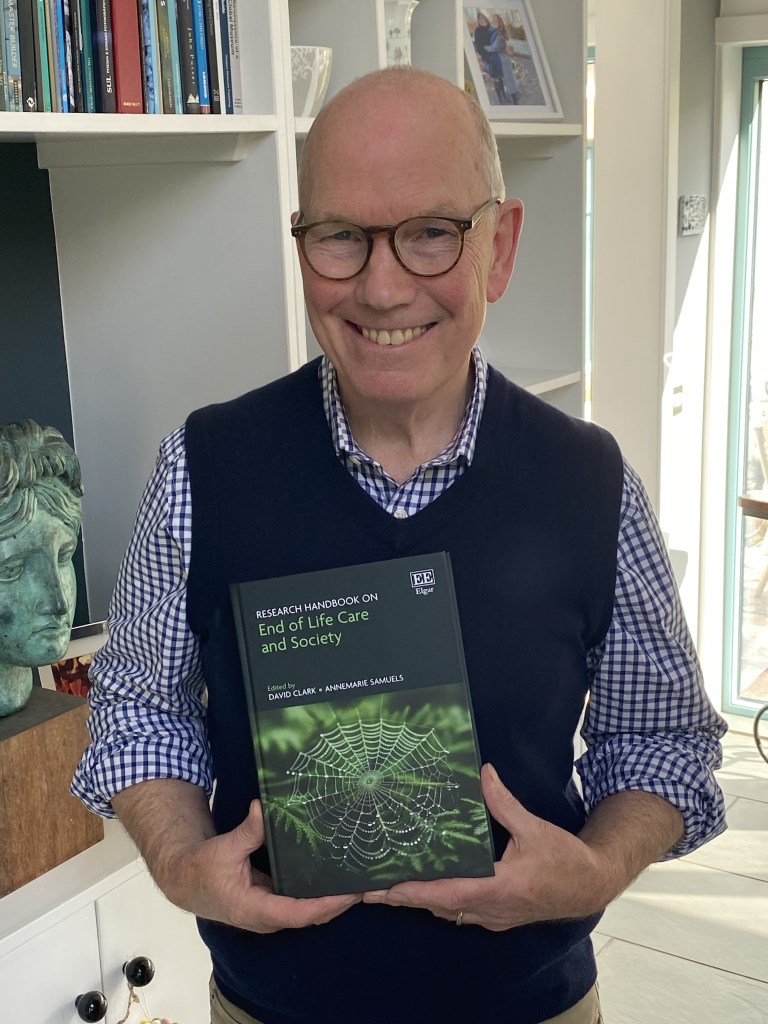
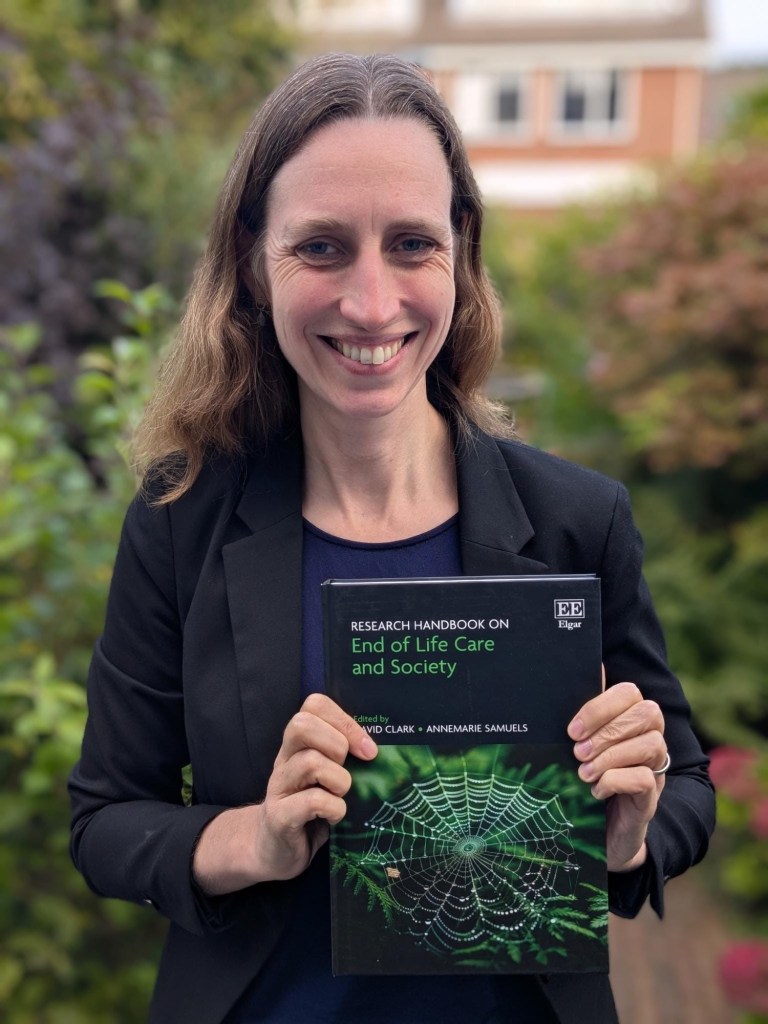
The Research Handbook on End of Life Care and Society, edited by David Clark and Annemarie Samuels, is published by Edward Elgar, 2025, ISBN 978 1 0353 1733 2. For Open Access to the entire contents, please click here
The two launch events can be attended in person or online.
For details of the Leiden University launch on 16th October and how to register, please go here
The University of Glasgow launch will take place at the Dumfries Campus on 30th October at 5.30pm. To register, please go here
 Quotidian
Thank you so much, David, for this wonderful gift!! Thank you for your continued dedication and perseverance. For your openness and attention to detail. Kindest wishes, Manuela
LikeLike
That’s very kind of you Manuela, and your comments come just hours before we launch the Handbook at an event in the Netherlands, to be followed by another in Scotland in two weeks from now.
LikeLike