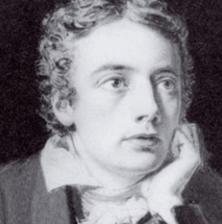
For many poetry readers, autumn is synonymous with John Keats and his famous hymn to mellow fruitfulness. I was reminded of it most dramatically in Rome this autumn when I stood in the tiny rooms where Keats had lived his last 100 days and I gazed upon the very place where he had died in 1821, age 25 years. His short life had contained much in the way of sorrows and suffering and this was further compounded in his dying.
When John was just eight years old, his father died from a fractured skull after falling from his horse. When Keats was 14, his mother died of tuberculosis, leaving her children in the custody of their grandmother. In that autumn of 1810, Keats left school to apprentice with Thomas Hammond, a surgeon and apothecary. Five years later he registered as a medical student at Guy’s Hospital, and began studying there in October 1815. He lodged with other medical students near the hospital, in Southwark and at this point had a genuine desire to become a doctor.
But as his studies progressed he grew increasingly ambivalent about a medical career. He had written his first extant poem in 1814, when he was 19. His literary ambitions were mounting, but so too were his financial problems and he was also prone to periods of low mood and depression. In 1816 he received the licence which made him eligible to practise as an apothecary, physician, and surgeon. But before the end of that year he announced to his guardian that he was resolved to be a poet. It was the year in which his first poem, O Solitude! appeared in print.
Keats devoted more and more time to the study of literature. He had spent a great deal on his medical training and was in financial difficulties. But nevertheless, by December 1816, and under the heady influence of his artistic friends, Keats decided to give up medicine in favour of verse.
The following Spring, now suffering from a succession of colds, and unhappy with his living arrangements in damp rooms in London, Keats moved with his brothers to accommodation in the village of Hampstead. Here both John and George nursed their brother Tom, who was suffering from tuberculosis. In the autumn of that year, 1817, Keats began taking mercury for his own ailments.
The following June however he was fit enough to begin an arduous walking tour. Starting in Lancaster he made his way north, calling on Wordsworth at Rydal Mount near Grasmere, only to find the great poet was not at home, and then stayed a night in Dumfries on 2 July, where he wrote a somewhat ambivalent sonnet On Visiting the Tomb of Robert Burns .
Later that month, while on the Isle of Mull, he caught a bad cold and became too thin and fevered to proceed on the journey. Was he showing the early signs of tuberculosis at this point or was the infection still to take hold? One interpretation states:
‘Back in London in August, a chronic sore throat, toothache, irritability and nervousness show us how Keats’s protracted recourse to mercury had already poisoned him in body and mind – like the “pale warriors” of “La Belle Dame sans Merci”, loitering disconsolately between life and death. In this vulnerable state he was confined for three stressful months with his dying brother, contracting the tuberculosis that set him on the road to an early grave’ [1].
Tom Keats died on 1 December 1818. That winter of 1818–19, though a difficult period for the poet, also marked the beginning of his finest period, in which he wrote his most mature work, including To Autumn and Ode to Melancholy. The period brought his poetry both to its high point, and its conclusion.
In early February 1820 Keats began coughing blood. On the first occasion he told a friend this was his death warrant. It marked the start of a year of suffering and provoked his interest in ‘easeful death.’ ‘That year was one of uncontrolled phthisis – multiple haemoptysis and bouts of fever, sweats, and wasting—indeed, he had classical consumption. The picture is all too typical … this terminal year of Keats’s terrible suffering’ [2].
At the suggestion of his doctors, he agreed to move to the warmer climes of Italy, with his friend the artist Joseph Severn. They set out on 13 September 1820. The journey was eventful and problematic. Storms broke out followed by a dead calm that slowed the ship’s progress. When they finally docked in Naples, they were held in quarantine for ten days due to a suspected outbreak of cholera. Keats reached Rome on 14 November, by which time any hope of beneficial effects from the warmer climate were disappearing fast.
Keats wrote his last letter on 30 November 1820, to his friend Charles Armitage Brown; “Tis the most difficult thing in the world to me to write a letter. My stomach continues so bad, that I feel it worse on opening any book … I have an habitual feeling of my real life having past, and that I am leading a posthumous existence”.
The medical attention Keats received at this time may have hastened his death. In Rome he was cared for by the Edinburgh trained physician James Clark, who was making a special study of tuberculosis and the benefits of a warmer climate. Clark first declared that the cause of Keats’ illness was ‘mental exertion’ and that the source was largely situated in his stomach. But Clark eventually diagnosed consumption and placed Keats on a starvation diet of an anchovy and a piece of bread each day, intended to reduce the blood flow to his stomach. He also bled the poet; a standard treatment of the times, but likely a significant contributor to Keats’ weakness.
Severn’s biographer writes: ‘They could have used opium in small doses, and Keats had asked Severn to buy a bottle of opium when they were setting off on their voyage. What Severn didn’t realise was that Keats saw it as a possible resource if he wanted to commit suicide. He tried to get the bottle from Severn on the voyage but Severn wouldn’t let him have it. Then in Rome he tried again … Severn was in such a quandary he didn’t know what to do, so in the end he went to the doctor, who took it away. As a result Keats went through dreadful agonies with nothing to ease the pain at all.’ Keats was angry with both Severn and Clark when they would not give him laudanum (opium). He repeatedly demanded “how long is this posthumous existence of mine to go on?”‘ [3].
The first months of 1821 marked a slow and steady decline into the final stage of tuberculosis. Keats was coughing up blood and covered in sweat. Severn nursed him devotedly and observed in a letter how Keats would sometimes cry upon waking, as he found himself still alive.
‘Keats raves till I am in a complete tremble for him … about four, the approaches of death came on. [Keats said] “Severn— lift me up—I am dying—I shall die easy; don’t be frightened—be firm, and thank God it has come”‘. I lifted him up in my arms. The phlegm seem’d boiling in his throat, and increased until eleven, when he gradually sank into death, so quiet, that I still thought he slept.’
Keats and Severn had taken up lodgings in two rooms in Rome, right beside the Spanish Steps. The rooms have been preserved as a beautiful museum and a memorial to him and to Percy and Mary Shelley. As I sat in the room where Keats died, I pondered on his death and its place in the history of end of life care. [4]
The nineteenth century saw major demographic and social changes that began to transform how people died. Sudden death was being replaced by more protracted dying – associated with emerging diseases such as tuberculosis and cancer. Though Keats died young, people were beginning to live longer. As lives lengthened, so the manner of their ending was transformed. A preoccupation with what lay beyond death began to be replaced by a concern about the manner of dying.
At first doctors had little to offer, either in the way of curative intervention or systematic modes of symptom relief. Their role may have been limited to a combination of self-styled imperiousness and well-honed bedside manner, coupled with the judicious use of laudanum and opium that had become commonplace in the eighteenth century. As the nineteenth century progressed, however, medical men gained access to new technologies and also to the drugs that began to define the physician’s place at the deathbed.
The isolation of the soporific principle in opium was achieved in 1806 in Paderborn, Germany, by Friedrich Sertürner. He originally named the substance morphium after the Greek god of dreams, Morpheus, and for its tendency to induce sleep. The drug was first marketed to the general public by Sertürner and Company in 1817. After the invention of the hypodermic needle in 1857 by the English physician Alexander Wood, morphine became more extensively used.
In time some doctors became active in collating and disseminating their practice in caring for patients in the final stages of life.
Just five years after the death of Keats, CFH Marx presented his thesis De Euthanasia Medica at the University of Goettingen. Marx writes elegantly and comprehensively about the desired disposition of medicine to those who are dying and begins by asking what can be done to make the passing from life ‘gentle and bearable’. He calls this ‘euthanasia’, not in the sense we think of it today, but rather in its classical meaning of eu thanatos – the good death. He defines the achievement of this as a science that checks oppressing features of illness, relieves pain, and renders the supreme and inescapable hour a most peaceful one. He suggests that up to that time the subject had not been thoroughly studied, and he is modest in the claims he makes for his own contribution. But he is also critical of those physicians who, when they find their treatments wanting, begin to lose interest in their patient, believing they are dealing with a disease, and not a human being. The nobler path, he asserts, is taken by those physicians, who adopt three essential principles.
First, there is foresight: the watchful attendance of nurses and others who with skill take every opportunity to ensure the comfort of the patient and the correct organisation of the sickroom. Second, is the avoidance of suffering: this means eschewing dubious therapeutic and surgical measures, and focussing on eliminating or curbing pain, torment, and restlessness through sedative and analgesic medications. Third, is the pursuit of higher comfort: this should not be left only to the priest, but should capitalise on the known face of the physician, who endeavours to relieve agitation, bring confidence to the despairing, assure the doubtful, and assuage fear.
In all this, Marx is clear that ‘euthanasia’ is not about the physician bringing forward the moment of death, a practice he condemns: ‘least of all should he be permitted, prompted either by other people’s requests or by his own sense of mercy, to end the patient’s pitiful condition by purposely and deliberately hastening death’ . In this context Marx can still praise the use of narcotics, which ‘if properly and cautiously administered, are the most salubrious medicines for the whole human race and particularly appropriate for euthanasia’. At the same time they must be used with care, alert to untoward side effects, aware of how they can differ in every individual and sensitive to their power to produce stupor at high doses. He singles out opium as the ‘solace’ for tuberculosis or the ‘blessed anchor’ for cholera.
A quarter century after Marx, in 1954, the Edinburgh medical student Hugh Noble submitted a thesis for the degree of MD. It too had the title Euthanasia. Like Marx, Noble uses the term to denote a peaceful and idealised death. But he also nudges his thinking towards a consideration of what the new approaches to pain relief might mean for medicine, if challenged to use them for the purpose of bringing about the deliberate and final relief of suffering. Noble considers the question of when to treat the dying patient, how much to take his or her wishes into consideration, and how much information to proffer or withhold. Halfway through the thesis, he raises this fundamental question.
‘In regard to the active measures which may be adopted with the incurable or moribund, it may be asked how far the practitioner may be justified in interfering with the purposes of modifying or changing the mode of death.’
His response was that the sanctity of life placed such an action beyond the limits of medical practice and therefore rendered it something that must be condemned. He went on to observe that when the hope of recovery has passed, the physician often turns away from the patient, forgetting that ‘more may be done—that the time has come for restudying the case from a different point with a new object in view’. If the physician was forbidden from actively ending the life of a patient, this did not mean that he must aggressively seek to prolong it.
In 1887 the London physician William Munk moved beyond these student theses to produce a comprehensive and published guide for physicians and nurses of the day. Unlike Marx and Noble, he came to his major work on dying late in his career, at the age of 71. But like them his work was also entitled Euthanasia. Like his predecessors, therefore, Munk is still referring to the notion of a calm and peaceful death – the good death brought about with the assistance of the physician. He is clear that care should be taken to avoid even the accidental premature death of the dying patient by the incautious administration of opium. This sense of euthanasia had become widely understood in Victorian Britain and was also used to refer to glorious deaths encountered through global exploration or other feats of heroism, and which did not involve the medical practitioner.
Munk covers the main aspects of dying. He asserts that the moment of death is not as dreadful or painful in reality as might be imagined. He acknowledges that the process of dying may be painful but maintains the distinction between the moment of death and the ‘urgent symptoms of disease that precede and lead up to it.’ The mental aspects of dying, he states, echo the physical dimensions. That is, the moment of death is usually accompanied by calm, particularly if the physician or the patient’s friends have helped maintain an attitude of hope. The third phenomenon Munk considers is the state of the intellect as death approaches. This may vary from alert to delirious, but regardless of what state has been dominant during the process of dying, the transition to the moment of death is marked by a ‘return of intelligence, that “lightening up before death” which has impressed and surprised mankind from the earliest ages’.
Munk maintained that much suffering is not ‘naturally or necessarily incident to the act of dying’ but is due to surrounding circumstances that can be changed or managed. These include the provision of appropriate bedding, physical position in the bed, fresh air in the room, suitable food, and so on. Munk also asserts that wine and spirits are of special use in the treatment of the dying. In all cases, the wishes of the patient are the most reliable guide to what should be given.
Munk gives considerable space to precise and detailed recommendations about how to use opium to best effect. Opium in this context, he states, is ‘worth all the materia medica’, but ‘its object and action must be clearly understood’. It is given both to relieve pain and to ‘allay that sinking and anguish about the stomach and heart, which is so frequent in the dying, and is often worse to bear than pain, however severe’. It should be given freely and judiciously, not timidly and inadequately, or it will not achieve its purpose.
It is tempting to see Munk as the grandfather of modern palliative medicine and the new medical thinking on care for the dying which was slowly moving forward through the nineteenth century. In those small rooms adjacent to the Spanish Steps, Keats died too young, his poetic path cut short. His death also came too early to benefit from the medical improvements in the care of the dying which were just around the corner. Trained as a physician himself, he was unable to benefit from new medical approaches which might have released him from his posthumous existence. He was thereby denied the easeful death he so much desired.
[1] Roe, N Mercury sent John Keats to an early grave. The Telegraph ^ October, 2012.
[2] Smith, H The strange case of Mr Keats’ tuberculosis. Clinical Infectious Diseases 38 (7): 991-993, 2004.
[3] Brown, S Joseph Severn, A Life: The Rewards of Friendship. Oxford University Press, 2009.
[4] Clark, D To Comfort Always. A history of palliative medicine since the nineteenth century. Oxford: Oxford University Press, 2016
Featured image: Joseph Severn’s miniature of Keats, 1819


So good to hear from you David
Sent from Gmail Mobile
LikeLiked by 1 person