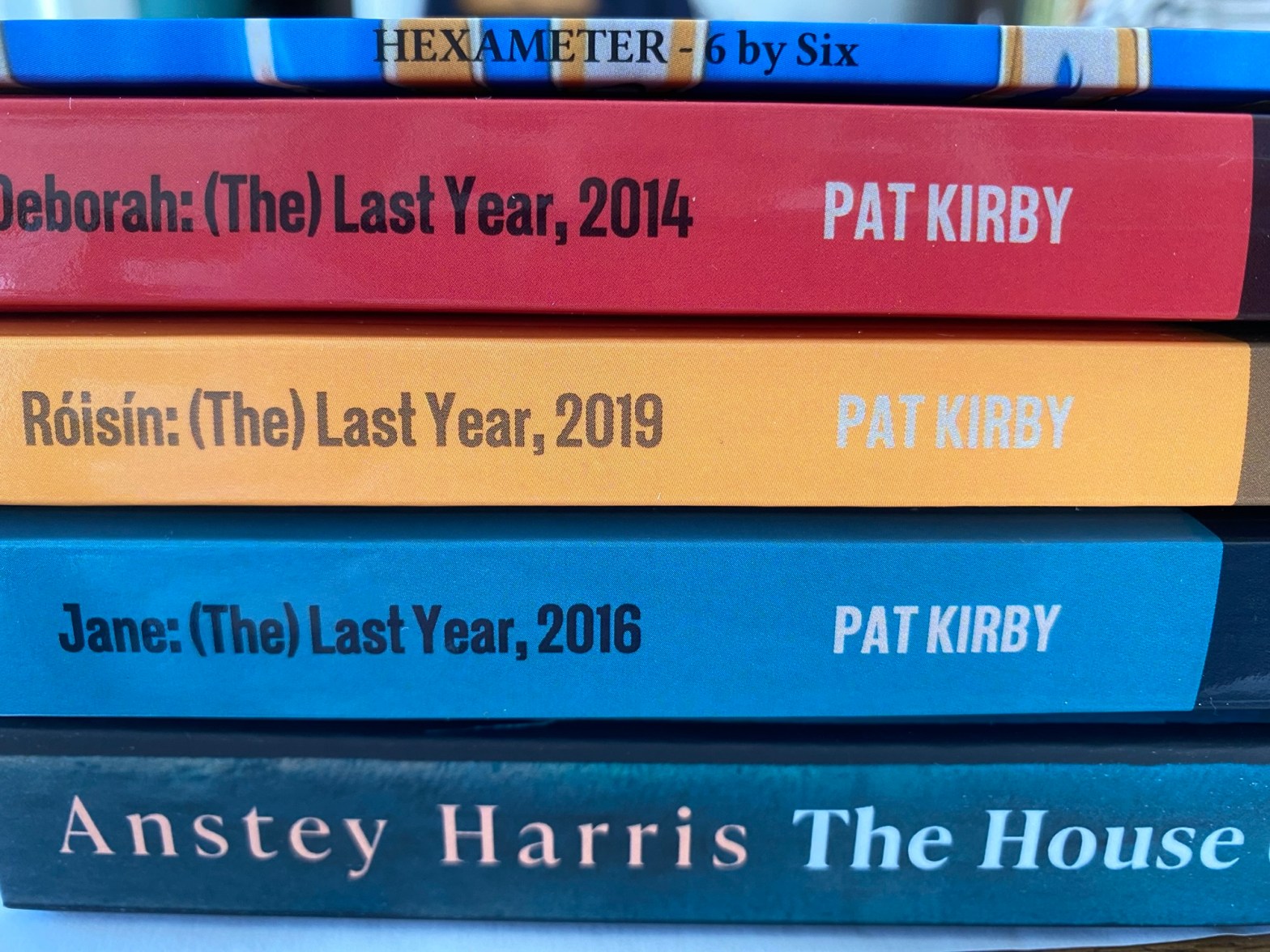
Sometimes good things come in threes. When these happen on my home patch and relate to matters of reading and writing, then I consider myself especially fortunate. Recently, and in just over one week I attended three excellent events that fed my interests in the written word. Three local encounters that opened up new horizons and presented different ways of looking at and writing about the world.
Secrets, suspense and stake
Anstey Harris is a writer of commercial fiction who enjoys considerable success and a large readership. She’s a person whose latest book, set in my home region of Dumfries and Galloway, currently enjoys 19,000 reviews on Amazon. So when some University colleagues of mine involved in the DeathWrites network organised a workshop led by her, I was keen to attend.
A dozen of us gathered together, in person and online. There were short story writers, novelists, a poet and academics with interests in creative non-fiction. The theme of the event was ‘Secrets, Suspense, and Stakes’.
Anstey talked through each of these and also gave us prompts for short exercises where we wrote our own responses and shared them with the group. She spoke about the various types of secret: silver lining, dark, or open, as well as the idea of strategic opacity through which the writer keeps something secret from the reader, using omission or obscurity to increase complexity, realism and suspense.
Secrets can also have requirements of their own. They may have to be protected, defended, denied or excused. Secrets can be vital to the stake the reader has in a particular character or storyline. The stake is what invests us so that we care about what is happening in the story and feel compelled to stay with it. But secrets need to be used judiciously. They may be exposed in a big reveal, or fed to us parsimoniously. For as Anstey noted: once the doors are opened, they can’t be closed.
This was my first encounter with a workshop focussed on the craft of fiction writing. I came away feeling challenged about my lack of knowledge of the tropes and techniques Anstey described, but also persuaded that used with care and reflection, they offer great opportunities to enhance my own writing. In the days following I obtained a copy of Anstey’s recent novel The House of Lost Secrets and encountered a model demonstration of the ideas she had spelled out in the workshop. The jump from concepts to content was vividly displayed. Anstey proved to be both a wonderful teacher and a compelling writer.
Celebrating a Nithsdale triology
Pat Kirby is an American, who has lived for many years in Dumfries and Galloway, not far from me. A former school teacher, she’s been working for around a decade on a trilogy of novels, set in our local area. I was lucky enough to be invited to her launch event, which took place in the vibrant setting of Old School Thornhill, a superb venue for community events and activities of many kinds.
Pat introduced us to the novels and read some extracts from each, highlighting specific themes: about enduring female friendships, coupledom, family life, and wider relationships. Written in the first person, Pat readily acknowledged the stories contain elements of her own life, but not entirely.
I was delighted to purchase the three books at the launch and read them in fairly quick succession afterwards. In some places they feel like a memoir or even extracts from a diary, for example, documenting day to day events or the itinerary in a journey. By these means, the novels quickly draw in the reader, who is addressed personally and indeed quite frequently. Pat does an excellent job in creating suspense and stake and there are some very significant secrets in the trilogy. I was reminded of the idea of the unreliable narrator, who intentionally or not, may be misleading the reader. This led me to consider where autobiography might end, and invention take over. Perhaps it doesn’t matter, unless maybe you know the author and the settings and even feel you recognise the fictitious people she is writing about, and as a result get distracted and taken away from the central story line. It’s an interesting tension and can enrich the reading.
The books have a wonderfully well developed sense of place. Much of the action occurs in and around Nithsdale and Galloway, with their hills and rivers, village communities and towns, and high ratios of creatives. But there are also journeys to the USA and Japan, as well as to other parts of Scotland. A lot of alcohol is consumed and hangovers appear rather frequently. Here and there is a bit of kiss and tell. The novels cover three intense years in the lives of the principal characters and move the reader along, often with helpful reminders of wider events occurring at the time. The result is a deep feeling of reader interest and concern around the experiences of the main characters, and their associates. For this to be sustained over three volumes is an incredible achievement of the writing. In what follows I have tried to avoid spoilers.
The central character of the first volume, and it might be said of the trilogy as a whole, is Deborah Heaney. Soon after retiring from her job as a teacher, she is diagnosed with a life limiting condition. Whilst she is expected to remain healthy for the coming year, thereafter her condition is likely to deteriorate rapidly. In Deborah (the Last Year), 2014 we encounter the first person narrator electing to tell no one about her diagnosis, not even her family and closest friends, and instead embarking on a journey of biographical reflection, reminiscence, personal pleasure and purposive denial. Deborah goes back to the United States, where she grew up, leaving her husband John to continue his work as a GP, and also to ruminate on past events in their marriage. Old ghosts are revisited, unusual interactions occur. When complete strangers are convinced Deborah is someone else, she even encounters the doppelganger experience. Her year of choice and autonomous living is vividly portrayed in Pat’s storytelling. On returning home from her travels, Deborah throws a grand winter solstice party, prior to which she begins, incrementally, to tell friends and family the news of her illness. By this time Deborah has already embarked on her novel: ‘The snake eating its tale’, as she ironically puts it.
In the second volume, Jane (the Last Year), 2016 the narration switches from Deborah to one of her long-time friends, Jane Menzies, an artist and resident of the town of Dumfries. Jane is the mother of five children who have now grown up and left home. She remains somewhat precariously committed to their father, her long time partner and a rather self-absorbed writer. At this pivotal moment in her life Jane is seeking to resurrect her artistic ambitions. As she dives deeper into her project and her work becomes more demanding, curious experiences occur, mainly associated with watery contexts. Elements of magical realism creep into the writing and are wonderfully well executed, creating tension and intrigue. We also see the complex encounters that develop between Jane and her dear friend Deborah, when Deborah’s health, as predicted, suddenly worsens and the realities of dying and death move suddenly closer.
The third narrator is Róisin. In her early thirties and separated, she arrives in Scotland from the USA, just in time for Hogmanay. She has won a poetry prize at the Wigtown Book Festival and a generous sponsor has paid for her to come to collect it. In Róisin (the Last Year), 2019 and as the new year gets underway, she finds part-time employment, and accommodation, with an artisan baker in the village of Moniaive. Rising before dawn to work, she spends the afternoons on her first novel, and the early evenings getting to know an assortment of musicians, writers, and creatives who inhabit the local scene. Then something happens. Befriended by the multi-talented Rose, she is supported and guided through the many challenges she faces.
In this final volume of the trilogy, Pat draws parallels to the doppelgangers and the shape-shifting water sprites of the first two novels, as Róisin experiences the phenomenon of lucid dreaming: awareness of a dream as it is happening, whilst also having the capability to influence its course. She explores the meaning of this in her personal support sessions with Rose. In due course she meets Jamie, a young man collaborating with Rose on the creation of a hill-top stone circle. He is the twin son of Deborah and John, and has some major worries about what he now knows is an hereditary illness that ended his mother’s life. What happens thereafter is the subject of Pat’s exquisitely crafted denouement! Hard to say, but I think this third novel was the pick of the bunch and my favourite of the three.
Pat Kirby’s trilogy of life in Dumfries and Galloway is a tour de force. It has multiple interesting characters, employs deft use of each passing year to tell gripping stories that run on from one volume to the next, beautifully anchored in a vibrant and colourful rural setting. It’s a heady brew and the volume of work in its creation should not be under-estimated. There must be around a quarter million words of Nithsdale story telling here and I feel sure the books will be read and enjoyed by many people who know and love the region. Pat’s insider-outsider position as a long term resident originally from the United States has been admirably exploited to produce three linked novels that celebrate life, community, and ultimately, many of the complexities surrounding what it means to be human. Pat may feel that her writing ambitions are now complete, but those who enjoy these novels may well be curious about where her talents will focus next!
Poems and poets at the Kirkcudbright Book Festival
Hexameter is the group name for six experienced poets with connections to Dumfries and Galloway. Along with a poet friend of mine, I was fortunate to see their debut performance at the Kirkcudbright Book Festival, where they launched their first anthology 6 by six, a handsomely presented volume containing six poems from each member of the group. Hexameter is a values-based collective, with a challenging ethos in which they work together to write better poems and become better poets. It’s a subtle distinction and implies a supportive but robust approach to giving and receiving feedback on each other’s work. Their first collection, according to the blurb, ‘allows each poet to showcase their distinctive voice while also creating a group identity’.
The poems presented at Kirkcudbright ranged from wry and humorous, to up-skittling and dark. The poets sometimes explained their inspirations, like falling asleep in the theatre, or missing a connecting train, and the journey their ideas took from there. Unlike the novelists Anstey Harris and Pat Kirby, the Hexameter poets are engaged in a craft, where brevity rather then longform, is key. But their poems also make use of stake and tension, often culminating in a final line heavily loaded with shock, irony, resignation, humour or hope. I particularly enjoyed the mundane yet deeply human contradiction captured in the ending of David Mark Williams’ poem, Cafe of Broken Dreams:
We're not inclined to make a fuss
over what we've been served.
We won't be back, we said the first time
but here we are again.
Feeling thankful
I’ve no reason to believe that Dumfries and Galloway is any more or less well served than other places in the kinds of literary events described here. Yet writing workshops, book launches and book festivals do seem to proliferate in my home region and undoubtedly precipitate and support a thriving community of interest in the written and the spoken word. Wigtown, with its numerous book shops and internationally acclaimed festival, is the outstanding exemplar. Dumfries and Galloway therefore have much to offer readers and writers. I am especially interested in those writers living in and setting stories inspired by this fascinating region of rolling hills, woods and pastures, rivers and coastline, rural towns and villages. We may be challenged by climate change, demographic trends and economic shocks, as well as by global conflicts and divisions, but our region has somehow forged a literary eco-system that constantly inspires, consoles and provokes. Three events in a week was rich fare indeed, and will sustain me now as I turn back to a writing project of my own!
Find out more here about these writers and how to access their works
My thanks to all the writers whose work is discussed here.
There is lots of information about the writings of Anstey Harris to be found at: https://ansteyharris.com/
Pat Kirby’s books are available in some Nithsdale bookstores, like Chapters and Thomas Tosh, and can also be purchased direct via: https://patkirby.co.uk/
The first anthology from the Hexameter Collective is published by Coronach Press. Contact coronach@gmail.com. The full reference from the extract above is: David Mark Williams, Cafe of Broken Dreams. In: Hexameter, 6 by six, Coronach Press, Glasgow, 2026, page 36.
 Quotidian
All three ‘encounters,’ including your take on Hexameter, interesting and worthy of further exploration. Thank you for that!
LikeLike